

Vapour control layers play an important role in Australian building envelope design, but their selection cannot be separated from the climate in which a building is located. A membrane that is appropriate for one external wall assembly may not provide the same moisture performance when used in another climate or construction arrangement.
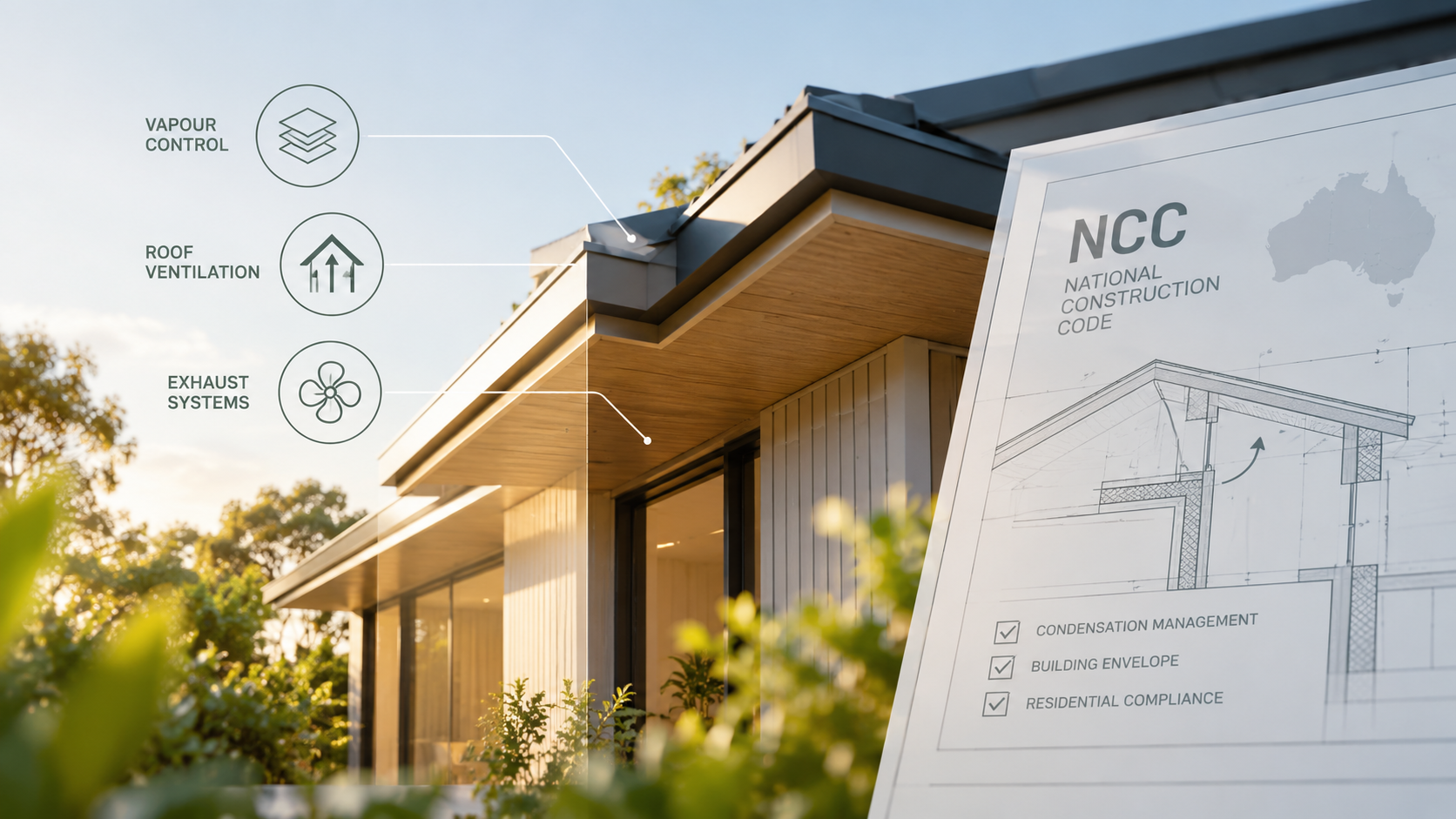
Australia's National Construction Code (NCC) recognises the relationship between climate conditions and moisture management. Under NCC 2022, specific Deemed-to-Satisfy provisions establish vapour permeance requirements for certain materials used in external wall construction, with different requirements across nominated climate zones.
For architects, building designers, builders and project teams, the practical question is not simply whether a membrane is described as breathable or vapour resistant. It is whether the specified material has the appropriate classification, is used in a suitable construction arrangement and satisfies the requirements applicable to the project.
Vapour control membrane selection should respond to the building's climate zone, construction arrangement and applicable NCC provisions, rather than relying on a single membrane strategy for every Australian project.
In Brief
How do Australian climate zones affect vapour control layer selection?
Australian climate zones experience different temperature, humidity and seasonal moisture conditions. These differences influence the way water vapour moves through external wall assemblies and the moisture management characteristics required of construction materials.
Under NCC 2022, the relevant Deemed-to-Satisfy provisions specify vapour permeance classifications for certain sarking-type materials and secondary insulation installed on the external side of primary insulation in external walls.
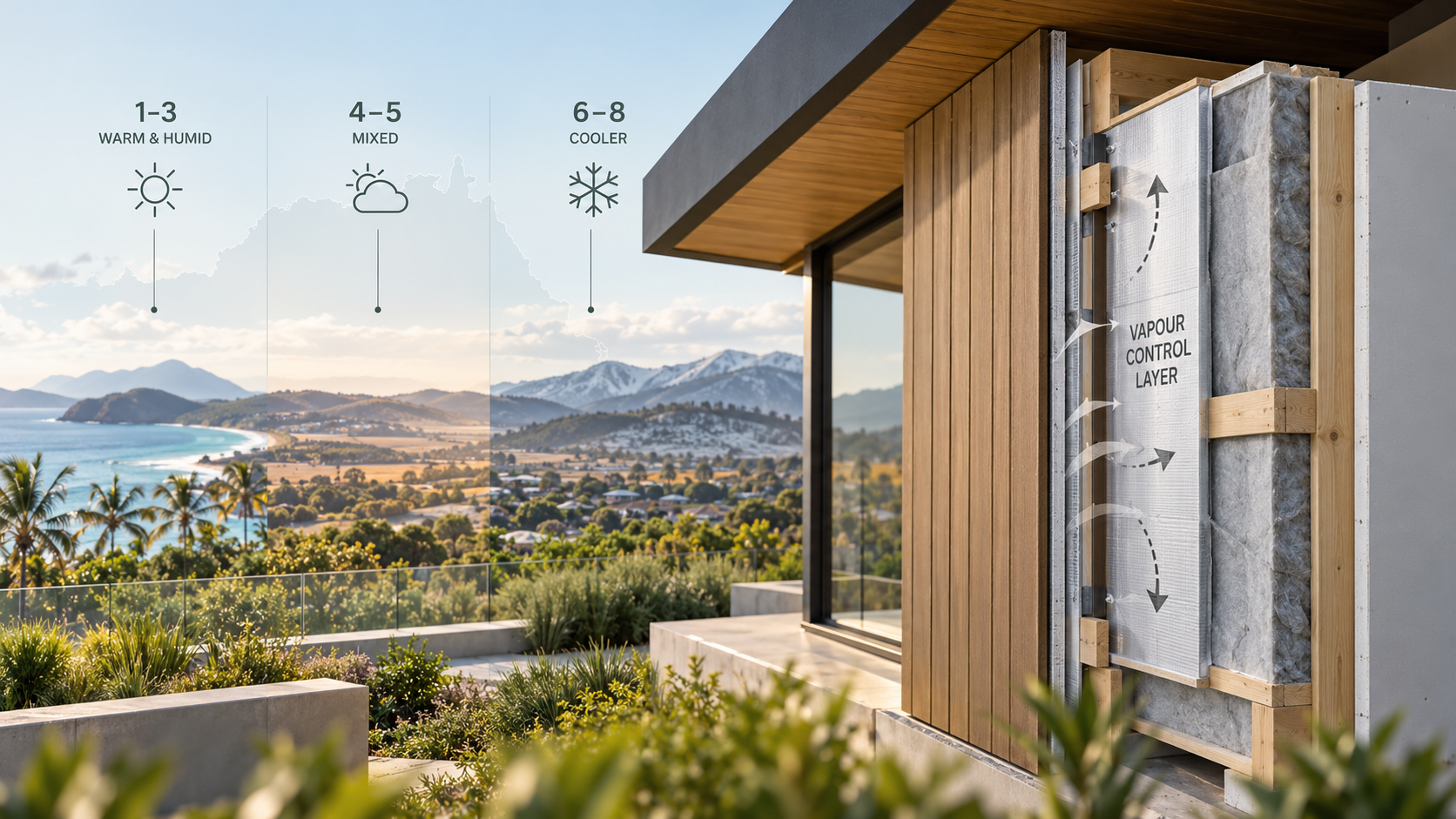
For the construction arrangements covered by those provisions, climate zones 4 and 5 require a Class 3 or Class 4 vapour permeable material, while climate zones 6, 7 and 8 require a Class 4 vapour permeable material.
These classifications are not universal requirements for every membrane in every wall. Their application depends on the relevant NCC provisions, building classification and construction details.
For the broader principles of moisture transport and condensation risk, see Moisture & Condensation Risk Analysis.
NCC and material classification note: This article uses the NCC 2022 condensation management framework and AS/NZS 4200.1 vapour control classifications as technical reference points. The climate-zone requirements discussed apply to specified external wall construction arrangements and should not be interpreted as a universal membrane selection rule. The applicable NCC edition, amendments, jurisdictional variations and building classification must be confirmed for each project. Product classifications and installation requirements should be established from appropriate technical documentation before materials are specified.
Why does climate zone matter when selecting a vapour control layer?
A building envelope is exposed to changing temperature and humidity conditions throughout the year. These conditions influence the vapour pressure differences across construction assemblies and the potential for moisture to accumulate within particular material layers.
In cooler climates, winter conditions may create moisture movement from heated internal spaces towards colder external parts of the assembly. In warm and humid climates, moisture movement towards mechanically cooled internal spaces may also be important.
Some Australian locations experience both conditions during different parts of the year.
The implications for vapour control depend on several factors:
- the temperature and humidity conditions associated with the project location;
- the intended indoor heating and cooling conditions;
- the construction materials used within the external wall;
- the position of insulation and membranes;
- the vapour resistance of adjacent materials; and
- the capacity of the complete assembly to release accumulated moisture.
The NCC climate-zone framework provides a regulatory starting point for particular material requirements. It does not, by itself, describe every environmental condition that a building assembly will experience.
A suitable material selection therefore needs to satisfy the applicable requirements while remaining appropriate for the proposed construction.
What vapour permeance classes does NCC 2022 require in different climate zones?
NCC 2022 includes Deemed-to-Satisfy condensation management provisions addressing vapour permeance in specified external wall construction arrangements.
For relevant sarking-type materials and secondary insulation installed on the external side of primary insulation, the requirements distinguish between nominated NCC climate zones.
The relevant classifications are based on AS/NZS 4200.1, which provides a framework for identifying the vapour control characteristics of pliable building membranes.
| NCC climate zone | Relevant NCC 2022 classification |
|---|---|
| Climate zones 1, 2 and 3 | The specific Class 3 or Class 4 requirements described below are not prescribed in the same way for these zones. Other applicable requirements and assembly considerations must still be reviewed. |
| Climate zones 4 and 5 | Class 3 or Class 4 vapour permeable material for the specified external wall applications. |
| Climate zones 6, 7 and 8 | Class 4 vapour permeable material for the specified external wall applications. |
These requirements must be read within the scope of the applicable NCC provision. They do not establish that every membrane in climate zones 6, 7 or 8 must be Class 4, or that membrane selection in warmer climate zones is unrestricted.
A wall may contain multiple materials with different vapour control characteristics, and the requirements for one nominated layer should not be applied indiscriminately to the entire construction.
The selected membrane must also satisfy any other applicable material and installation requirements associated with its intended use.
For a broader explanation of the regulatory framework, see NCC Condensation Management Requirements for Australian Homes.
What is the difference between Class 3 and Class 4 vapour permeable membranes?
AS/NZS 4200.1 classifies relevant pliable building membranes according to their vapour control properties.
Class 3 and Class 4 materials are both classified as vapour permeable, but Class 4 represents a higher level of vapour permeance.
This distinction is important where the applicable NCC provision specifies a particular classification.
A Class 3 material should not be assumed to satisfy a requirement for Class 4 merely because both products are described as breathable.
Before specifying a membrane, designers should confirm:
- the manufacturer's declared vapour control classification;
- the relevant product test documentation;
- the material's suitability for the intended construction application;
- whether the product meets the applicable NCC classification requirement;
- any additional properties required for the intended use; and
- the installation details necessary to maintain the specified performance.
The classification provides useful information about vapour diffusion, but it does not establish the complete moisture performance of a wall assembly.
A more vapour-permeable membrane is not automatically the most appropriate product in every construction arrangement. Its selection must remain consistent with the intended assembly and relevant compliance requirements.
What should designers consider in climate zones 1, 2 and 3?
Climate zones 1, 2 and 3 include warmer Australian climate regions, although humidity, seasonal conditions and building operation can differ considerably between locations.
In warm and humid conditions, outdoor moisture exposure and mechanical cooling can influence the direction and magnitude of vapour movement through external wall assemblies.
Where internal surfaces or construction layers are cooled, humid air and water vapour may contribute to elevated moisture conditions in vulnerable parts of the assembly.
The absence of the specific Class 3 or Class 4 requirement applicable to colder nominated zones should not be interpreted as confirmation that vapour control is unnecessary.
Relevant design questions include:
- What indoor temperature and humidity conditions are expected?
- Will mechanical cooling create cooler surfaces within the assembly?
- Are low-permeance finishes or other resistant layers present?
- Can the proposed wall release moisture under the expected conditions?
- Are materials exposed to moisture from additional sources?
- Does the selected membrane arrangement suit the complete construction?
These questions help establish whether the proposed assembly warrants further moisture performance consideration beyond the relevant prescriptive requirements.
A warm-climate location does not, by itself, determine the correct position or classification of every vapour control layer.
What are the vapour control considerations in climate zones 4 and 5?
Climate zones 4 and 5 include regions that can experience both heating and cooling conditions during the year.
The moisture behaviour of external wall assemblies may therefore change between seasons, particularly where indoor temperature and humidity conditions differ substantially from those outdoors.
For the specified external wall applications, NCC 2022 permits Class 3 or Class 4 vapour permeable materials.
This provides a defined material classification requirement, but the selection between compliant products should still account for the complete construction.
Design considerations include:
- the vapour permeance of the proposed membrane;
- the position of primary insulation;
- the presence of other vapour-resistant layers;
- the expected seasonal moisture conditions;
- the drying characteristics of the assembly; and
- the compatibility of the membrane with the intended wall construction.
A Class 3 or Class 4 classification may establish satisfaction of the relevant material requirement, but it should not be treated as a complete assessment of moisture accumulation or drying behaviour.
Where an assembly includes unusual material combinations or limited drying pathways, additional review may be appropriate.
Why does NCC 2022 specify Class 4 vapour permeable materials in climate zones 6, 7 and 8?
Climate zones 6, 7 and 8 include cooler Australian regions where winter temperature differences can create conditions associated with moisture accumulation within external wall assemblies.
During heating periods, water vapour may move from warmer internal environments towards colder external construction layers.
Where moisture accumulates and drying is restricted, the risk of prolonged elevated humidity within the assembly may increase.
NCC 2022 requires Class 4 vapour permeable materials for the specified external wall applications in these climate zones.
The higher vapour permeance classification supports the intended moisture management approach for those construction arrangements.
Designers should nevertheless consider:
- whether the proposed wall falls within the relevant NCC provision;
- the declared classification of the specified material;
- the position of the material relative to primary insulation;
- the vapour resistance of internal finishes and other layers;
- the potential for moisture to accumulate during winter;
- the ability of the assembly to dry; and
- the influence of project-specific indoor conditions.
Specifying a Class 4 material does not guarantee that every possible wall assembly will be free from condensation risk.
The material classification must be considered alongside the construction arrangement and the other requirements relevant to the project.
Why does membrane location relative to primary insulation matter?
The location of a membrane within an external wall is important because the temperature and moisture conditions vary through the construction.
NCC 2022 distinguishes particular materials installed on the external side of primary insulation when establishing the relevant vapour permeance requirements.
This distinction means that the same product classification should not automatically be applied to every layer within the wall.
For example, an external sarking-type membrane and an internal vapour control layer may serve different functions within the complete assembly.
When reviewing membrane location, the project team should identify:
- which material is the primary insulation layer;
- which membranes are located externally or internally to that insulation;
- which material is subject to the relevant NCC classification requirement;
- whether other construction layers restrict vapour movement; and
- whether the complete arrangement has an appropriate moisture management strategy.
Changing the position of insulation or membranes can alter the moisture behaviour of the assembly, even where the same products are retained.
The relevant NCC requirement and the broader assembly performance should therefore be reviewed whenever a significant construction-layer arrangement changes.
What should be checked before specifying a vapour control membrane?
Membrane selection should be based on the requirements of the project and the declared technical characteristics of the proposed product.
A product's general description may not provide sufficient information to establish whether it is suitable for a particular NCC climate zone or construction arrangement.
Before finalising a specification, designers should confirm:
- Applicable requirements: The relevant NCC edition, building classification and climate zone.
- Construction application: Whether the product is intended for the proposed wall or roof arrangement.
- Vapour classification: The declared AS/NZS 4200.1 classification where applicable.
- Supporting evidence: Appropriate product documentation and relevant test information.
- Material compatibility: The relationship with insulation, cladding, linings and other membranes.
- Installation requirements: Relevant laps, joints, penetrations, fixings and continuity details.
- Other performance functions: Any additional weatherproofing, durability or construction requirements relevant to the intended use.
- Design coordination: Consistency between architectural drawings, schedules and technical specifications.
A change in membrane product during documentation or construction should not be treated as an administrative substitution where its vapour classification or other relevant properties differ.
The replacement material should be checked against the original design assumptions and applicable requirements.
Clear specifications help reduce uncertainty about which material is intended and how it contributes to the proposed wall assembly.
Is vapour control the same as airtightness?
Vapour control and airtightness address different mechanisms of moisture transport through the building envelope.
Vapour diffusion involves the movement of water vapour through materials in response to a vapour pressure difference. Air leakage involves air moving through gaps, joints and other discontinuities, potentially carrying moisture with it.
A membrane can provide vapour control without forming a continuous air barrier. Similarly, an airtight material may remain relatively vapour permeable.
The relevant material properties and installation details should therefore be considered separately, even where one product contributes to both functions.
For further information about uncontrolled air movement, see Air Leakage and Home Performance.
When might vapour control selection require further moisture performance assessment?
Meeting an applicable membrane classification requirement is an important part of demonstrating compliance, but it does not necessarily establish the complete moisture behaviour of a proposed building assembly.
Some designs may warrant further investigation because of their material combinations, environmental exposure or limited drying potential.
Additional review may be appropriate where:
- the assembly contains multiple materials with high vapour resistance;
- the construction has limited drying potential;
- the membrane arrangement differs from a conventional wall assembly;
- moisture-sensitive materials are located in potentially vulnerable positions;
- the building is subject to demanding indoor or outdoor humidity conditions;
- the proposed construction differs from the assumptions used in an earlier assessment;
- the assembly relies on a Performance Solution; or
- the project team needs to understand the sensitivity of the design to material selection.
Where appropriate, a project-specific moisture assessment may help investigate how the proposed assembly responds to relevant environmental conditions.
This does not mean that detailed hygrothermal modelling is automatically required whenever a membrane is specified.
The assessment approach should be proportionate to the project and the technical question that needs to be resolved.
Vapour control membrane selection checklist
- Confirm the project's NCC climate zone.
- Establish the applicable NCC edition, jurisdiction and building classification.
- Identify the relevant external wall construction arrangement.
- Determine which membrane or secondary insulation layer is subject to the applicable provision.
- Confirm whether a Class 3 or Class 4 requirement applies.
- Check the product's declared AS/NZS 4200.1 vapour control classification.
- Review the position of the membrane relative to primary insulation.
- Identify other low-permeance materials within the assembly.
- Consider the expected seasonal temperature and humidity conditions.
- Review the assembly's potential for moisture accumulation and drying.
- Confirm any additional product and installation requirements.
- Coordinate the selected material with architectural drawings and specifications.
- Review proposed substitutions or construction changes.
- Determine whether further moisture performance assessment is appropriate.
Frequently Asked Questions
Vapour control questions for Australian climate zones
Do all Australian climate zones require the same vapour control membrane?
No. The relevant NCC provisions distinguish between climate zones for specified external wall applications. Under NCC 2022, the applicable requirements include Class 3 or Class 4 materials in climate zones 4 and 5, and Class 4 materials in climate zones 6, 7 and 8, subject to the scope of the relevant provisions.
What is the difference between Class 3 and Class 4 vapour permeable membranes?
Both are vapour permeable classifications under AS/NZS 4200.1, but Class 4 represents higher vapour permeance. Where the applicable NCC provision requires Class 4, a Class 3 material should not be assumed to satisfy that requirement.
Does climate zone 6 require a Class 4 membrane?
Under the relevant NCC 2022 external wall provisions, specified sarking-type materials and secondary insulation installed externally to primary insulation must be Class 4 vapour permeable in climate zone 6. This should not be interpreted as a requirement for every membrane used anywhere in the building.
Are vapour control layers required in tropical Australian climates?
The applicable requirements depend on the building classification, construction arrangement, NCC edition and jurisdiction. The absence of a particular Class 3 or Class 4 provision does not mean moisture management is unnecessary in tropical climates.
Can a breathable membrane prevent condensation?
A vapour-permeable membrane can contribute to an appropriate moisture management strategy, but it does not guarantee that condensation will be prevented. The behaviour of the complete wall assembly and its environmental conditions must also be considered.
Should vapour control membranes be positioned inside or outside insulation?
There is no universal position appropriate for every construction. The location should be determined from the intended wall assembly, applicable NCC provisions, material characteristics and expected moisture conditions.
Is hygrothermal modelling required when selecting a membrane?
Not automatically. Appropriate material selection and compliance with applicable Deemed-to-Satisfy provisions may be sufficient for some projects. Detailed moisture assessment may be appropriate for unusual assemblies, limited drying conditions or particular Performance Solutions.
Related Knowledge
Continue exploring moisture and building envelope performance
Moisture & Condensation Risk Analysis
Explore the building physics principles behind moisture transport, condensation risk, vapour control and drying potential.
NCC Condensation Management Requirements
Understand the NCC provisions affecting vapour permeance, ventilation and condensation management in Australian residential buildings.
Air Leakage and Home Performance
Understand how uncontrolled air movement differs from vapour diffusion and influences building envelope performance.
Thermal Bridge Analysis
Explore how localised heat flow and surface temperature conditions relate to building envelope performance.
Moisture & Condensation Risk Analysis
Review vapour control within your proposed building assembly
Where a proposed external wall assembly involves complex membrane arrangements, limited drying potential or uncertain moisture behaviour, Certified Energy can assist with project-specific moisture and condensation risk analysis to support informed material selection and design decisions.
Explore Moisture & Condensation Risk Analysis