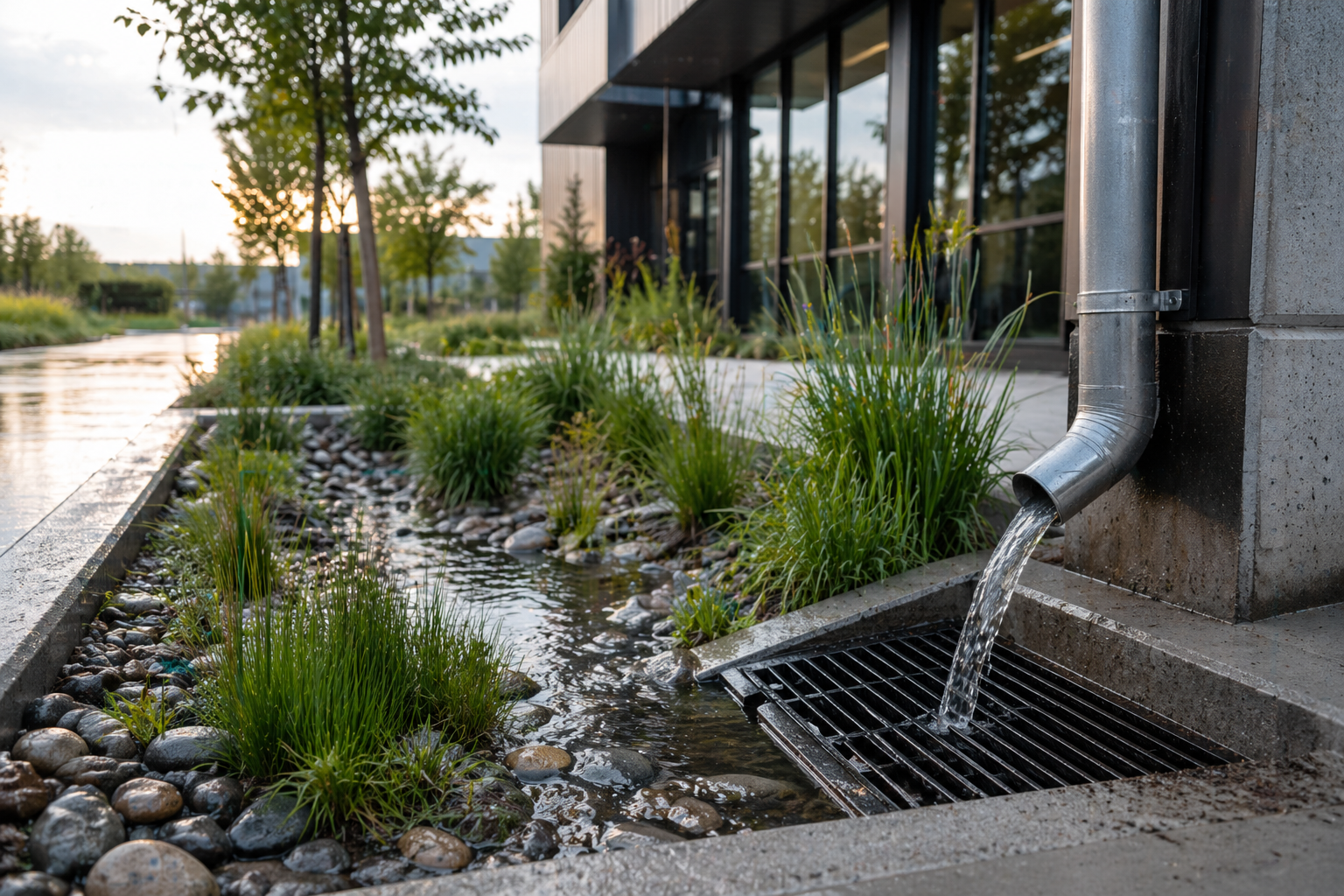



A STORM report records how stormwater runoff from a proposed development has been assessed, which treatment measures have been modelled and whether the resulting design achieves the required treatment performance.
In Brief
A STORM report generally includes the project details, assessed site areas, impervious catchments, proposed stormwater treatment measures, modelling assumptions and the final treatment result.
It should clearly explain how runoff from roofs, driveways, paving and other impervious surfaces has been represented and where that runoff is directed.
Where rainwater tanks, raingardens, permeable surfaces or other treatment measures are proposed, the report should identify their relevant dimensions, connections and operating assumptions.
The report focuses on stormwater treatment performance. It does not ordinarily replace drainage drawings, detention calculations, flood modelling or civil engineering documentation.
Inside a Typical STORM Report
A STORM report converts the stormwater treatment strategy shown across the project drawings into a clear and reviewable assessment.
The exact format can vary depending on the project, assessment tool and council requirements. However, a useful report should allow the project team or assessing authority to understand:
- which version of the development has been assessed;
- how the site has been divided into catchments;
- which surfaces generate runoff;
- where runoff from each surface is directed;
- which stormwater treatment measures have been included;
- what assumptions have been used;
- the resulting treatment performance; and
- which design commitments must be maintained in the project documentation.
The report should contain enough information for the result to be checked against the drawings rather than presenting a score without explaining how it was obtained.
For a broader explanation of the assessment process, visit the Certified Energy STORM Knowledge Hub.
Project and Property Details
The beginning of the report should identify the project being assessed.
This commonly includes:
- the project address;
- the development type;
- the client or project reference;
- the drawing set used for the assessment;
- relevant drawing numbers and revision dates;
- the date of the assessment; and
- the assessment method or software used.
Recording the plan revision is particularly important. If the building footprint, paving, tank size or landscape design changes later, the assessment may also need to be reviewed.
Site Area and Surface Breakdown
A central part of the report is the breakdown of the development into different surface types.
These may include:
- roof areas;
- balconies or terraces;
- driveways;
- car parking areas;
- pedestrian paths;
- patios and other paving;
- permeable paving;
- landscaped areas;
- lawns or garden beds; and
- other pervious or impervious surfaces.
The area schedule should reconcile with the overall site area and the current drawings.
Unaccounted surfaces can make the assessment difficult to verify and may overstate the proportion of runoff receiving treatment.
Impervious Catchment Areas
A STORM report should identify the impervious areas that generate runoff and explain how they have been assigned to treatment measures.
For example, the report may distinguish between:
- roof area connected to a rainwater tank;
- roof area discharging directly to the drainage system;
- driveway area directed to a raingarden;
- paving draining through a permeable surface;
- impervious area draining to another treatment measure; and
- impervious area remaining untreated.
This catchment allocation is important because a treatment measure only contributes to the assessment where runoff is credibly directed to it.
A rainwater tank located on the plan does not automatically treat every roof surface. The connected roof catchment must be identified.
Rainwater Tank Details
Rainwater tanks are commonly used in STORM assessments to capture and reuse roof runoff.
Where a tank is included, the report should generally identify:
- the tank storage capacity;
- the roof area connected to the tank;
- the building or dwelling served by the tank;
- the proposed rainwater reuse demands;
- whether the tank supplies toilets;
- whether it supplies laundry use, where applicable;
- whether it supplies garden irrigation;
- the landscaped area associated with irrigation demand; and
- any assumptions affecting the modelled performance.
Tank size alone does not determine the treatment outcome. Performance also depends on how much roof area is connected and how regularly stored water is reused.
The final report should therefore present the tank, catchment and reuse assumptions as one coordinated treatment measure.
Raingarden or Biofiltration Details
Where a raingarden or biofiltration system is included, the report should describe how it has been represented in the assessment.
Relevant information may include:
- the treatment surface area;
- the impervious catchment draining to the system;
- the proposed location;
- the general treatment type;
- how runoff reaches the treatment area;
- whether an overflow is required;
- any modelled infiltration assumptions; and
- the maintenance responsibility where relevant.
The dimensions used in the assessment should remain achievable within the site and should correspond with the landscape or hydraulic documentation.
A modelled raingarden should not be treated as an abstract allowance that is absent from the physical design.
Permeable Surface Details
Permeable paving or other infiltration surfaces may also contribute to the treatment strategy.
A report using permeable surfaces should clearly identify:
- the area treated as permeable;
- its location within the development;
- whether it receives runoff from adjoining surfaces;
- the treatment assumptions used;
- any constraints that may affect infiltration; and
- the need for ongoing maintenance.
Simply labelling ordinary paving as permeable is not sufficient. The modelled surface should correspond to an appropriate permeable pavement design and specification.
Untreated Areas
A clear STORM report should also identify runoff-generating areas that do not pass through a treatment measure.
Untreated areas may include:
- small roof sections that cannot be connected to a tank;
- entry paths draining directly to the legal point of discharge;
- balconies with separate drainage;
- parts of a driveway that bypass a raingarden; or
- other isolated hard surfaces.
It is not always necessary for every individual square metre of impervious area to receive its own treatment measure. However, all relevant areas should be included honestly so the overall performance result represents the proposed development.
Assessment Assumptions
The assessment result depends on the inputs and assumptions used. These should be stated clearly enough for the project team to understand the commitments behind the result.
Typical assumptions may relate to:
- surface classifications;
- roof catchment allocations;
- tank capacities;
- occupancy or water reuse demand;
- toilet connections;
- irrigated landscape area;
- raingarden size;
- permeable surface performance;
- runoff routing; and
- the inclusion or exclusion of existing site areas.
If an assumption later changes, the treatment result may also change. For example, reducing the connected roof area or removing toilet reuse can affect the performance attributed to a rainwater tank.
The STORM Score or Treatment Result
The report should include the final assessment result and explain what that result means for the project.
Depending on the tool and reporting format, this may include:
- an overall treatment score or performance rating;
- the contribution of individual treatment measures;
- the proportion of the best-practice objective achieved;
- pollutant-reduction results;
- an indication that the target has or has not been achieved; and
- the calculator or software output supporting the result.
The result should not be presented in isolation. It should be traceable back to the areas, catchments and treatment measures described elsewhere in the report.
Read How Is a STORM Score Calculated? for a focused explanation of how the assessment inputs influence the result.
Recommended Design Commitments
A useful STORM report should identify the key design commitments that need to be retained as the project develops.
These may include:
- minimum rainwater tank capacity;
- minimum connected roof catchment;
- required toilet or irrigation connections;
- minimum raingarden area;
- minimum permeable paving area;
- required runoff connections;
- treatment locations; and
- maintenance requirements where applicable.
These commitments can then be coordinated with the architectural, landscape, hydraulic and civil documentation.
Plan Mark-ups and Supporting Drawings
A report is easier to review when the relevant catchments and treatment measures can be located on a plan.
Depending on the project, the report may include or refer to:
- a site plan;
- a roof catchment plan;
- an impervious-area plan;
- a treatment measure plan;
- coloured catchment mark-ups;
- tank locations;
- raingarden locations;
- permeable paving areas; and
- directional notes showing runoff connections.
The STORM report does not necessarily need to become a detailed hydraulic drawing. Its purpose is to make the treatment model understandable and verifiable.
Consistency With the Project Drawings
The report and drawings should describe the same project.
Common inconsistencies include:
- a tank capacity in the report that differs from the plan;
- a roof catchment that cannot physically drain to the nominated tank;
- toilet reuse included in the model but omitted from the hydraulic notes;
- a raingarden that has been removed from the landscape plan;
- permeable paving counted in the report but specified as conventional paving;
- outdated site areas following a design revision; and
- different treatment measures shown across separate consultant drawings.
These discrepancies can lead to council questions, further information requests or a need to revise the assessment.
What a STORM Report Does Not Usually Include
A STORM report has a focused scope. It demonstrates the performance of the proposed stormwater treatment measures.
Unless separately commissioned, it does not ordinarily include:
- detailed pit and pipe design;
- pipe sizing calculations;
- on-site detention calculations;
- legal point of discharge documentation;
- finished surface levels;
- overland flow paths;
- flood modelling;
- civil construction drawings;
- hydraulic certification; or
- a complete drainage engineering design.
A project may require some or all of these items in addition to its stormwater treatment report.
How It Differs From a Stormwater Management Plan
A STORM report is primarily a quantitative record of runoff treatment performance.
A Stormwater Management Plan may have a broader scope and can bring together matters such as:
- the overall site drainage strategy;
- stormwater treatment;
- retention and reuse;
- detention;
- discharge arrangements;
- construction-phase controls;
- maintenance responsibilities; and
- coordination with civil or landscape design.
The STORM result may form part of a broader Stormwater Management Plan, but the two documents should not automatically be treated as interchangeable.
Read STORM Report vs Stormwater Management Plan for a detailed comparison.
Why the Report Content Matters
A treatment score is only useful when the underlying design can be understood and implemented.
A well-prepared report helps:
- council understand how the result was obtained;
- architects coordinate the required site areas;
- hydraulic consultants document tank and reuse connections;
- landscape designers retain sufficient treatment space;
- builders understand the relevant project commitments;
- developers reduce the risk of late design changes; and
- future revisions remain consistent with the approved treatment strategy.
The practical value lies not only in achieving a target but in documenting a treatment response that can be carried through into the constructed development.
Practical Considerations for Victorian Projects
Use the Current Drawing Revision
The report should identify the precise plans used. Submitting an assessment based on superseded drawings can create avoidable discrepancies.
Check the Total Site Area
Roof, paving, driveway, landscape and other surface areas should reconcile with the overall assessment boundary.
Show Credible Runoff Connections
Each treatment measure should receive runoff from the catchment assigned to it. Physical levels and drainage arrangements may need to be checked by the relevant designer.
Coordinate Rainwater Reuse
Any toilet, laundry or irrigation demand included in the assessment should be reflected in the project documentation.
Allow Enough Physical Space
Modelled tanks, raingardens and permeable surfaces need to fit within the development without conflicting with access, landscaping, services or private open space.
Confirm Council Expectations
Some councils may request specific plans, maintenance notes, calculator outputs or broader stormwater documentation in addition to the treatment report.
What Information Is Needed to Prepare the Report?
A STORM report can usually be prepared once the project drawings contain enough information to measure the site and identify a credible treatment strategy.
Commonly requested documents include:
- current architectural plans;
- a site plan with dimensions;
- a roof plan;
- landscape plans, where available;
- proposed rainwater tank sizes;
- nominated reuse connections;
- proposed raingarden or permeable surface areas;
- council correspondence;
- requests for further information;
- planning permit conditions; and
- relevant hydraulic or civil information.
Read What Information Is Needed for a STORM Assessment? for the complete project checklist.
How Certified Energy Can Help
Certified Energy can review the available project plans and prepare a clear stormwater treatment assessment for suitable Victorian developments.
The process may include:
- measuring site and impervious areas;
- allocating runoff catchments;
- reviewing proposed rainwater tanks and reuse demands;
- assessing raingardens or permeable surfaces;
- testing the overall treatment performance;
- identifying practical opportunities to improve the result;
- documenting key modelling assumptions;
- preparing clear project recommendations; and
- coordinating the assessment with the submitted drawings.
Where the project requires detailed MUSIC modelling, drainage design, detention calculations or civil engineering, that broader scope should be identified separately.
Explore the STORM Assessment Knowledge Hub or send through the available plans and council correspondence for an initial project review.
Frequently Asked Questions
What does a STORM report include?
It generally includes project details, the assessed site and impervious areas, stormwater catchments, proposed treatment measures, modelling assumptions and the final treatment performance result.
Does a STORM report include a site plan?
The report should include or refer to sufficient plan information to show how roofs, driveways, paving, landscaped areas and treatment measures have been represented.
Does the report identify untreated areas?
Yes. Relevant impervious surfaces that do not drain through a treatment measure should still be included so the overall result accurately reflects the development.
What rainwater tank information is included?
The report should normally state the tank capacity, connected roof catchment and the proposed reuse demands used in the assessment.
Does a STORM report include a score?
Yes. It should include the relevant assessment output and indicate whether the proposed treatment strategy achieves the applicable performance objective.
Does the report need to match the architectural plans?
Yes. Areas, treatment locations, tank capacities and other commitments should remain consistent across the report and project drawings.
Is a STORM report a drainage design?
No. A STORM report addresses runoff treatment performance. Drainage design deals with collection, conveyance, detention and discharge.
Does the report include detention calculations?
Not ordinarily. On-site detention and drainage capacity are separate matters unless they have been specifically included in a broader commissioned scope.
Can a STORM report form part of a planning submission?
Yes. It may be submitted to support the stormwater treatment component of a Victorian planning application, request for further information or permit condition.
Does the report need updating if the plans change?
It may need to be reviewed where changes affect site areas, roof catchments, tanks, reuse demands, raingardens, permeable paving or other treatment measures.
- STORM Assessments and Reports Knowledge Hub
- What Is a STORM Assessment?
- When Is a STORM Assessment Required in Victoria?
- How Is a STORM Score Calculated?
- What Does a 100% STORM Rating Mean?
- What Information Is Needed for a STORM Assessment?
- Can Rainwater Tanks Improve a STORM Rating?
- Common Reasons a Project Fails a STORM Assessment
- STORM Report vs Stormwater Management Plan
- STORM Assessment vs Drainage Design