


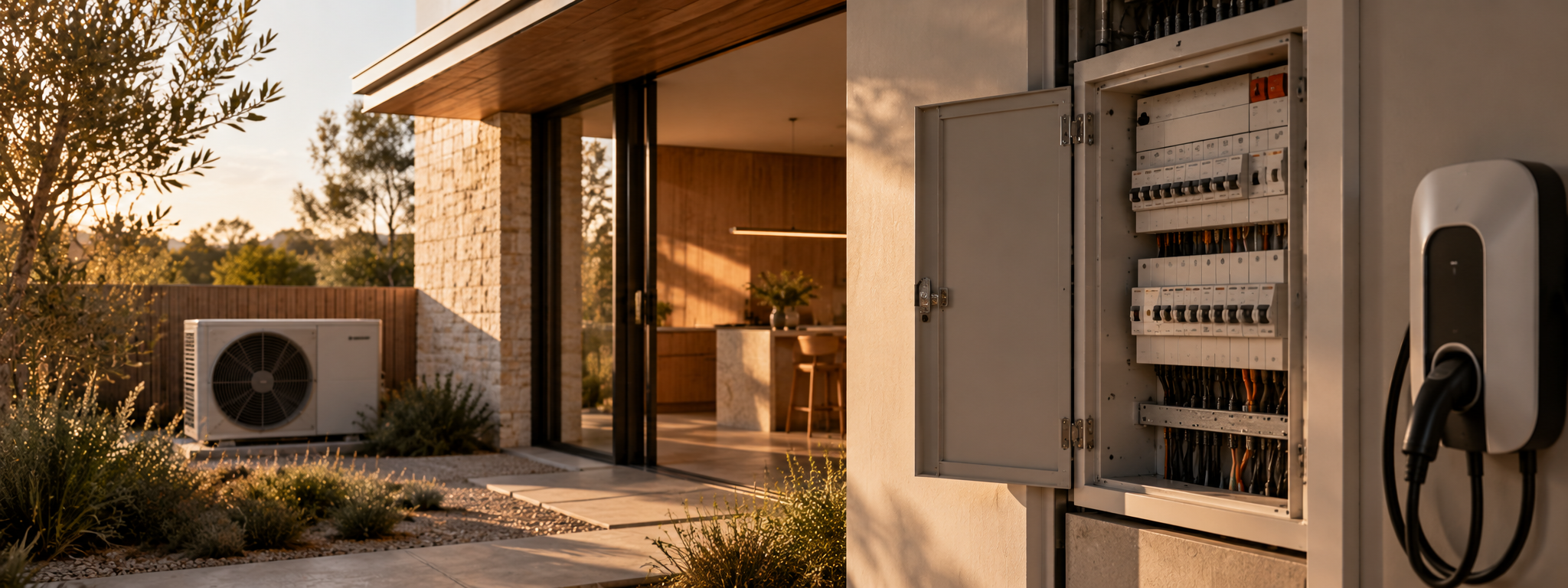
Replacing gas appliances with electric systems changes how a home uses electricity. Heating, hot water, cooking and electric vehicle charging can introduce new electrical requirements that need to be considered alongside the dwelling's existing supply, switchboard, circuits and other household loads.
For new homes, these requirements can be coordinated during electrical design. For existing homes, they may need to be reviewed before equipment is purchased or installation work begins.
Not every all-electric home requires a switchboard upgrade or a new electricity supply. The appropriate arrangement depends on the property, the selected equipment and the applicable electrical installation requirements.
Electrical capacity planning is not about assuming every electric appliance needs a larger supply. It is about checking whether the proposed systems can be accommodated safely and appropriately.
In Brief
What Electrical Capacity Checks Are Relevant to Home Electrification?
Electrical capacity concerns whether a dwelling's electricity supply and installation can accommodate the electrical demand of its connected equipment.
When planning electrification, an appropriately qualified electrical professional may need to review the existing supply, switchboard, circuits, proposed equipment loads and relevant operating conditions.
Future additions, including electric vehicle charging, further heating and cooling equipment or battery storage, may also influence electrical planning.
The assessment should consider the applicable requirements for maximum demand, electrical protection, equipment installation and network connection arrangements.
A residential energy performance assessment can help inform building and household system decisions, but it does not replace electrical capacity assessment, electrical design or installation certification.
Technical and professional scope note: Electrical supply capacity, maximum demand, switchboard adequacy, circuit requirements and installation safety must be assessed by appropriately qualified electrical professionals. Certified Energy's residential energy performance and compliance assessments do not constitute electrical inspections, electrical design or certification of electrical infrastructure.
Why Electrification Can Change Household Electrical Demand
Gas and electric appliances obtain energy from different sources. When gas hot water, heating or cooking equipment is replaced with electric alternatives, part of the household's energy demand shifts to electricity.
The resulting electrical requirements depend on the technology selected. A heat pump hot water system, for example, has different operating characteristics from a conventional electric resistance hot water system.
Reverse-cycle air conditioning also differs from direct electric resistance heating. Efficient equipment may provide useful heating or hot water with lower electricity consumption than some alternative electric technologies, but its electrical connection requirements still need to be assessed.
An all-electric home may also experience periods when several systems operate together, including cooking, heating, hot water production and electric vehicle charging.
Electrical capacity planning considers the proposed equipment, the relevant operating conditions and the installation requirements rather than assuming every home needs the same electrical infrastructure.
1. Check the Existing Electricity Supply
For an existing dwelling, an important starting point is establishing the electricity supply available to the property.
A licensed electrical professional may need to review the existing supply arrangement, relevant capacity limitations and whether the proposed equipment can be accommodated.
Some homes have single-phase supplies, while others have three-phase arrangements. Neither should automatically be considered sufficient or insufficient for electrification without reviewing the project's actual requirements.
Supply capacity may also be affected by network connection conditions and existing infrastructure. Where an upgrade is required, coordination with the relevant electricity distributor or other parties may be necessary.
For new homes, expected household loads should be communicated during electrical design so the proposed installation can be planned around the intended systems.
2. Review the Switchboard and Existing Circuits
A switchboard distributes electricity to the circuits within a dwelling and contains protective devices associated with the electrical installation.
When new electric equipment is proposed, the switchboard and existing circuits may need to be reviewed to determine whether they are suitable for the intended installation.
Relevant considerations can include available circuits, the need for dedicated circuits, protective devices and the condition of existing electrical infrastructure.
Older dwellings may have electrical infrastructure that requires attention independently of the electrification project. However, the age of a dwelling alone does not establish whether a switchboard upgrade is necessary.
A licensed electrician must assess the installation and determine what work, if any, is required.
Key distinction: A switchboard upgrade is a project-specific finding, not an automatic requirement of home electrification.
3. Identify the Requirements of Each Proposed Electric System
Different household systems have different electrical characteristics. Equipment information is needed to determine the requirements of the proposed installation.
| Household system | Relevant electrical consideration | Wider project consideration |
|---|---|---|
| Heating and cooling | Selected equipment, circuits and operating characteristics. | Building thermal performance, equipment location and specialist sizing. |
| Heat pump hot water | Equipment-specific supply requirements and any supplementary heating elements. | Location, airflow, noise, service access and operating controls. |
| Electric cooking | Cooktop and oven specifications, circuit requirements and installation arrangements. | Kitchen layout and suitable ventilation. |
| Electric vehicle charging | Charging equipment, potential demand and load management. | Parking location, future provisions and charging patterns. |
| Solar and battery systems | Generation, storage, protection and connection requirements. | Roof suitability, equipment space and intended operating configuration. |
The table identifies areas for professional review. It does not specify electrical installation requirements for a particular dwelling.
4. Consider Simultaneous Demand, Not Just Appliance Ratings
An important distinction in electrical planning is the difference between individual equipment ratings and the demand that an electrical installation must be designed to accommodate.
Not every appliance necessarily operates at full output at the same time. However, electrical design cannot simply assume that loads will never coincide.
Maximum demand must be determined using the applicable electrical requirements, equipment information and installation circumstances.
For example, a household might operate air conditioning while preparing dinner and charging an electric vehicle. Whether this creates a capacity issue depends on the selected systems and the installation.
Some technologies can incorporate scheduling, controls or load management, but their suitability and implementation require appropriate electrical design.
The objective is an appropriately designed installation rather than automatically selecting the largest possible electricity supply.
5. Plan for Future Electrification Without Assuming Every Upgrade Happens Now
Homeowners may replace gas equipment in stages rather than converting the entire dwelling at once.
For example, hot water may be replaced first, followed by heating, cooking and eventually electric vehicle charging.
This approach can align electrification with appliance replacement, renovation work or available budgets.
Before undertaking substantial electrical work, it can be useful to identify likely future equipment so the electrical professional can consider whether practical provisions should be included.
Future planning does not require immediate installation of every system. It helps avoid overlooking foreseeable requirements during current work.
6. Understand What Solar and Batteries Can and Cannot Resolve
Rooftop solar can reduce electricity imported from the grid during periods when generation is available.
Battery storage may allow some generated electricity to be used at other times, depending on the system and household demand.
However, neither technology automatically resolves electrical supply or switchboard capacity limitations.
Solar generation varies, and a battery's ability to support particular household loads depends on its configuration, operating mode and technical characteristics.
The electrical installation still requires appropriate assessment, including relevant generation, storage, protection and network connection requirements.
7. Separate Electrical Capacity From Residential Energy Performance
Electrical capacity and residential energy performance are connected, but they answer different questions.
An electrical capacity assessment considers whether the supply and installation can safely accommodate the proposed electrical loads.
A residential energy performance assessment considers aspects of how a dwelling is expected to use energy under a defined assessment methodology.
For example, NatHERS thermal performance modelling evaluates heating and cooling energy requirements under standardised conditions.
NatHERS Whole of Home models specified household energy systems and their contribution to the dwelling's modelled energy performance.
For applicable NSW residential projects, BASIX establishes relevant sustainability requirements and commitments.
These assessments can inform decisions about building fabric and household systems. They do not certify that an electrical supply, switchboard or circuit is adequate for a proposed installation.
Electrical Capacity Planning Checklist
Before purchasing or installing major electric household equipment, project teams can use the following questions to organise the information needed for professional review.
| Question | Why it matters |
|---|---|
| What electricity supply is currently available? | Establishes the existing supply arrangement for professional review. |
| Has the switchboard been assessed? | Identifies relevant installation and protective device requirements. |
| What equipment will be installed? | Provides equipment information for electrical design. |
| Are additional circuits required? | Helps establish the installation scope. |
| Which loads may operate together? | Supports an appropriate maximum demand assessment. |
| Is electric vehicle charging planned? | Identifies an additional current or future load. |
| Will remaining gas systems be replaced later? | Supports staged electrification planning. |
| Are solar or battery systems proposed? | Identifies generation, storage and connection considerations. |
| Have relevant energy assessment assumptions been reviewed? | Helps maintain consistency with proposed household systems. |
This checklist is a planning aid. It is not an electrical inspection procedure or a substitute for a licensed electrician's assessment.
Illustrative Example: Electrifying an Existing Gas Home
Consider an existing home with gas hot water, gas space heating and a gas cooktop.
The homeowner plans to replace the hot water system with a heat pump, install reverse-cycle air conditioning and change to induction cooking. Electric vehicle charging may be added later.
Before equipment is purchased, a licensed electrical professional reviews the existing supply, switchboard, circuits and proposed equipment requirements.
The review may identify that some existing infrastructure can be retained while additional circuits or other electrical work are required. Alternatively, the installation conditions may indicate that more substantial changes are necessary.
The outcome cannot be determined from the decision to replace gas appliances alone.
Separately, a residential energy assessment may help the homeowner understand the building's thermal characteristics and identify relevant opportunities to reduce heating and cooling demand.
Frequently Asked Questions
Electrical Capacity for Home Electrification FAQs
Does every all-electric home need a switchboard upgrade?
No. The need for a switchboard upgrade depends on the existing installation, proposed equipment and applicable electrical requirements. A licensed electrician should determine whether an upgrade is necessary.
Is single-phase power enough for an all-electric home?
It may be sufficient for some homes. The answer depends on the supply arrangement, proposed electrical loads and applicable design requirements. Three-phase power should not be assumed necessary for every all-electric dwelling.
Does a heat pump hot water system require a dedicated circuit?
Circuit requirements depend on the selected equipment, manufacturer specifications and applicable electrical installation requirements. A licensed electrical professional should determine the appropriate arrangement.
Can solar panels compensate for limited electrical supply capacity?
Solar can reduce grid electricity consumption during generation periods, but it does not automatically eliminate supply capacity limitations. The electrical installation still requires appropriate assessment.
Does an energy rating confirm that a home can support electric appliances?
No. A residential energy rating assesses modelled energy performance under its defined methodology. It does not assess electrical safety, switchboard adequacy or supply capacity.
Should electrical capacity be checked before replacing gas appliances?
Yes. Before installing equipment that changes the home's electrical requirements, the relevant supply and installation arrangements should be reviewed by an appropriately qualified electrical professional.
Related Knowledge
Related Home Electrification and Residential Energy Guidance
Home Electrification
Explore how electric household systems, building fabric, solar and residential energy performance connect.
NatHERS Existing Homes
Understand how existing dwelling energy performance assessments can inform residential improvement planning.
NatHERS Whole of Home
Learn how specified household systems contribute to modelled new-home energy performance.
NatHERS Thermal Performance
Explore how the thermal characteristics of a dwelling influence modelled heating and cooling energy requirements.
Residential Energy Performance
Planning an All-Electric Home or Residential Energy Upgrade?
Certified Energy can assist with relevant residential energy performance and compliance assessments for projects considering electric household systems. Electrical supply capacity, switchboard requirements and installation safety should be reviewed separately by appropriately qualified electrical professionals.
Explore Home Electrification Services