

Visual Impact Assessment
Viewpoints are not selected simply because a proposed development can be seen from them. A useful viewpoint represents how a relevant person or group may experience visual change within the surrounding environment.
In Brief
Viewpoints in a Visual Impact Assessment are selected to represent relevant views of a proposed development. Selection may consider potential visibility, visual receptors, distance, viewing direction, landscape and built context, accessibility and the sensitivity or importance of a view. The appropriate approach depends on the project, location and applicable assessment requirements.
Why viewpoint selection matters
A Visual Impact Assessment considers how a proposed development may change existing views and the visual environment experienced by people around a site. Viewpoints provide specific locations from which those potential changes can be examined.
That does not mean every location from which a proposal could potentially be seen needs to become an assessment viewpoint. Depending on the project and assessment methodology, a representative set of locations may be selected to understand different viewing conditions, receptor groups and parts of the surrounding environment.
The objective is therefore not simply to find visible locations. It is to select viewpoints that provide useful evidence for understanding the nature and significance of potential visual change.
What is a viewpoint in a Visual Impact Assessment?
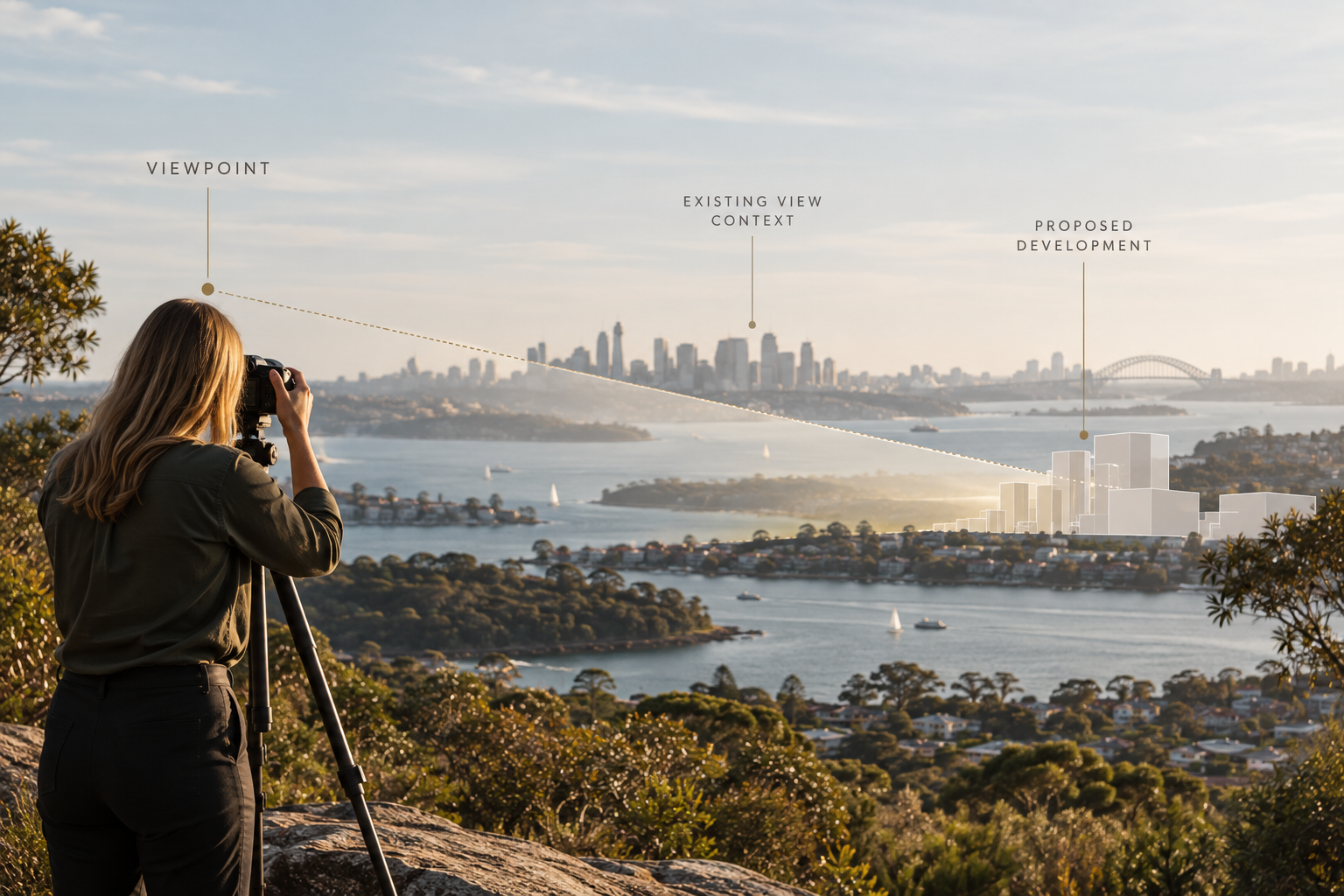
A viewpoint is a defined location used to examine a view towards a proposed development and its surrounding visual context. It creates a consistent position from which existing conditions and potential future change can be considered.
A viewpoint is different from a visual receptor. The viewpoint is the location from which a view is assessed. A visual receptor is the person or group of people who may experience that view, such as residents, visitors, users of public spaces or people travelling along a route.
One viewpoint may therefore help represent the experience of a wider receptor group rather than only the exact point at which a photograph or observation is made.
A representative viewpoint is not simply somewhere a proposal can be seen. It is a location that helps explain how a relevant visual receptor may experience the proposed change.
What makes a viewpoint representative?
There is no single set of viewpoint-selection criteria that applies to every Visual Impact Assessment in Australia. The appropriate methodology depends on the type and scale of development, its location, the planning context and any project-specific guidance or assessment requirements.
Factors that may inform viewpoint selection include potential visibility, the people likely to experience a view, distance and viewing direction, topography, vegetation, surrounding built form, accessibility and the character or importance of the existing view.
A useful selection normally provides a representative picture of relevant viewing conditions rather than concentrating only on locations that are closest to the proposal or where visibility is greatest.
Potential visibility is only the starting point
Before representative viewpoints can be considered, the assessment team needs to understand the relationship between the proposal and its surroundings. Potential visibility may help identify parts of the surrounding area where relevant views could occur.
For some projects, a Viewshed Analysis may assist with the separate question of where a proposal could potentially be visible based on factors such as terrain and project geometry. This is different from selecting representative viewpoints for a Visual Impact Assessment.
A location can have theoretical or actual visibility without automatically becoming an important assessment viewpoint. The VIA must also consider who experiences the view, the nature of that view and whether the location is useful for understanding potential visual effects.
Visual receptors help determine which views matter
Viewpoint selection is closely connected to visual receptors: the people or groups who may experience visual change as a result of a proposal.
Depending on the project, relevant receptors might include residents, users of public spaces, visitors, recreational users or people travelling through an area. Different receptor groups can experience the same development from different distances, directions and visual contexts.
Representative viewpoints can therefore be selected to capture a range of relevant viewing experiences rather than treating every possible observer or location as equivalent.
Are the closest viewpoints always the most important?
Not necessarily. Distance can influence how prominent a development appears, but proximity alone does not determine the relevance of a viewpoint.
A nearby location may have limited or screened views because of vegetation, terrain or existing buildings. A more distant location may provide a clearer or more representative view and may be experienced by a different or particularly relevant receptor group.
The importance of a viewpoint therefore needs to be considered within the complete visual context rather than determined by distance alone.
How viewpoints are selected in practice
The precise process varies between projects, but viewpoint selection commonly develops through a combination of desktop review, understanding potential visibility, identifying relevant receptors and examining actual site conditions.
1. Review the proposal and surrounding context. Understand the scale, form and location of the proposed development and the environment in which it would be seen.
2. Consider potential visibility. Identify areas from which relevant views of the proposal may occur.
3. Identify relevant visual receptors. Consider the people and groups who may experience visual change.
4. Review candidate locations. Consider viewing direction, distance, accessibility and the visual context represented by each location.
5. Verify conditions on site where appropriate. Field observations can reveal screening, vegetation, built form or access conditions that are not fully apparent during desktop review.
6. Select a representative range. Choose viewpoints that collectively help explain the relevant visual experiences around the proposal.
7. Record the basis for selection. A clear assessment should explain why the selected viewpoints are appropriate for the project and its context.
Can viewpoints change during the assessment?
Yes. Candidate viewpoints identified during desktop review do not always remain the most useful locations once actual site conditions are examined.
Vegetation, buildings, terrain, access restrictions or unexpected viewing conditions may affect whether a location provides a representative view. Site investigation can also reveal relevant views or receptor locations that were not obvious from mapping and project documentation alone.
For that reason, viewpoint selection can be an iterative part of the assessment rather than a fixed list established before the visual environment has been properly understood.
Viewpoint selection and Viewshed Analysis answer different questions
The two processes can support each other, but they should not be treated as interchangeable.
A Viewshed Analysis examines potential geographic visibility: where a proposal may be visible from. Viewpoint selection within a Visual Impact Assessment identifies representative locations from which the nature and significance of visual change can be considered.
Visibility can therefore help inform viewpoint selection, but visibility alone does not determine visual impact.
What information helps determine appropriate viewpoints?
The information required depends on the project, but viewpoint selection is easier when the assessment begins with a clear understanding of the proposal and its surrounding environment.
Useful information may include current architectural or project drawings, the proposed location and dimensions of buildings or structures, site and topographic information, surrounding development and landscape context, known sensitive locations, relevant planning requirements and available survey or photographic information.
The appropriate evidence and assessment methodology should then be determined for the particular project rather than applying the same viewpoint framework to every development.
Continue Reading
Understand the complete Visual Impact Assessment process
Viewpoint selection is one part of a wider assessment process that considers visual receptors, existing visual character, the magnitude of change and the significance of potential visual effects.
Explore Visual Impact Assessment →Visual Impact Assessment
Need to understand the potential visual effects of your project?
The appropriate visual assessment depends on the proposal, surrounding environment, planning pathway and the questions the project needs to answer.
Send us your available plans and project information. We can review the documentation and help identify the appropriate visual assessment pathway and scope.
Start Your Project