

The position of insulation within an external wall can influence more than its thermal performance. It also affects the temperature of adjacent construction layers, the location of potentially cold surfaces and the conditions under which moisture may accumulate within the assembly.
Insulation installed within a wall cavity, continuously outside the structure or on the internal face of an existing wall can produce different temperature profiles. Even where similar insulation materials and nominal thermal resistance values are used, the resulting moisture behaviour may not be equivalent.
For architects, building designers, builders and project teams, understanding these differences helps inform insulation selection, wall detailing and decisions about whether a proposed construction requires further condensation risk assessment.
Insulation placement changes where temperature differences occur within a wall. The resulting condensation risk depends on how those temperature conditions interact with moisture movement, material properties and the assembly's capacity to dry.
In Brief
How does insulation placement affect condensation risk in walls?
Insulation reduces heat transfer through a wall, but its location also influences the temperature of other materials within the assembly.
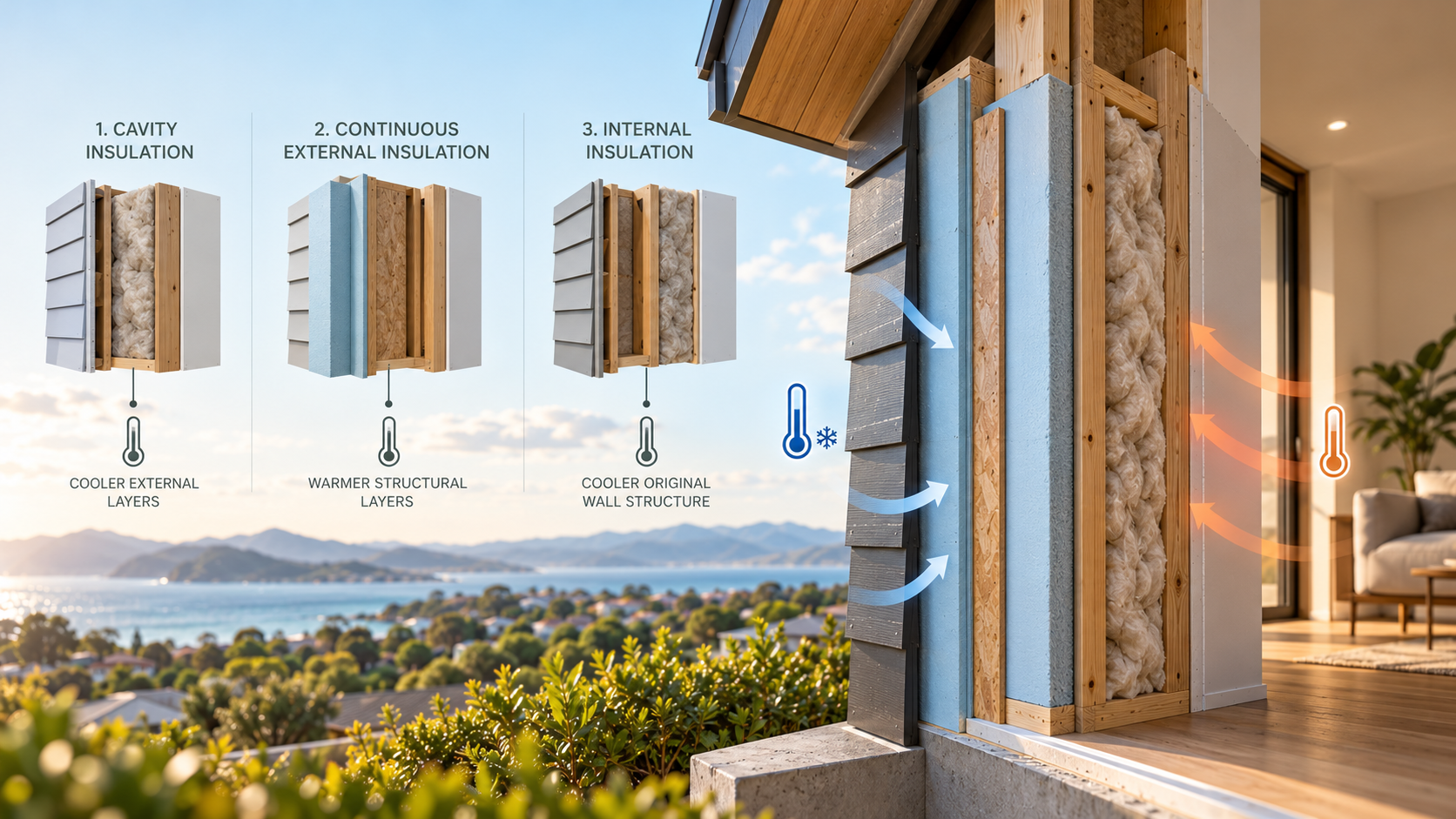
Cavity insulation, continuous external insulation and internal insulation can create different temperature conditions at structural members, sheathing, membranes and other interfaces.
Where moisture reaches a sufficiently cool surface or construction layer, relative humidity may increase and condensation can develop.
The position of insulation must therefore be considered alongside vapour control, air leakage, moisture exposure, climate and drying potential.
For the broader building physics principles, see Moisture & Condensation Risk Analysis.
Technical and NCC note: The relationships described in this article are general building physics principles rather than universal construction recommendations. The appropriate insulation arrangement depends on the complete wall assembly, climate, material characteristics and intended indoor conditions. Applicable NCC energy efficiency and condensation management requirements must be confirmed for the project, including the relevant Code edition, building classification and jurisdictional variations. Where necessary, project-specific assessment should be used to evaluate the proposed construction.
How does insulation placement change temperature within a wall?
A wall assembly contains a sequence of materials through which heat is transferred between indoor and outdoor environments.
Insulation introduces thermal resistance within that sequence. The location of this resistance influences the temperature of construction layers on either side.
During winter, a wall with insulation positioned towards the interior may leave more of the external structure exposed to colder conditions. A wall with continuous insulation outside the structure may maintain warmer temperatures within some internal construction layers.
During warm weather, particularly where internal spaces are mechanically cooled, the temperature relationships may differ.
The relevant design questions include:
- Where is the principal thermal resistance located?
- Which construction layers are likely to experience lower temperatures?
- Can moisture reach those layers through diffusion or air movement?
- Are moisture-sensitive materials present at vulnerable interfaces?
- Can accumulated moisture dry under the expected conditions?
The location of a theoretical dew point is not, by itself, a complete indication of condensation risk. Actual moisture behaviour also depends on the properties of materials, environmental conditions and moisture transport mechanisms.
Understanding the temperature profile provides a useful starting point, but the complete assembly determines the moisture performance.
What happens when insulation is installed within a wall cavity?
Cavity insulation is commonly installed between framing members within external wall construction.
This arrangement provides thermal resistance within the depth of the wall while leaving other construction layers positioned on either side of the insulation.
Under cooler outdoor conditions, sheathing or other materials located outside the insulated cavity may experience lower temperatures than materials closer to the interior.
If moisture reaches those cooler layers, the potential for elevated relative humidity or condensation may increase.
Important considerations include:
- the insulation material and its installed thickness;
- the continuity of insulation between framing members;
- the temperature of external sheathing or other adjacent layers;
- the presence and properties of wall membranes;
- the vapour resistance of internal finishes;
- air leakage through wall junctions and penetrations; and
- the capacity of the assembly to dry.
Framing members can also create different local thermal conditions from the insulated portions of a wall.
This does not mean that cavity insulation is inherently unsuitable. Its performance depends on the complete wall construction and the conditions for which it is designed.
The relevant objective is to ensure that the insulation, membranes, framing and other layers operate together as an appropriate building envelope assembly.
How does continuous external insulation affect condensation risk?
Continuous external insulation is positioned outside the principal structural wall assembly, creating a thermal resistance layer that extends across framing members and other structural components.
In cooler conditions, this arrangement can help maintain higher temperatures within construction layers located on the internal side of the external insulation.
Maintaining warmer temperatures at certain interfaces may reduce the likelihood of condensation where moisture is present.
However, the outcome depends on the thickness and thermal resistance of the external insulation, the properties of the other wall layers and the relevant climate conditions.
Design considerations include:
- the proportion of total thermal resistance provided externally;
- the temperature of structural sheathing and framing;
- the vapour permeance of the external insulation material;
- the presence of membranes or other resistant layers;
- the potential for inward or outward drying;
- the continuity of insulation at junctions and penetrations; and
- the effect of seasonal temperature and humidity changes.
Some external insulation materials provide substantial resistance to vapour diffusion. Their presence can therefore influence drying potential as well as temperature.
Continuous external insulation should not automatically be assumed to eliminate condensation risk, particularly where the remaining assembly contains moisture-sensitive materials or restricted drying pathways.
The appropriate configuration should be assessed in relation to the complete wall rather than external insulation considered in isolation.
What are the moisture risks of internal wall insulation?
Internal wall insulation is positioned on the room-facing side of an existing or proposed wall assembly.
This approach may be considered where external insulation is impractical, where existing façades must be retained or where project constraints limit changes to the outside of the building.
Under cooler outdoor conditions, internal insulation can reduce the amount of heat reaching the original wall structure.
As a result, parts of the existing wall may remain cooler than they would without the internal insulation.
If moisture reaches those cooler materials, the potential for elevated humidity or condensation may change.
Relevant considerations include:
- the construction and moisture condition of the original wall;
- the thermal resistance added internally;
- the resulting temperature of the existing wall materials;
- the vapour resistance of insulation and internal finishes;
- the potential for moisture to enter from outside;
- the capacity of the original wall to dry; and
- the continuity of insulation at floors, ceilings and other junctions.
Internal insulation can also change the drying behaviour of existing construction by reducing heat flow into the original wall or introducing additional vapour resistance.
These effects may be particularly relevant where the existing wall contains moisture-sensitive materials or is exposed to significant external moisture.
Internal insulation is not automatically unsuitable, but its effect on the existing assembly should be understood before the design is finalised.
Can the same wall materials behave differently when insulation is moved?
Yes. Changing the location of insulation can alter the temperature of construction layers even where the same materials and similar overall thermal resistance are retained.
For example, consider a wall assembly containing structural framing, sheathing, insulation, membranes and internal lining.
If most of the insulation is positioned within the framing cavity, the sheathing may experience different winter temperatures from those occurring when a substantial continuous insulation layer is installed externally.
If the insulation is instead placed internally, the structural wall may experience lower temperatures during heating periods.
These changes influence the environmental conditions experienced by moisture-sensitive layers.
| Insulation arrangement | Key condensation considerations |
|---|---|
| Within framing cavity | Temperature of external sheathing, insulation continuity, framing effects and moisture movement through the assembly. |
| Continuous external insulation | Temperature of internal structural layers, external insulation vapour resistance and available drying pathways. |
| Internal insulation | Temperature and moisture behaviour of the original wall, internal vapour resistance and potential changes to drying. |
The comparison does not establish that one arrangement is universally preferable.
The most suitable insulation configuration depends on the climate, wall materials, intended indoor conditions, construction constraints and applicable regulatory requirements.
Where alternative arrangements are being considered, comparing their moisture behaviour can help inform the design decision.
How do sheathing and vapour control layers influence the result?
The moisture behaviour of an insulated wall depends partly on the properties of materials adjacent to the insulation.
Sheathing, membranes, rigid insulation and internal finishes can have different levels of vapour resistance and moisture storage capacity.
Where insulation placement changes the temperature of these materials, the conditions under which moisture accumulates or dries may also change.
A relatively vapour-resistant layer can restrict moisture movement through part of the assembly. Depending on its position, this may contribute to moisture management or limit drying.
Relevant questions include:
- Which construction layers provide substantial vapour resistance?
- Where are those layers positioned relative to insulation?
- How does the insulation arrangement affect their temperature?
- Could moisture become present between resistant layers?
- What drying pathways remain available?
- Does the proposed membrane arrangement satisfy the applicable NCC requirements?
A material that performs appropriately in one insulation configuration should not automatically be assumed suitable when the insulation arrangement changes.
For a more detailed discussion of membrane classifications and climate-zone considerations, see Vapour Control Layers in Australian Climate Zones.
How do Australian climate conditions change the assessment?
Australian climate conditions influence the temperature and humidity differences experienced across external wall assemblies.
In cooler climates, heated indoor environments and colder outdoor conditions can create temperature profiles that make some external construction layers more vulnerable to moisture accumulation.
In warmer and humid climates, the operation of airconditioning can produce cooler internal conditions while the outside environment remains warm and moisture-laden.
Mixed climates may experience different moisture conditions during heating and cooling seasons.
These variations mean that the consequences of insulation placement cannot be determined from the wall construction alone.
The assessment may need to consider:
- the project location and NCC climate zone;
- seasonal outdoor temperature and humidity;
- anticipated indoor heating and cooling conditions;
- the position of insulation and vapour-resistant layers;
- the potential for moisture movement in different directions; and
- the drying characteristics of the proposed assembly.
An insulation arrangement that maintains favourable temperatures at a particular interface in one climate may produce different conditions elsewhere.
For this reason, insulation placement should be considered in relation to the project's expected environmental conditions rather than a universal construction rule.
Does better thermal performance always mean lower condensation risk?
Improving thermal resistance can reduce heat transfer through a wall, but it does not automatically eliminate condensation risk.
The effect of additional insulation depends on where it is installed and how the resulting temperature changes interact with moisture movement.
For example, adding insulation internally may improve the thermal resistance of an existing wall while reducing the temperature of some original construction materials during winter.
Adding insulation externally may maintain warmer temperatures within structural layers under the same conditions, but the vapour resistance of the added materials can influence drying potential.
Similarly, insulation placed within a framing cavity may provide a suitable thermal solution while leaving some adjacent layers exposed to colder conditions.
The nominal R-value of a wall therefore does not describe its complete moisture behaviour.
Thermal performance and moisture performance should be considered as related but distinct aspects of building envelope design.
Where insulation changes substantially alter the construction arrangement, reviewing condensation risk may help avoid unintended moisture consequences.
When should alternative insulation positions be assessed?
Insulation placement is most useful to review while wall construction details and material selections remain flexible.
Not every insulation arrangement requires detailed hygrothermal modelling. However, some projects may benefit from closer consideration of moisture performance.
Further review may be appropriate where:
- the design introduces substantial internal insulation to an existing wall;
- continuous external insulation is being added to a complex wall assembly;
- the proposed wall contains multiple vapour-resistant layers;
- moisture-sensitive materials are located at potentially cold interfaces;
- the insulation position differs from an established construction arrangement;
- the project involves demanding temperature or humidity conditions;
- alternative insulation configurations are being compared;
- material substitutions may alter the original design assumptions; or
- a Performance Solution requires supporting moisture performance evidence.
Depending on the project, the assessment may involve a review of the wall layer sequence, material characteristics, environmental conditions or a more detailed hygrothermal analysis.
The purpose is to understand whether the proposed insulation arrangement creates moisture conditions that require further design attention.
The level of assessment should be proportionate to the complexity of the construction and the technical question being considered.
Insulation placement and condensation risk checklist
- Identify the complete proposed external wall assembly.
- Confirm whether insulation is located internally, within the cavity or externally.
- Establish the thermal resistance of each relevant insulation layer.
- Review the likely temperature of adjacent construction materials.
- Identify moisture-sensitive sheathing, framing and other materials.
- Confirm the position and properties of vapour control layers.
- Consider air leakage pathways through the wall construction.
- Review the potential for moisture accumulation at concealed interfaces.
- Consider the drying potential of the complete assembly.
- Assess the influence of local climate and intended indoor conditions.
- Confirm the applicable NCC energy efficiency and condensation management requirements.
- Review insulation continuity at junctions and penetrations.
- Check whether proposed material substitutions alter the wall arrangement.
- Determine whether additional moisture performance assessment is appropriate.
Frequently Asked Questions
Insulation placement and wall condensation questions
Can insulation placement cause condensation in walls?
Insulation placement can change the temperature of construction layers and therefore influence condensation risk. Whether condensation develops depends on moisture exposure, material properties, air movement, climate and drying potential.
Is external insulation better for preventing condensation?
Continuous external insulation can help maintain warmer temperatures within some structural layers during cooler conditions. However, its effect depends on the insulation's thermal and vapour characteristics, the other wall materials and the project climate. It is not a universal guarantee against condensation.
Does internal insulation increase condensation risk?
Internal insulation can change the temperature and drying behaviour of the original wall. In some conditions, parts of the existing construction may become cooler and more vulnerable to moisture accumulation. The actual risk depends on the complete assembly and environmental conditions.
Can a wall meet thermal insulation requirements and still experience condensation?
Yes. Thermal resistance requirements address heat transfer, while condensation risk also depends on moisture movement, material properties and drying potential. Compliance with thermal insulation requirements alone does not establish that every possible moisture risk has been resolved.
Does adding more insulation always reduce condensation risk?
No. Additional insulation changes the temperature profile of the wall. Depending on its position, it may improve conditions at some interfaces while making other layers cooler or changing the assembly's drying behaviour.
When is hygrothermal modelling useful for wall insulation design?
Hygrothermal modelling may be useful where insulation placement creates complex temperature and moisture conditions, where the assembly has limited drying potential or where alternative wall configurations require comparison. It is not automatically required for every insulated wall.
Related Knowledge
Continue exploring moisture and building envelope performance
Moisture & Condensation Risk Analysis
Explore the broader building physics principles behind moisture movement, condensation risk and building envelope assessment.
Vapour Control Layers in Australian Climate Zones
Understand how climate-zone conditions and membrane classifications influence vapour control material selection.
Condensation Risk in Roof and Ceiling Assemblies
Explore how insulation position, ventilation and construction details influence moisture behaviour in roof assemblies.
Thermal Bridge Analysis
Understand how localised heat flow and thermal discontinuities influence temperatures within building envelope assemblies.
Moisture & Condensation Risk Analysis
Understand how insulation placement affects your proposed wall assembly
Where a wall design includes alternative insulation arrangements, moisture-sensitive materials or uncertain drying conditions, Certified Energy can assist with project-specific moisture and condensation risk analysis to support informed design decisions and construction documentation.
Explore Moisture & Condensation Risk Analysis