

Residential Design Coordination
Residential designs continue to evolve after energy modelling begins. The important question is whether a change affects the assumptions or performance demonstrated by the assessment.
During a Verification Using a Reference Building (VURB) assessment, changes to architectural drawings, glazing specifications, insulation, shading or other building characteristics may affect the thermal comparison. Understanding when a revision needs review helps project teams maintain consistency between the model, compliance evidence and final construction documentation.
In Brief
Design Changes May Require the VURB Model to Be Reviewed
A VURB assessment evaluates a defined residential design against a compliant reference building using prescribed modelling conditions.
When the design changes, the project team should determine whether the revised information affects the building geometry, thermal characteristics, reference building assumptions or compliance conclusions.
Not every change requires a complete new simulation. Some changes may have no relevant effect, while others may require updated inputs, further calculations or revised compliance documentation.
The assessment should ultimately reflect the design and specifications being relied upon for approval and construction.
Model Integrity
Why Do Design Revisions Matter in a VURB Assessment?
A VURB assessment is based on a particular version of the proposed dwelling. Architectural geometry, glazing, construction materials, insulation and other relevant information are used to calculate the building's thermal loads.
The proposed building is then compared with a reference building established according to the applicable Verification Method.
If a relevant specification changes after modelling, the earlier result may no longer describe the current proposal accurately. This does not necessarily mean the dwelling would fail the comparison, but it means the effect of the change should be established rather than assumed.
The purpose of revision control is to maintain a clear relationship between the assessed design, the technical evidence and the drawings or specifications used for the project.
Design Change Categories
Which Residential Design Changes May Affect VURB Modelling?
01 — Building Geometry
Layout and Building Form
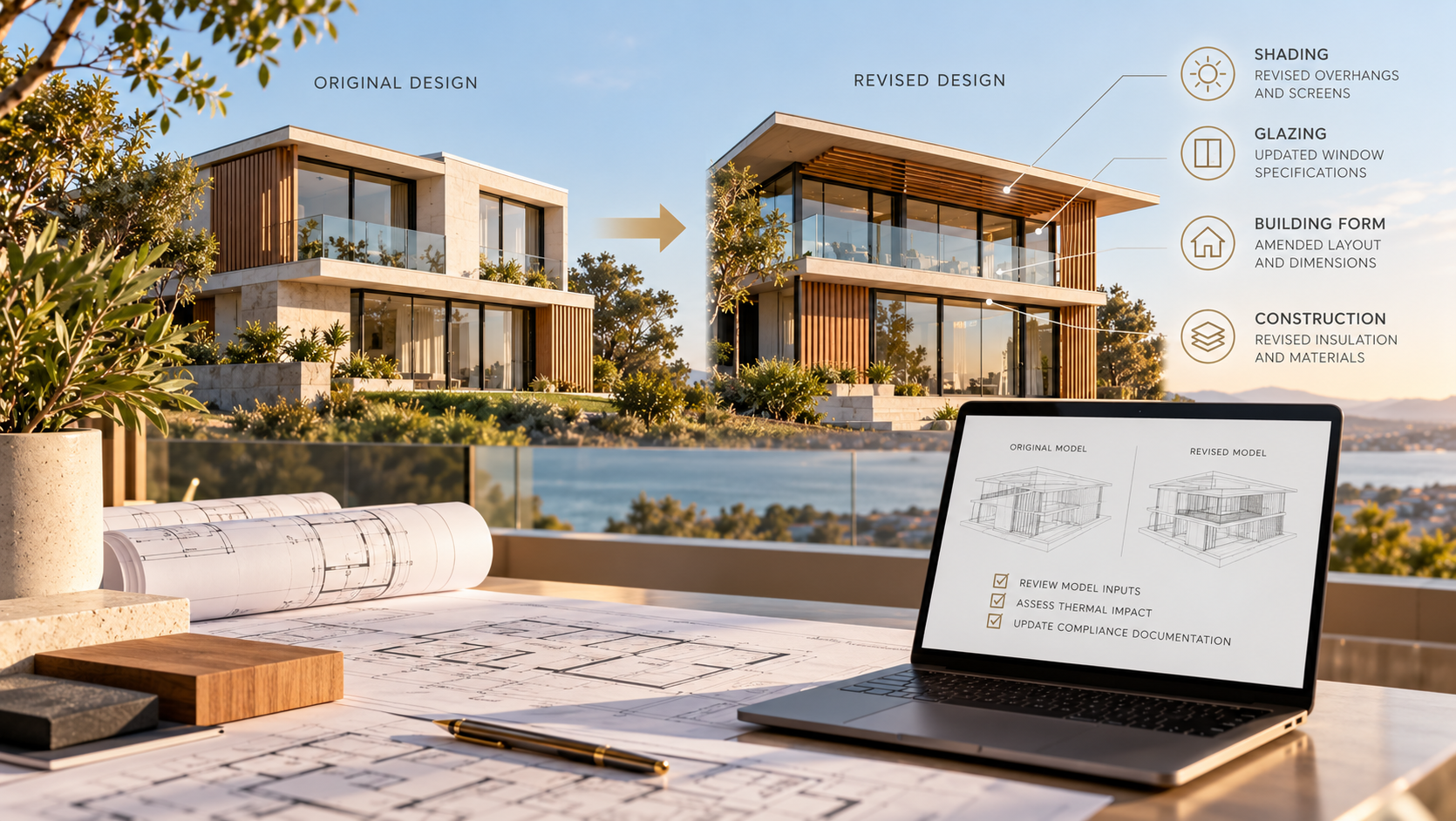
Changes to floor plans, building dimensions, ceiling heights, roof geometry or the extent of conditioned spaces may affect the thermal model and reference building definition.
02 — Glazing
Windows and Glass Specifications
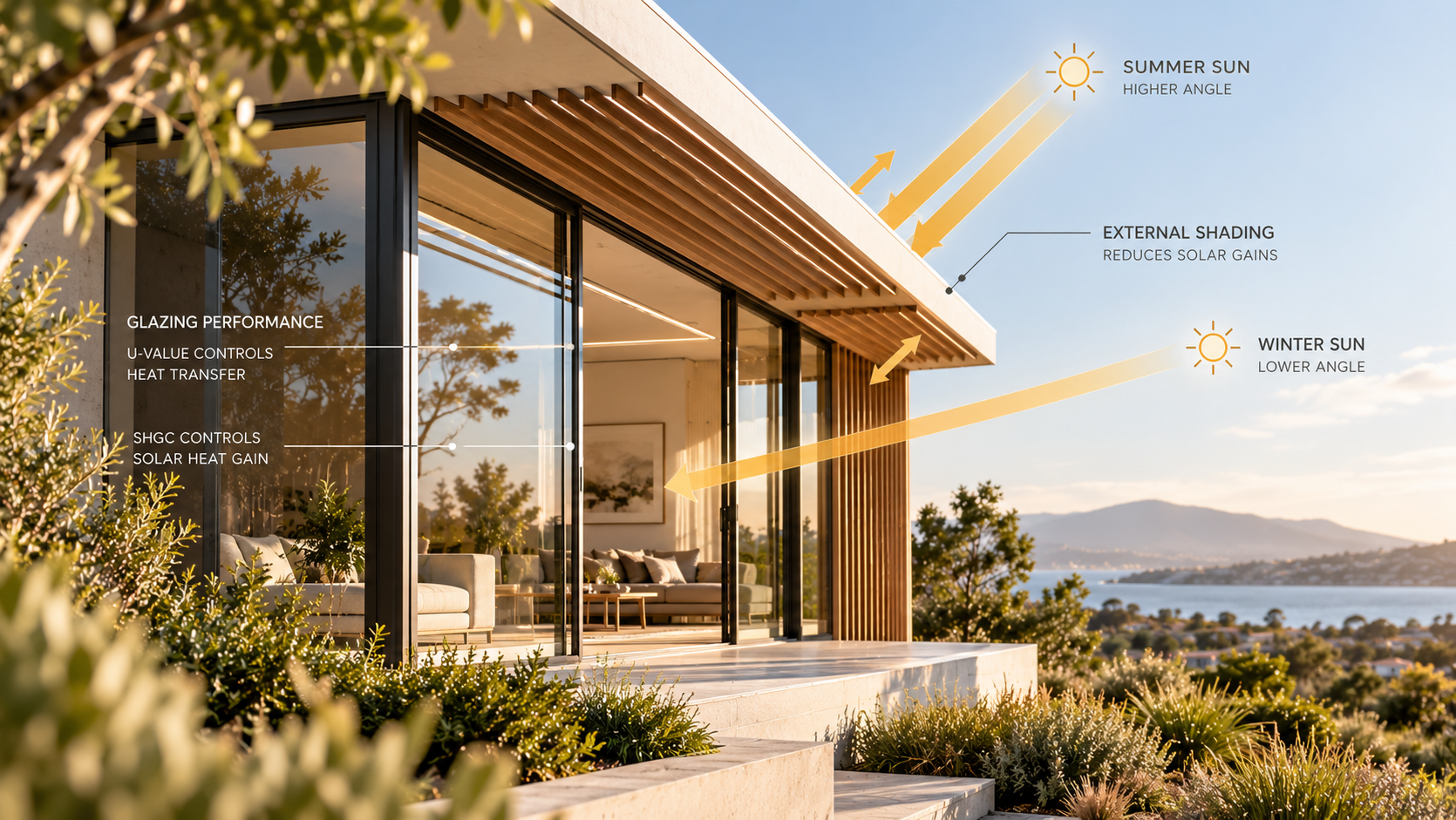
Changes to window dimensions, locations, frame systems, U-values or solar heat gain coefficients can alter the modelled heating and cooling loads.
03 — Building Fabric
Construction and Insulation
Changes to wall, roof or floor assemblies, insulation specifications or relevant thermal properties may affect the comparison and retained direct compliance requirements.
04 — Solar Exposure
Shading and Orientation
Revised overhangs, external screens, nearby obstructions or building orientation can change solar exposure and may require the relevant model assumptions to be updated.
Comparative Modelling
When Does the Reference Building Also Need to Change?
Under national NCC 2022 H6V2, the proposed dwelling and reference building share prescribed characteristics, including the floor plan, orientation and location and size of glazing.
If a design revision changes one of these common characteristics, the reference building may also need to be updated so that the comparison continues to use the required consistent inputs.
For example, enlarging a glazed opening is not simply a change to the proposed building's window specification. The revised glazing dimensions must be reflected in the relevant common model geometry.
By contrast, changing the thermal performance specification of a window without altering its dimensions may primarily affect the proposed building model. The precise modelling response depends on the requirements of H6V2 and the information changed.
The reference building should not be retained unchanged merely for convenience if a revision affects a characteristic that must be common to both models.
Revision Assessment
How Might Different Changes Be Reviewed?
| Design revision | Potential assessment impact | Appropriate review consideration |
|---|---|---|
| Window size or location changes | Changes common building geometry and potentially solar gains and heat transfer | Review and, where necessary, update both proposed and reference models |
| Different glazing product | May change U-value, SHGC and thermal loads | Verify the replacement specification and reassess relevant model inputs |
| Insulation specification changes | May affect thermal loads and retained direct requirements | Check both modelling effects and applicable minimum obligations |
| External shading changes | May change solar exposure and seasonal load calculations | Review the actual shading geometry and relevant modelling treatment |
| Floor plan or building form changes | May affect the proposed and reference building geometry | Determine the extent of required model revisions and renewed comparison |
| Finish or product changes unrelated to modelled performance | May have no material effect on the thermal assessment | Confirm whether any modelled property or compliance obligation is affected |
These are illustrative review considerations, not fixed regulatory revision categories. The actual response depends on the nature of the change, the applicable requirements and the supporting assessment evidence.
Extent of Reassessment
Does Every Design Change Require a Complete New VURB Assessment?
Not necessarily. The need for further modelling depends on whether the revision affects the technical basis or conclusions of the existing assessment.
A change unrelated to the modelled building characteristics may be resolved through a documented review. A change to glazing, insulation, building geometry or other relevant inputs may require the model to be updated and the affected calculations repeated.
Where a change substantially alters the design, the scope of reassessment may be more extensive. A revised compliance conclusion should be based on sufficient evidence rather than an assumption that the original outcome will remain unchanged.
The NCC does not establish a universal numerical threshold for what constitutes a minor VURB design revision. The technical significance of each change must be considered in context.
Documentation Consistency
Why Must the Assessment Match the Current Drawings and Specifications?
A technically valid calculation is only useful when the building it represents can be clearly identified.
For a residential Performance Solution, the supporting documentation should identify the design and relevant assumptions assessed, the method used and the basis for the compliance conclusion.
Where architectural drawings and specifications are revised, the assessment documentation may need to be updated so that the model and design records remain consistent.
This is particularly important where product substitutions or drawing revisions occur after an earlier modelling result has been issued.
The required documentation and approval response depend on the project stage, the applicable regulatory framework and the relevant authority's requirements.
Project Coordination
A Practical Approach to Managing VURB Design Revisions
A structured review process helps project teams understand the technical significance of a revision before relying on an existing assessment result.
01 — Identify the Change
Confirm what has changed and which drawings, schedules or specifications have been revised.
02 — Review the Modelled Inputs
Determine whether the change affects building geometry, thermal properties, shading, prescribed common inputs or retained compliance requirements.
03 — Establish the Reassessment Scope
Decide whether a documented review is sufficient or whether updated modelling and comparison results are required.
04 — Review the Compliance Outcome
Confirm that the revised design continues to satisfy the applicable assessment criteria and other relevant requirements.
05 — Coordinate the Documentation
Record the relevant revision, align the technical evidence with the current design and confirm whether updated submissions or approvals are needed.
This is a practical coordination approach, not a separately prescribed five-step VURB procedure.
Timing and Project Delivery
When Should a Design Revision Be Sent for Review?
Potentially relevant changes should be raised before the revised design or specification is relied upon for compliance, approval or construction.
Early review is particularly valuable when changes affect glazing orders, insulation selections, external shading or building geometry, as these decisions can become difficult to reverse once procurement or construction progresses.
Where the project has already received approval, the team should also determine whether the change requires an approval amendment, additional evidence or another regulatory step. This is a separate consideration from the technical modelling update itself.
Keeping the assessment aligned with the latest coordinated documentation helps avoid uncertainty about which design version has been evaluated.
Frequently Asked Questions
VURB Design Revision Questions
Does changing a window require a new VURB assessment?
It depends on what changes. Different window dimensions or performance specifications may affect the modelled comparison. The assessor should determine whether updated inputs, calculations or documentation are necessary.
Can insulation be changed after VURB modelling?
A proposed insulation change should be reviewed before being relied upon. It may affect the thermal comparison and must still satisfy any applicable direct insulation requirements under the selected compliance pathway.
Does the reference building need to be remodelled when the floor plan changes?
A floor plan revision can affect characteristics required to be common to the proposed and reference buildings. The modelling should be reviewed and updated as necessary to preserve the prescribed comparison.
Does every minor architectural change require another simulation?
No universal rule requires a complete new simulation for every minor revision. The relevant question is whether the change affects the assessed design, modelling assumptions, applicable requirements or compliance conclusion.
Can a previous VURB result be reused after design changes?
Only where the earlier evidence remains applicable to the revised proposal. That should be established through an appropriate technical review rather than assumed from the original result.
What if a design change is made after approval?
The project team should determine whether the change affects the existing technical evidence and whether the relevant approval authority requires amended documentation or another approval step. Technical reassessment and regulatory approval are related but distinct matters.
Is H6V2 available for residential projects in NSW?
H6V2 does not apply under the NSW variation to NCC 2022 Volume Two. NSW projects must follow the applicable BASIX, NSW NCC and approval requirements.
Related Guidance
Continue Exploring VURB and Project Documentation
Knowledge Hub
VURB Assessment and Reference Building Compliance
Explore the wider assessment method and residential compliance framework.
Project Documentation
Essential Documents for a VURB Assessment
Review the drawings and technical information needed for a coordinated assessment.
Design Decisions
Glazing and Shading in VURB Assessments
Understand how glazing specifications and solar control affect thermal modelling.
Thermal Modelling
Heating and Cooling Load Modelling
Learn how the proposed and reference building loads are compared.
Residential Compliance Coordination
Has Your Residential Design Changed Since Its Energy Assessment?
Share your current drawings, previous assessment information and a summary of the proposed revisions. Certified Energy can review the applicable compliance pathway and advise what further technical assessment may be appropriate.
Explore VURB Assessment ServicesLast reviewed: October 2026. This article discusses design revisions in the context of national NCC 2022 Volume Two H6V2. Applicable NCC editions, jurisdictional variations and project-specific approval requirements must be confirmed. Part of the Certified Energy Residential Compliance Knowledge Hub.