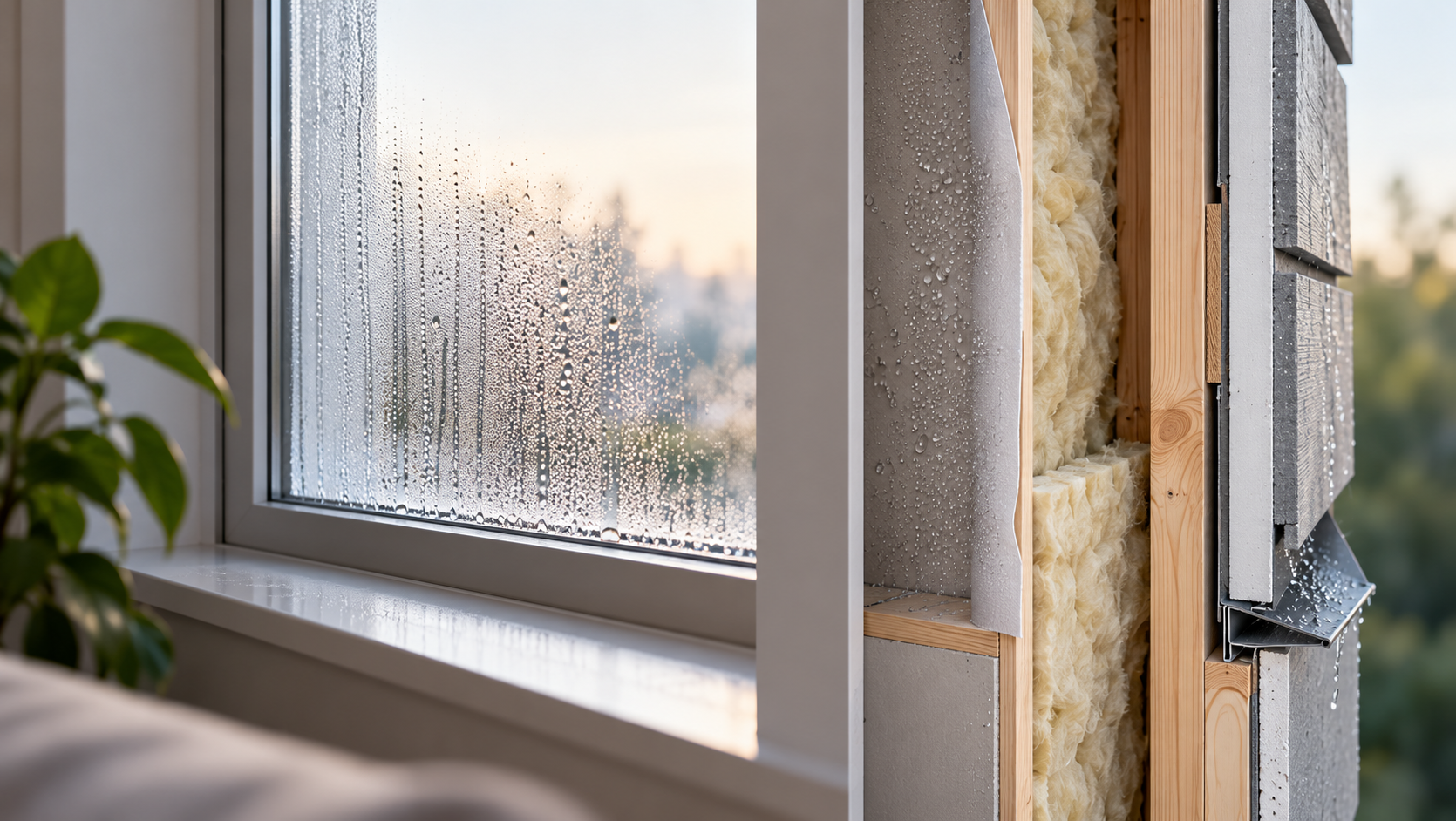


Moisture can move into and through a building envelope in more than one way. Two important mechanisms are vapour diffusion through materials and the transport of water vapour by moving air.
Although these mechanisms can contribute to moisture conditions within walls and roofs, they operate differently. Vapour diffusion depends on differences in water vapour pressure and the resistance of construction materials. Air leakage depends on air movement through gaps, joints and other unintended pathways.
For architects, building designers and project teams, understanding the distinction helps clarify why a membrane's vapour properties do not, by themselves, establish whether an assembly is airtight or adequately protected against moisture transported by air.
Vapour diffusion moves moisture through materials. Air leakage carries moisture with moving air. Controlling one mechanism does not automatically control the other.
In Brief
What Is the Difference Between Vapour Diffusion and Air Leakage?
Vapour diffusion is the movement of water vapour through materials in response to differences in vapour pressure. The amount transferred depends on the vapour resistance of the material, the pressure difference and other relevant conditions.
Air leakage occurs when air moves through unintended openings in the building envelope. That air can carry water vapour into or through concealed construction spaces.
Air movement requires a pressure difference and a connected pathway. Vapour diffusion does not require bulk airflow through an opening.
Both mechanisms may contribute to moisture risk, but neither guarantees that condensation will occur. The temperature conditions, moisture load, flow pathway and drying behaviour of the assembly must also be considered.
Technical and NCC note: This article distinguishes two moisture transport mechanisms and their implications for building envelope design. It does not prescribe a universal airtightness target, vapour-control membrane or condensation assessment method. Applicable NCC provisions depend on the relevant Code edition, jurisdiction, building classification and construction arrangement. Rainwater penetration and plumbing leaks are separate sources of liquid water and may require different investigation.
Vapour Diffusion vs Air Leakage: Key Differences
| Characteristic | Vapour diffusion | Air leakage |
|---|---|---|
| Transport mechanism | Water vapour diffuses through materials | Water vapour is carried by moving air |
| Driving force | Water vapour pressure difference | Air pressure difference |
| Pathway | Permeable material layers | Connected gaps, joints, cracks or penetrations |
| Primary control | Appropriate vapour resistance and layer arrangement | Continuous air control and sealed interfaces |
| Assessment consideration | Material properties and vapour pressure conditions | Airflow pathways, pressure conditions and leakage rates |
These mechanisms can occur simultaneously. A wall assembly may permit some vapour diffusion through its materials while also containing localised gaps that allow air movement.
How Does Vapour Diffusion Work Through Building Materials?
Water vapour can move through certain construction materials without air flowing through an opening. This process is known as vapour diffusion.
The movement is driven by differences in water vapour partial pressure. Vapour pressure is influenced by both temperature and humidity, so relative humidity alone does not establish the direction of diffusion.
Different construction materials resist diffusion to different degrees. Some membranes, linings and finishes permit relatively ready vapour movement, while others offer substantially greater resistance.
In a layered assembly, the combined vapour resistance of the materials affects how water vapour can move between the indoor and outdoor environments.
The direction and magnitude of vapour diffusion can also change with seasonal and operational conditions. It is therefore not appropriate to assume that water vapour always travels from inside to outside.
For detailed membrane classifications and climate-specific considerations, see Vapour Control Layers in Australian Climate Zones.
How Does Air Leakage Transport Moisture Into an Assembly?
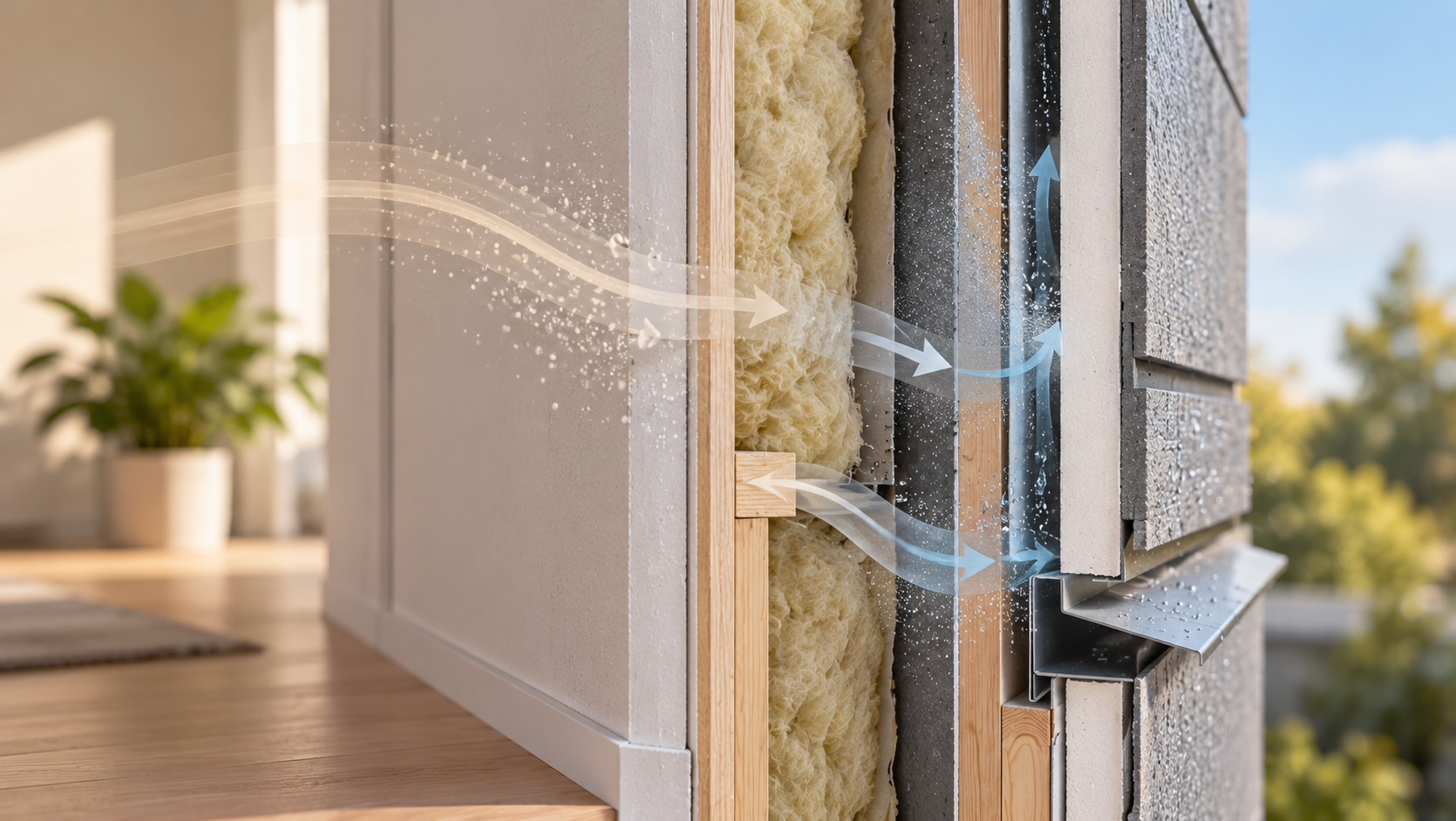
Air leakage is a different process. Rather than water vapour diffusing through a material, air itself moves through a connected opening.
That moving air contains water vapour. Where it passes into concealed construction, it can introduce moisture to locations that may experience different temperatures from the original air source.
Air movement may be driven by wind, mechanical systems or pressure differences associated with temperature and building height.
Potential pathways include:
- unsealed joints between lining boards;
- gaps at wall-to-ceiling interfaces;
- service penetrations through the air control layer;
- poorly sealed window and door interfaces;
- discontinuities around structural connections;
- unsealed roof and wall junctions; and
- other connected openings through the building envelope.
Not all air leakage will result in condensation. Air may pass through an assembly without reaching conditions that cause water vapour to condense, or the moisture may leave through another pathway.
The concern arises where the airflow pathway and local conditions allow moisture to accumulate at a vulnerable surface or within a moisture-sensitive material.
Can Air Leakage Carry More Moisture Than Vapour Diffusion?
Under some conditions, air movement through an opening can transport substantially more water vapour than diffusion through the surrounding material area.
However, there is no single universal ratio that describes the relative contribution of these mechanisms in every building.
The amount of moisture transported by air leakage depends on the opening, airflow rate, pressure conditions and moisture content of the moving air.
The amount transferred by diffusion depends on the material area, vapour resistance and vapour pressure difference.
Even where significant moisture is carried by moving air, only part of that moisture may condense or remain within the construction. The temperature and path of the airflow matter.
For design purposes, the important conclusion is that vapour resistance alone cannot be used as evidence that unintended airflow and associated moisture transport have been controlled.
Why Are Vapour Control and Air Control Different Functions?
A vapour control layer influences the diffusion of water vapour through an assembly. An air control layer restricts unintended movement of air through the building envelope.
One product may contribute to both functions, but only where its properties, installation and detailing are appropriate for each.
A material can have high vapour resistance yet fail to provide effective air control if joints, penetrations and edges are left unsealed.
Conversely, an appropriately detailed airtight layer may remain relatively vapour permeable.
This distinction is particularly important at junctions, where a membrane may be continuous across a wall area but interrupted by a window, floor edge or service penetration.
Effective building envelope coordination therefore considers both material properties and continuity of the relevant control layers, rather than assuming one characteristic provides all moisture protection.
How Can Both Mechanisms Affect the Same Wall?
Consider a framed external wall with internal plasterboard, cavity insulation, sheathing, a membrane and external cladding.
Water vapour may diffuse through the materials according to their vapour properties and the environmental conditions acting on the wall.
At the same time, an unsealed electrical penetration or discontinuity at a junction may allow air to move into the wall cavity when a suitable pressure difference exists.
The resulting moisture conditions are not necessarily the same. Diffusion may occur across a broad area of the assembly, while air leakage may create a more localised transport pathway.
If the moving air reaches a sufficiently cool concealed surface, condensation may occur. Whether moisture remains in the wall depends on the amount deposited, material properties and subsequent drying conditions.
This example illustrates why the wall should not be evaluated solely from the vapour classification of one membrane or the nominal insulation value.
Can the Direction of Moisture Movement Change With Climate?
Yes. Both the vapour pressure difference and the air pressure conditions acting on a building can change over time.
In cooler conditions, heated indoor spaces may have higher water vapour pressure than the exterior. This can support outward vapour diffusion through suitable materials.
In warm, humid conditions, particularly where the interior is mechanically cooled, the outdoor vapour pressure may be higher and inward diffusion may become relevant.
Air leakage direction is controlled by pressure differences rather than vapour pressure alone. Wind, mechanical ventilation and temperature-driven pressure effects can therefore produce inward or outward airflow under different circumstances.
These processes should not be assumed to operate in the same direction simply because they both involve water vapour.
Understanding the relevant climate and operating conditions helps establish which pathways require attention for a particular wall or roof assembly.
Does Hygrothermal Modelling Include Air Leakage?
Not automatically. The answer depends on the modelling method, software capabilities and assumptions used.
Many conventional one-dimensional hygrothermal assessments investigate heat and moisture movement through defined material layers, including vapour diffusion and other supported transport processes.
Unintended air leakage through gaps and construction defects may not be represented unless a suitable method explicitly incorporates the relevant airflow or moisture source.
This is an important limitation when interpreting results. A model showing acceptable diffusion-related moisture behaviour does not necessarily demonstrate that the construction will be unaffected by uncontrolled air leakage.
Where airflow is central to the concern, the project may require additional assessment of air pathways, detailing, pressure conditions or construction performance.
The relevant modelling assumptions should be clear so that the results are not interpreted as covering mechanisms outside the assessment scope.
What Should Architects Coordinate in Wall and Roof Details?
Understanding the two transport mechanisms helps identify which details need to be coordinated during building envelope design.
Relevant considerations include:
- identifying the intended air control layer;
- confirming continuity at walls, roofs and floor junctions;
- detailing penetrations and openings consistently;
- identifying the vapour properties of relevant membranes and linings;
- considering the position of insulation relative to other layers;
- recognising where a material performs more than one control function;
- coordinating installation requirements with the construction documentation; and
- reviewing changes that affect air control continuity or vapour resistance.
These are coordination considerations rather than a universal specification. The appropriate strategy depends on the building type, climate, assembly and relevant requirements.
For the broader relationship between moisture transport, assembly behaviour and condensation assessment, see Moisture & Condensation Risk Analysis.
Moisture Transport Review Checklist
- Identify the wall or roof assembly being considered.
- Confirm the complete material layer sequence.
- Identify relevant vapour-resistant and vapour-permeable layers.
- Establish the intended air control layer.
- Review continuity at penetrations, openings and junctions.
- Consider indoor and outdoor temperature and humidity conditions.
- Distinguish vapour pressure differences from air pressure differences.
- Identify potential unintended airflow pathways.
- Consider whether local temperatures could permit condensation.
- Review whether the assembly has suitable drying pathways.
- Confirm which transport mechanisms are included in any modelling.
- Record assumptions and limitations relevant to the assessment.
Frequently Asked Questions
Vapour Diffusion and Air Leakage FAQs
What is the difference between vapour diffusion and air leakage?
Vapour diffusion is water vapour movement through materials driven by a vapour pressure difference. Air leakage transports water vapour with air moving through unintended openings under an air pressure difference.
Can air leakage cause interstitial condensation?
Yes, where moisture-laden air reaches concealed surfaces or interfaces with conditions suitable for condensation. However, not every air leakage pathway results in condensation or moisture accumulation.
Is a vapour barrier the same as an air barrier?
No. Vapour control concerns diffusion through materials, while air control concerns unintended airflow. A product may perform both functions when its properties and installation are suitable, but the terms are not interchangeable.
Does water vapour always move from inside to outside?
No. Vapour diffusion direction depends on the vapour pressure difference, which can change with climate, season and indoor operating conditions. Airflow direction is governed by air pressure differences.
Does hygrothermal modelling account for air leakage?
Not necessarily. Conventional assembly modelling may represent diffusion and other material transport processes without explicitly modelling unintended airflow through gaps. The assessment scope and software assumptions should be checked.
Can a wall be airtight but still allow vapour diffusion?
Yes. A suitably continuous air control layer can restrict airflow while remaining relatively vapour permeable. Air permeability and water vapour permeance describe different properties.
Related Knowledge
Explore Related Building Envelope Guidance
Moisture & Condensation Risk Analysis
Explore how climate, materials and construction layers influence moisture behaviour within the building envelope.
Vapour Control Layers in Australian Climate Zones
Understand membrane vapour characteristics and their relationship with climate and assembly design.
Surface vs Interstitial Condensation
Compare visible condensation with moisture developing at concealed construction interfaces.
Condensation Risk in Roof and Ceiling Assemblies
Examine roof and ceiling configurations where moisture movement and construction details influence concealed conditions.
Moisture & Condensation Risk Analysis
Understand the Moisture Pathways Within Your Building Envelope
Where a proposed wall, roof or façade assembly raises questions about vapour movement or concealed moisture risk, Certified Energy can assist with project-specific moisture and condensation risk analysis. A clearly defined assessment scope helps distinguish the mechanisms being investigated and the limitations of the selected method.
Explore Moisture & Condensation Risk Analysis