


Residential Performance Verification
An unfavourable reference building comparison does not necessarily mean a residential design must be abandoned. It means the proposed building has not yet demonstrated compliance through the selected verification method.
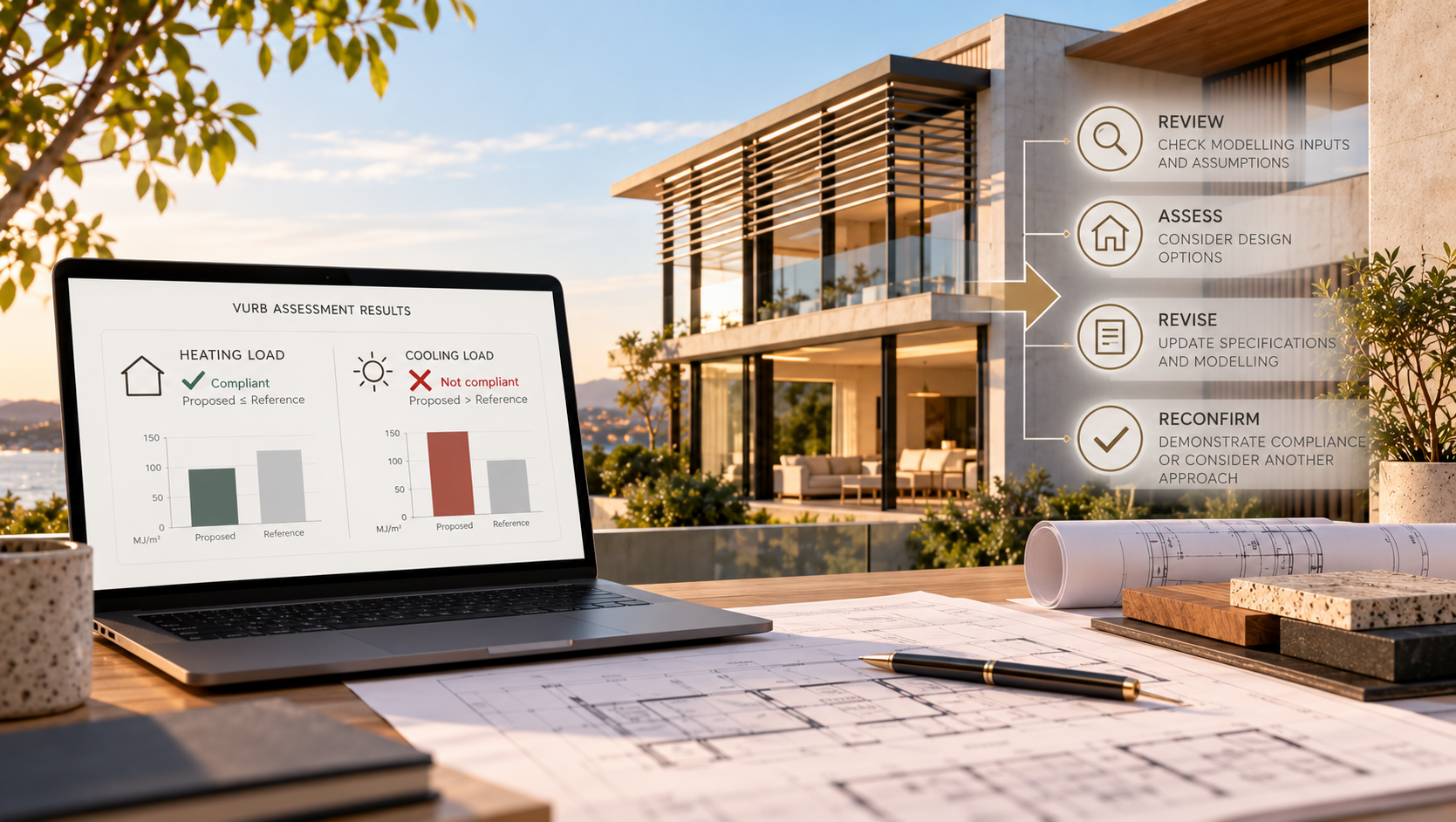
When a Verification Using a Reference Building (VURB) assessment does not satisfy the applicable heating or cooling load criteria, the next step is to understand the result before deciding how to respond. This may involve checking modelling inputs, reviewing the proposed specifications, considering design refinements or evaluating another appropriate compliance pathway.
In Brief
An Unfavourable VURB Result Requires Review, Not Assumptions
Under the national NCC 2022 H6V2 method, the proposed dwelling is compared with a compliant reference building using prescribed modelling conditions.
The required heating and cooling comparisons depend on the NCC climate zone. In climate zones 2 to 7, both loads must be no greater than the corresponding reference building values.
If a required comparison is not satisfied, H6V2 has not verified the proposed building's compliance with H6P1 on the assessed basis.
The appropriate response depends on the cause, the extent of the difference, the available design options and the compliance requirements applicable to the project.
Understanding the Outcome
What Does It Mean When a VURB Assessment Does Not Meet the Criteria?
An unfavourable VURB result means that one or more required thermal load comparisons have not been satisfied for the assessed design.
For example, a proposed building may have a heating load below its reference value but a cooling load above the corresponding reference value. Where both comparisons are required, the favourable heating result does not compensate for the cooling result.
The result should be distinguished from a broader conclusion that the project cannot comply with the NCC. It establishes that the current evidence does not demonstrate compliance through the relevant H6V2 comparison.
Further investigation may identify modelling issues, potential design improvements or another suitable way to demonstrate compliance. None of these outcomes should be presumed before the relevant assessment has been completed.
Performance Criteria
Which Heating and Cooling Comparisons Must Be Satisfied?
| NCC climate zone | Required H6V2 comparison |
|---|---|
| Climate zone 1 | Proposed cooling load must be equal to or less than the reference building cooling load. |
| Climate zones 2–7 | Both proposed heating and cooling loads must independently be equal to or less than their corresponding reference values. |
| Climate zone 8 | Proposed heating load must be equal to or less than the reference building heating load. |
These are the national NCC 2022 H6V2 criteria. Jurisdictional variations must be checked separately. A combined heating-and-cooling total cannot replace an individual comparison required by the method.
Initial Technical Review
What Should Be Checked Before Changing the Design?
The first response should be to confirm that the modelling comparison accurately represents the proposed building and the required reference building.
This includes checking whether the correct drawings and specifications were used, whether common model assumptions have been applied consistently and whether the reference building satisfies the prescribed Deemed-to-Satisfy provisions.
Particular attention may be needed where architectural revisions, glazing substitutions or construction specification changes occurred during the assessment.
An input correction is not a design optimisation measure. Its purpose is to establish an accurate and defensible comparison before considering whether the proposed dwelling itself needs to change.
Review Priorities
Four Areas to Investigate After an Unfavourable Result
01 — Model Inputs
Input Accuracy
Review the building geometry, window schedules, construction specifications and prescribed operating assumptions for accuracy and consistency.
02 — Reference Building
Benchmark Consistency
Confirm that the reference building uses the required compliant specifications and shares all characteristics prescribed as common to both models.
03 — Thermal Drivers
Heating or Cooling Demand
Identify which required load exceeds its reference value and investigate the modelled characteristics contributing to that outcome.
04 — Compliance Requirements
Retained Obligations
Check the direct insulation, thermal break, floor edge insulation and building sealing provisions that remain applicable under H6V2.
Potential Design Responses
What Design Changes Might Be Considered?
Where the original model is accurate but does not satisfy the required comparison, the project team may investigate changes to the proposed building's thermal characteristics.
Potential measures include alternative glazing specifications, external solar control, improvements to relevant construction assemblies or other adjustments supported by the modelling results.
The appropriate response depends on whether heating demand, cooling demand or both are contributing to the unfavourable outcome. A measure that reduces cooling demand may also affect useful winter solar gains, and the reverse may apply.
These options should be treated as matters for investigation, not guaranteed remedies. Any revised design must be reassessed against the applicable comparison and retained compliance requirements.
Assessment Response
Matching the Review to the Result
| Assessment finding | What it indicates | Appropriate next consideration |
|---|---|---|
| Cooling load exceeds the reference value | The cooling comparison has not been satisfied where required | Review model accuracy and the design characteristics contributing to cooling demand |
| Heating load exceeds the reference value | The heating comparison has not been satisfied where required | Review heat loss, useful solar gains and relevant construction specifications |
| Both required loads exceed their reference values | Neither comparison is satisfied | Investigate the broader thermal response and evaluate coordinated design options |
| Model inputs do not match the drawings | The calculation may not accurately represent the proposed building | Correct the relevant inputs and repeat the affected comparison |
| A retained direct requirement is not satisfied | A separate condition of H6V2 remains outstanding | Address the applicable requirement directly rather than relying on a favourable load result |
This table outlines practical assessment considerations. It does not prescribe a particular design remedy or guarantee a compliant outcome.
Reference Building Integrity
Can the Reference Building Be Adjusted to Improve the Comparison?
The reference building cannot be modified arbitrarily to produce a more favourable benchmark.
Under H6V2, the reference building must satisfy the relevant Deemed-to-Satisfy provisions and share prescribed characteristics with the proposed building. These include orientation, floor plan, glazing location and size, and other specified inputs.
If a genuine design revision changes a characteristic that must be common to both models, the reference building may also need to be updated. That is different from selectively weakening the benchmark to achieve a passing result.
A defensible assessment must maintain the prescribed relationship between the proposed building and its reference building throughout the modelling process.
Compliance Pathway Review
What if the Proposed Design Still Does Not Meet H6V2?
If the proposed design continues to exceed the applicable reference building load after an appropriate review, H6V2 has not demonstrated compliance on that basis.
The project team may need to consider further design changes or review whether another compliance approach is available and appropriate for the project.
The NCC provides different ways of demonstrating compliance with Performance Requirements, including Deemed-to-Satisfy Solutions and Performance Solutions assessed using appropriate Assessment Methods.
However, an unsuccessful H6V2 comparison does not itself establish compliance through another pathway. Any alternative must independently satisfy the applicable regulatory requirements and be supported by suitable evidence.
For the broader distinction between approaches, see VURB vs DTS: Understanding the Reference Building Pathway.
Assessment Documentation
How Should the Revised Assessment Be Documented?
Where modelling inputs or design specifications are revised, the technical record should make clear which design version has been assessed and which assumptions support the final comparison.
This may include revised architectural drawings, updated glazing or construction schedules, model input records and the resulting heating and cooling load comparisons.
A previous unsuccessful result should not be presented as evidence of compliance. Equally, a revised result should not be relied upon until the relevant criteria and additional requirements have been checked.
The extent of reporting and any required approval documentation depend on the applicable Performance Solution process, project stage and regulatory authority.
Practical Next Steps
A Structured Response to an Unfavourable VURB Result
01 — Confirm the Applicable Criterion
Identify which heating or cooling comparison is required for the relevant climate zone and which criterion has not been met.
02 — Validate the Modelling Basis
Review the calculation method, common assumptions, reference building construction and current project inputs.
03 — Investigate the Thermal Drivers
Determine which aspects of the proposed building contribute to the unfavourable comparison.
04 — Evaluate Appropriate Options
Consider supportable design changes or another applicable compliance pathway without assuming either will achieve compliance.
05 — Reassess and Document the Outcome
Undertake the necessary reassessment and ensure the final technical evidence aligns with the design being submitted or constructed.
This is a practical review framework, not a separately prescribed five-step NCC procedure.
Frequently Asked Questions
VURB Assessment Outcome Questions
What happens if a VURB assessment fails?
If a required heating or cooling comparison is not satisfied, the assessed design has not demonstrated compliance through H6V2. The project team should review the modelling basis and consider whether further assessment, design changes or another appropriate compliance approach is needed.
Can a VURB assessment pass heating but fail cooling?
Yes. Heating and cooling loads are assessed separately where required. In national NCC 2022 climate zones 2 to 7, both loads must be equal to or less than their corresponding reference building values.
Can better glazing improve an unsuccessful VURB result?
Potentially. Different glazing U-values and solar heat gain coefficients can influence heating and cooling loads. The effect depends on the design and climate, and any revised specification must be evaluated through the applicable modelling method.
Can excess cooling demand be offset by better heating performance?
Not where both individual comparisons are required. In climate zones 2 to 7, a favourable heating result does not compensate for a cooling load that exceeds its reference building value.
Does an unsuccessful VURB assessment mean the home cannot be approved?
Not necessarily. It means compliance has not been demonstrated through the assessed H6V2 comparison. The project may require design revisions or another appropriate compliance approach, subject to the applicable NCC and approval requirements.
Can the reference building specifications be weakened to obtain a passing result?
No. The reference building must comply with the prescribed Deemed-to-Satisfy provisions and use the common assumptions required by H6V2. It cannot be selectively altered to make the comparison easier.
Does H6V2 apply to residential projects in NSW?
No. H6V2 does not apply under the NSW variation to NCC 2022 Volume Two. NSW residential projects must follow the applicable BASIX, NSW NCC and approval requirements.
Related Guidance
Continue Exploring VURB Assessment and Compliance
Knowledge Hub
VURB Assessment and Reference Building Compliance
Explore the wider verification method and residential compliance framework.
Thermal Modelling
Heating and Cooling Load Modelling
Understand how the proposed and reference building loads are calculated and compared.
Design Response
Glazing and Shading in VURB Assessments
Explore how glazing properties and external solar control influence thermal performance.
Design Revisions
Design Changes During a VURB Assessment
Learn when revised drawings or specifications may require model updates.
Residential Performance Review
Need to Understand an Unfavourable VURB Assessment Result?
Share your project location, current drawings and available assessment results. Certified Energy can review the applicable compliance requirements and advise on appropriate technical next steps for your residential project.
Explore VURB Assessment ServicesLast reviewed: October 2026. This article discusses the national H6V2 Verification Method under NCC 2022 Volume Two. Applicable NCC editions, jurisdictional variations and project-specific approval requirements must be confirmed. Part of the Certified Energy Residential Compliance Knowledge Hub.