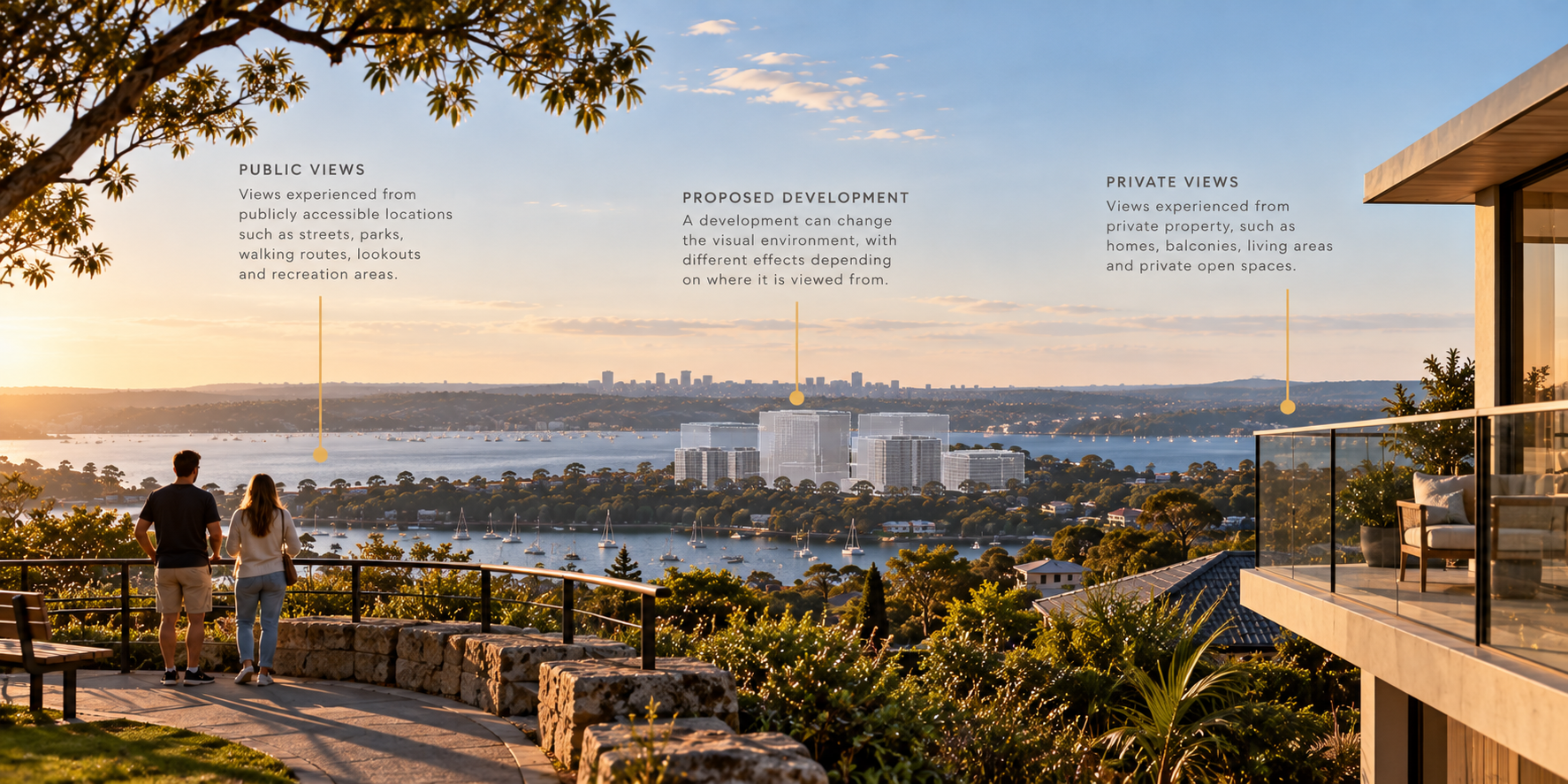


Visual Impact Assessment
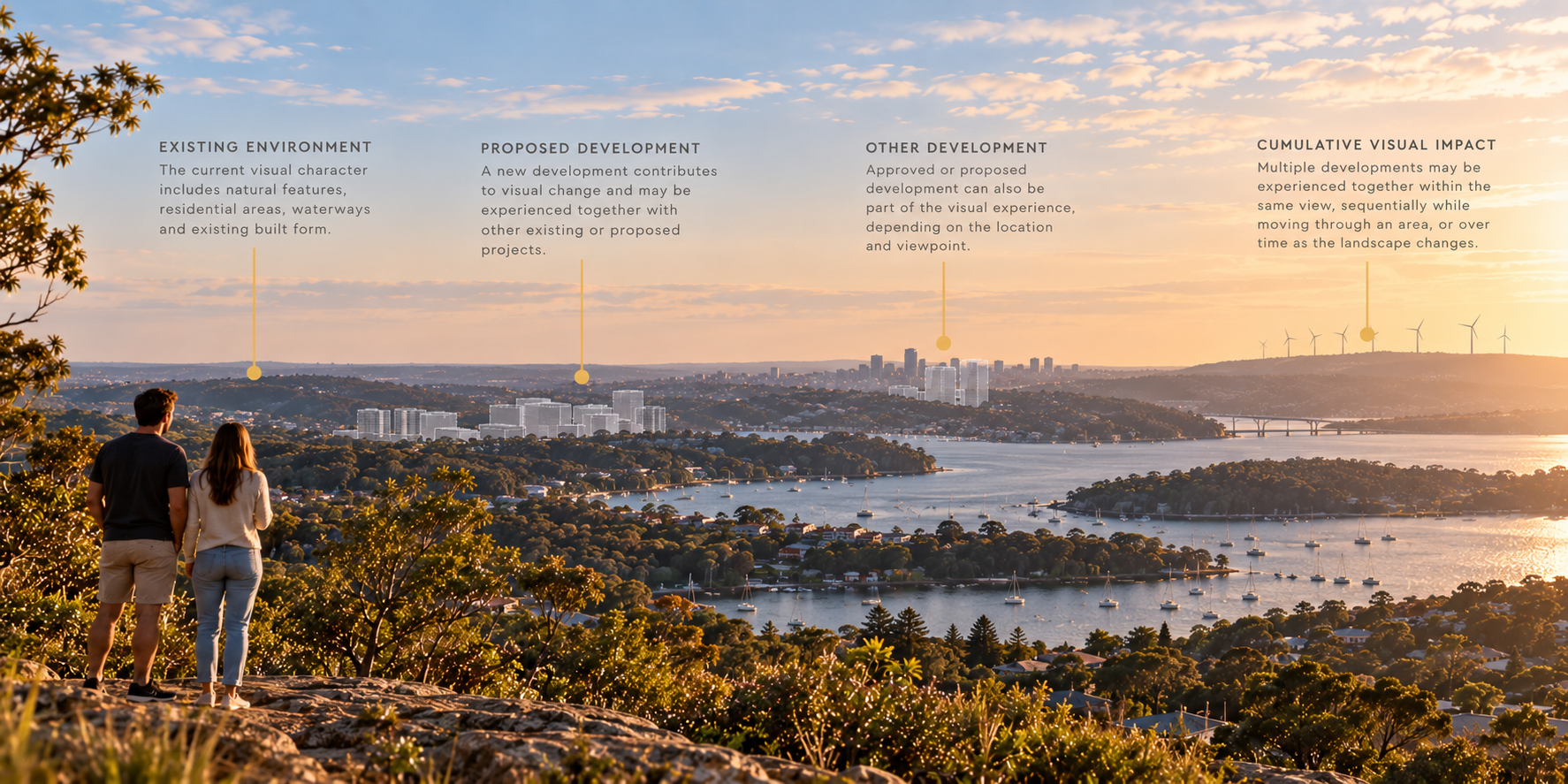
A development may not be the only change occurring within a landscape or visual environment. Where other relevant developments are existing, approved or proposed, a Visual Impact Assessment may need to consider how those changes interact rather than viewing each project entirely in isolation.
In Brief
Cumulative visual impact considers how a proposed development may contribute to visual change when experienced together with other relevant development or change. This may occur when several developments are experienced within the same view, when a viewer turns between different developments, or when different developments are encountered sequentially while moving through an area. The appropriate scope and assessment method depend on the project, planning requirements and applicable methodology.
What does cumulative visual impact mean?
A Visual Impact Assessment usually considers how a proposed development could change the visual environment experienced by relevant receptors. In some circumstances, however, that proposal forms only one part of a wider pattern of development or change.
Cumulative visual impact considers the visual effect that may arise when the proposal is experienced in combination with other relevant developments. The assessment is therefore concerned not simply with the appearance of one project, but with how multiple changes may interact within people's visual experience of a place.
Which developments need to be included, and how their cumulative effects should be assessed, depends on the applicable planning framework, project type and assessment methodology.
How is cumulative visual impact different from the impact of one development?
An assessment of an individual development asks how that proposal changes an existing visual condition. A cumulative assessment introduces another question: how does that change interact with other relevant development?
A project that produces a particular visual effect when considered alone may be experienced differently where similar or contrasting development is already present, approved or proposed nearby.
The cumulative question is therefore not simply whether other development exists. It is whether the relationship between relevant developments creates an additional or combined visual effect that should be considered within the assessment.
This distinction is important because cumulative effects may relate to a single viewpoint, a wider sequence of views or the repeated experience of development across an area.
Cumulative visual impact is not simply the number of developments that can be seen. It concerns how multiple developments or changes combine within the visual experience of a place.
Can cumulative effects occur within the same view?
Yes. One of the clearest forms of cumulative visual change occurs when two or more developments can be experienced from the same viewpoint.
Several developments may appear within the same field of view, allowing the viewer to experience them together. In other situations, developments may be visible from the same location but in different directions, requiring the viewer to turn to experience each one.
The visual relationship between those developments may then become relevant. Their apparent scale, separation, form, contrast and relationship with the surrounding visual environment can influence the nature of the combined experience.
The presence of several visible developments does not, by itself, determine the significance of the cumulative visual effect.
Can developments create cumulative effects if they are not visible at the same time?
Yes. Cumulative visual effects are not necessarily limited to developments that appear together within one view.
A person travelling along a road, walking route, railway or other movement corridor may encounter one development and then another as they move through the landscape. In this situation, the developments can form part of a sequence of visual experiences even though they are not visible simultaneously.
Depending on the applicable methodology, matters such as the frequency of these views, the distance between them, the duration of exposure and the nature of the visual change may be relevant to understanding the cumulative experience.
This means cumulative visual assessment can sometimes extend beyond a collection of static viewpoints and consider how visual change is experienced through movement.
What are combined, successive and sequential visual effects?
Cumulative visual assessment methodologies may distinguish between different ways multiple developments are experienced. The terminology and definitions can vary between methodologies, but several concepts are commonly useful.
Combined or simultaneous views occur where multiple developments can be experienced together from a viewpoint.
Successive views can occur where several developments are visible from the same general location but the viewer needs to turn or look in different directions to experience them.
Sequential views can occur where different developments are experienced one after another as a receptor moves through an area.
These concepts help describe how cumulative change is experienced, but the terminology and assessment method used for a particular project should follow the relevant guidance rather than being treated as a universal classification system.
Which other developments should be considered?
A cumulative visual assessment does not necessarily require every development within a broad surrounding area to be assessed in the same level of detail.
The scope should identify developments that are relevant to the potential cumulative visual effects of the proposal. Depending on the applicable framework, this may include existing development and particular approved or proposed projects.
Relevance may depend on matters such as location, potential visibility, project status, the visual relationship between developments and the receptors or viewpoints being assessed.
For projects subject to specific cumulative impact requirements, the relevant planning guidance may establish how other projects are identified and which development scenarios need to be considered.
Does cumulative visual impact only apply to wind and solar projects?
No. Cumulative visual effects are particularly prominent in guidance for some large-scale infrastructure and renewable energy projects, where several developments may occur within a shared landscape. The underlying issue, however, is broader than a particular development type.
Other forms of development can also contribute to cumulative visual change where multiple projects interact within relevant views or visual environments.
What differs is the assessment framework. Some project types have specific guidance or tools for cumulative visual assessment, while other projects may require a more project-specific approach.
A methodology developed for one development type should therefore not automatically be applied as a universal rule to every Visual Impact Assessment.
Does seeing several developments automatically mean high cumulative visual impact?
No. The number of developments visible from a location is only part of the visual context.
Multiple developments may be visually separated, screened, distant or experienced within a visual environment already characterised by similar forms of development. In another setting, an additional development may create a more noticeable change in the composition or experience of the view.
The assessment therefore needs to consider how the developments interact visually rather than treating cumulative impact as a simple count.
As with other aspects of VIA, the significance or rating assigned to cumulative effects depends on the methodology and project context being applied.
How do viewpoints help assess cumulative visual effects?
Representative viewpoints can help establish where relevant developments may be experienced together and what their relationship looks like from the perspective of a visual receptor.
For cumulative assessment, a useful viewpoint may need to reveal more than the proposed development alone. It may also need to show the relationship between the proposal, other relevant development and the surrounding visual context.
Where sequential effects are relevant, assessment may also need to consider how views change along a route rather than relying solely on one fixed viewing location.
For the broader principles behind viewpoint selection, see How Are Viewpoints Selected for a Visual Impact Assessment?
Can photomontages show cumulative visual change?
Photomontages and other visualisations can sometimes help communicate how a proposal may be experienced alongside other relevant development from a defined viewpoint.
They may be particularly useful where the relationship between developments is difficult to understand from plans or written descriptions alone. Depending on the assessment, visual material may illustrate an existing condition, the proposal itself and a relevant cumulative development scenario.
The visualisation still needs to be appropriate to the assessment question and prepared in accordance with any applicable methodology. A compelling image is not automatically reliable visual evidence.
See When Are Photomontages Used in a Visual Impact Assessment? for their role within VIA.
For evidence quality, see What Makes a Photomontage Reliable for Visual Impact Assessment?
How do visual receptors experience cumulative change?
Cumulative visual effects are ultimately experienced by people. The same collection of developments can therefore create different visual experiences for different receptor groups and locations.
A resident may repeatedly experience several developments from a particular location. A road user may encounter them intermittently along a route. A recreational user may experience them from a series of viewpoints while moving through a landscape.
Understanding the receptor and the circumstances of viewing helps explain how cumulative change is actually experienced rather than treating all visibility as equivalent.
For more on the people represented within visual assessment, see What Is a Visual Receptor in a Visual Impact Assessment?
Can cumulative development change visual amenity?
Yes. Where multiple developments alter the visual environment experienced by people, the cumulative change may be relevant to visual amenity.
The important distinction is that visual amenity describes the quality and experience of the visual environment, while cumulative visual impact describes how multiple relevant changes may interact within that experience.
A cumulative assessment therefore does not replace consideration of receptors, viewpoints, sensitivity or visual amenity. It provides another layer for understanding the proposed development within its wider visual context.
See What Is Visual Amenity in a Visual Impact Assessment? for the distinction in more detail.
How is cumulative visual impact considered within a VIA?
Where cumulative visual effects are relevant, the VIA may need to identify the other developments to be considered, establish appropriate receptors and viewpoints, describe how the developments may be experienced together or sequentially and assess the resulting visual change using the applicable methodology.
For some project types, specific planning guidance establishes detailed cumulative assessment methods. For others, the scope may be determined through project-specific planning requirements and professional assessment.
The objective is not simply to catalogue nearby development. It is to understand whether the proposed project contributes to a broader visual effect that is relevant to the people, views and visual environment being assessed.
This allows cumulative visual change to be considered as part of the wider Visual Impact Assessment rather than as an isolated count of visible projects.
Continue Reading
Visibility does not automatically mean visual impact
A development being visible is only part of the assessment question. Learn why visibility and visual impact describe different aspects of visual change.
Understand the difference →Visual Impact Assessment
Could other development contribute to your project's visual impact?
The need for cumulative visual assessment depends on the project, surrounding development, planning pathway and applicable assessment requirements.
Send us your plans and available project information. We can review the documentation and help identify the appropriate visual assessment scope.
Start Your Project