

Visual Impact Assessment
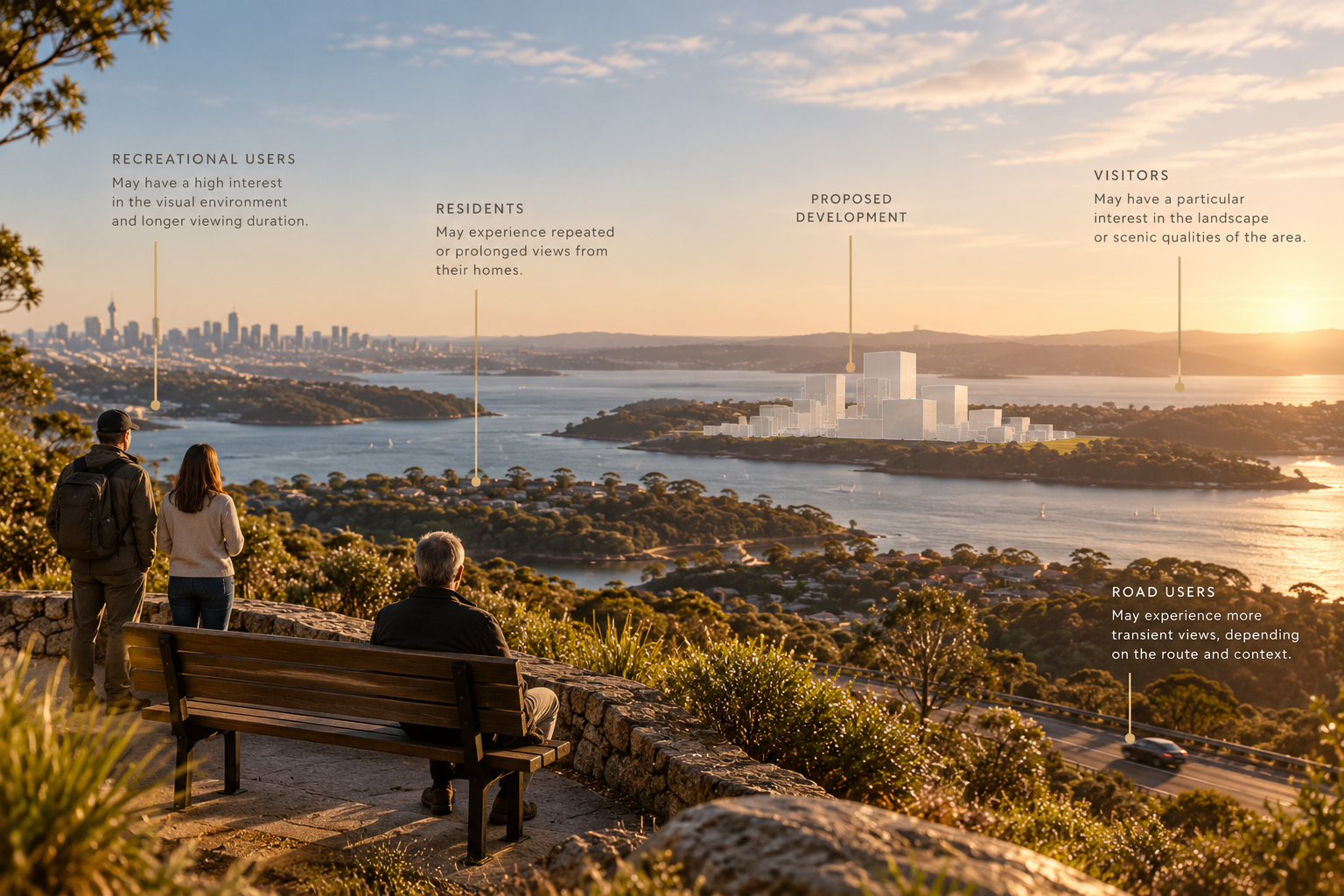
Two people can experience the same proposed development from different locations and under very different viewing circumstances. Visual sensitivity helps an assessment consider how susceptible a particular view, viewpoint or visual receptor may be to that proposed visual change.
In Brief
Visual sensitivity describes how susceptible a particular view, viewpoint or visual receptor may be to a proposed visual change. Depending on the assessment methodology, this may consider who experiences the view, their relationship to the visual environment, the nature and duration of the viewing experience, scenic quality and other project-specific circumstances. Sensitivity is different from the magnitude of visual change created by the proposal and does not, by itself, determine the resulting visual impact.
What does visual sensitivity mean?
Within a Visual Impact Assessment, it is not enough simply to establish that a proposed development may be seen. The assessment also needs to understand the circumstances in which visual change may be experienced.
Visual sensitivity is one way assessment methodologies address this. Depending on the methodology being used, sensitivity may relate to the visual receptor, the viewpoint or view being assessed, the quality or value of the visual setting, or a combination of these considerations.
For that reason, visual sensitivity should not be treated as a single fixed characteristic that can be assigned in the same way to every project. Its meaning and assessment need to be understood within the methodology, project type and planning context being applied.
Visual sensitivity is not simply personal preference
Visual sensitivity does not simply ask whether an individual likes or dislikes the appearance of a proposed development.
People can have different personal reactions to the same building, structure or landscape change. A formal visual assessment needs a more structured basis for considering sensitivity than individual aesthetic preference alone.
Depending on the applicable methodology, the assessment may instead consider matters such as the type of receptor, the reason a person is at a particular location, their relationship to the visual environment, the duration or frequency of the viewing experience and the qualities of the view or setting itself.
This provides a more consistent way of understanding susceptibility to visual change without treating visual impact as a simple question of taste.
What can influence visual sensitivity?
There is no single list of sensitivity factors that applies identically to every Visual Impact Assessment. Different guidance and project methodologies can structure the assessment in different ways.
Depending on the project, relevant considerations may include the type of visual receptor, the purpose or activity associated with the location, the receptor's relationship to or interest in the visual environment, the duration and frequency of the view, the direction or circumstances of viewing and the scenic quality or value attributed to the visual setting.
The same physical location can also support different viewing experiences. Someone living beside a site, a visitor stopping at a lookout and a person travelling through the area may each experience the surrounding visual environment differently.
Sensitivity therefore needs to be considered in relation to the receptor, view and project rather than inferred from location alone.
Visual sensitivity helps describe the susceptibility or importance of the visual experience being affected. It does not, by itself, determine the visual impact of a proposal.
How does the type of visual receptor matter?
A visual receptor is a person or group of people who may experience a change in a view or visual environment. Understanding who those people are can provide important context for considering sensitivity.
Residents, recreational users, visitors, workers and people travelling through an area do not necessarily engage with their surroundings in the same way. Some may experience a view repeatedly or for extended periods, while others may encounter it briefly or while focused primarily on another activity.
This does not mean that receptor type alone determines a sensitivity rating. It provides part of the context needed to understand the nature of the viewing experience.
The assessment methodology then determines how that information should be considered for the particular project.
Are residents always highly sensitive visual receptors?
Residential receptors may be treated as relatively sensitive in some visual assessment methodologies because people can experience repeated or prolonged views from their homes and may have a strong relationship with their immediate visual environment.
That does not establish a universal rule that every resident or residential viewpoint must receive the same sensitivity rating. The circumstances of the view, the nature of the residential setting and the methodology being applied remain relevant.
A residence may also contain several different viewing conditions. A principal living area, a garden, an access road and a secondary window do not necessarily provide the same visual experience simply because they belong to the same property.
The appropriate assessment therefore depends on the relevant receptors and views rather than the residential land use label alone.
Are road users always less sensitive?
No. Road users should not automatically be treated as low-sensitivity receptors simply because they are moving through an area.
The visual experience can vary according to the type of route, purpose of travel, speed and duration of the view, the level of attention directed towards the surroundings and the visual character of the journey. A scenic or recreational route, for example, may involve a different relationship with the surrounding environment from an everyday journey where visual attention is limited.
Different methodologies may also classify road and transport receptors differently. This is another reason not to apply a generic sensitivity rating without considering the framework used for the assessment.
The important question is not simply whether a receptor is travelling, but what kind of visual experience is relevant to the particular location and proposal.
What role does scenic quality play?
Some visual assessment methodologies consider the scenic quality, value or importance of the visual setting when determining sensitivity. This recognises that the characteristics of the view itself can be relevant alongside the circumstances of the people experiencing it.
A view does not need to be an iconic landscape to form part of a visual assessment. Equally, describing a setting as scenic does not automatically establish the final level of visual impact. The importance given to scenic quality depends on the applicable methodology and project context.
This distinction is particularly important because visual sensitivity and landscape visibility are not interchangeable concepts. Sensitivity helps inform how a visual experience may respond to change; it does not replace separate analysis of landscape, skyline or geographic visibility where those matters are relevant.
Within a VIA, scenic quality is therefore best understood as one possible consideration within the wider assessment framework rather than as a stand-alone measure of impact.
Is visual sensitivity the same as visual impact?
No. Visual sensitivity is one consideration that may contribute to the assessment of visual effects, but it is not the final visual impact itself.
A sensitive receptor or view does not automatically mean that every visible proposal will result in a high visual impact. The development may create only a limited visual change. Conversely, a substantial change in a view does not tell us everything about the sensitivity of the people or visual setting affected.
This is similar to the distinction between visibility and visual impact. Establishing one characteristic of the visual relationship does not, by itself, determine the assessment outcome.
How sensitivity contributes to the evaluation of visual effects depends on the methodology applicable to the project.
How is sensitivity different from magnitude of visual change?
Sensitivity and magnitude answer different questions within visual assessment.
Visual sensitivity concerns the susceptibility or importance of the visual experience that may be affected. It considers the receptor, view or visual setting in accordance with the assessment methodology.
Magnitude of visual change concerns the change created by the proposal — its nature, scale or extent within the relevant view.
Keeping these concepts separate is important. A project should not be described as having high sensitivity simply because it creates a large visual change, just as a highly sensitive receptor does not tell us how substantial the proposed visual change will be.
Assessment methodologies may bring sensitivity and magnitude together when evaluating visual effects, but the way this is done can differ between project types and guidance. There is no single rating matrix that should be assumed to apply to every Australian Visual Impact Assessment.
Why does visual sensitivity need to be project-specific?
Visual Impact Assessments can be prepared for very different types and scales of development and under different planning frameworks. The methodology appropriate to one project should not automatically be transferred to another without considering the applicable requirements.
Project type, jurisdiction, planning pathway, applicable guidance and project-specific assessment requirements can all influence how visual sensitivity is defined and evaluated.
For this reason, labels such as high, moderate or low sensitivity are most useful when their basis is explained. A rating without a clear relationship to the relevant receptor, view and methodology provides little information about why that sensitivity has been assigned.
A well-structured assessment makes that reasoning visible: who or what is being considered, what characteristics influence sensitivity and how those considerations fit within the methodology used for the project.
Continue Reading
What is a visual receptor in a Visual Impact Assessment?
Visual sensitivity depends partly on understanding who may experience a visual change and the circumstances in which that experience occurs. Start with the role of visual receptors within a VIA.
Understand visual receptors →Visual Impact Assessment
Need to understand the potential visual effects of your project?
The appropriate approach to visual sensitivity depends on the proposal, visual setting, relevant receptors and the assessment methodology applicable to the project.
Send us your available plans and project information. We can review the documentation and help identify the appropriate visual assessment pathway and scope.
Start Your Project