

Embodied Carbon Hotspots
Which Construction Materials Have the Highest Embodied Carbon?
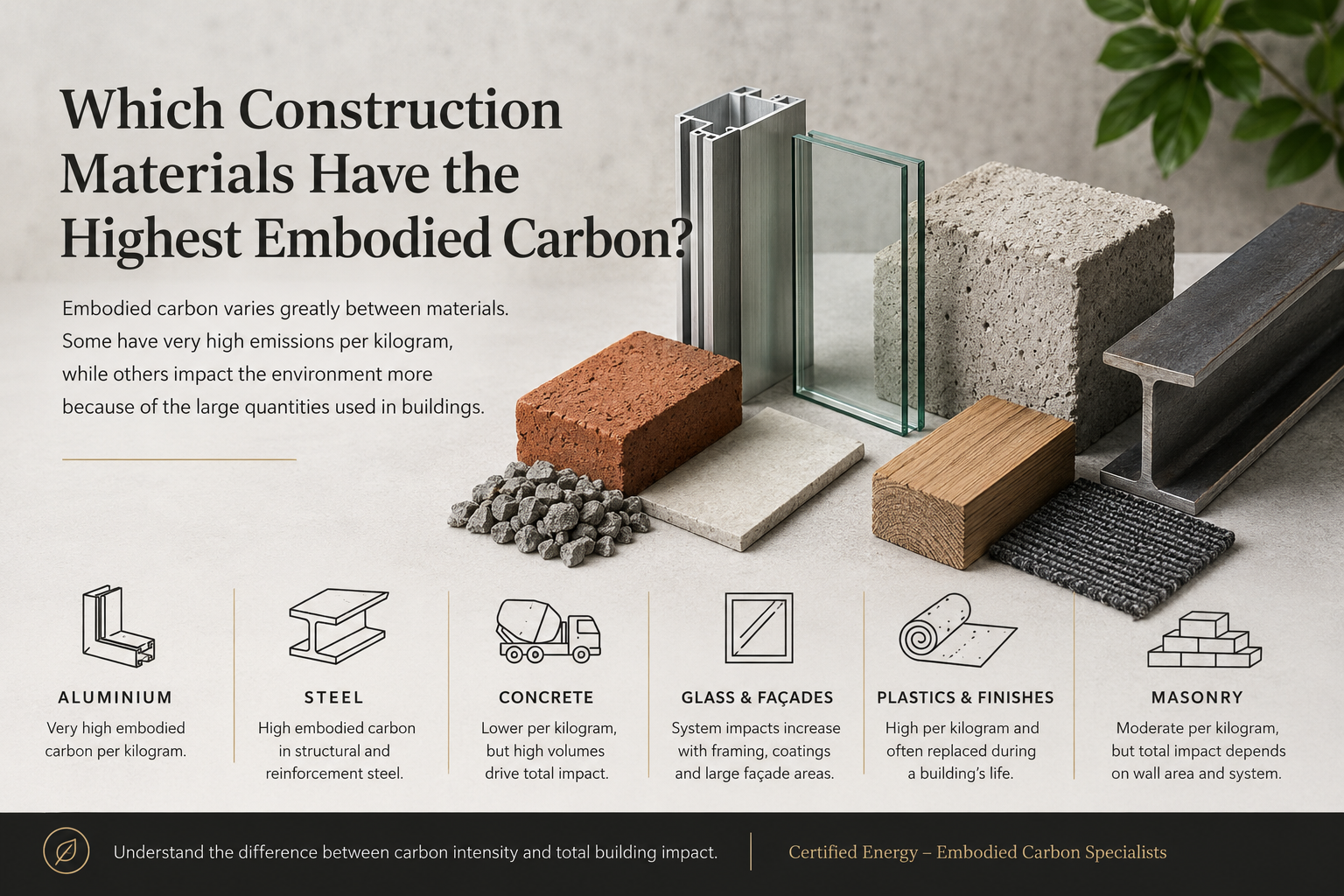
Some materials have high embodied carbon per kilogram. Others create a larger total impact because they are used across large areas or volumes of a building.
Asking which construction material has the highest embodied carbon can produce two different answers. One material may have a high carbon intensity per kilogram, while another may create a larger total impact because thousands of tonnes or cubic metres are used across the building.
Among common building products, aluminium can have one of the highest impacts per kilogram. Structural steel, reinforcing steel and stainless steel are also carbon intensive compared with concrete or masonry. However, concrete frequently becomes one of the largest whole building contributors because it is used throughout slabs, footings, columns, walls and cores.
Complex façade systems can become significant hotspots as well. A curtain wall may combine aluminium, glass, coatings, spandrels, fixings and support systems across a large external area. The useful question is therefore not simply which material has the highest number. It is which materials and systems create the largest impact in the actual project.
In Brief
Highest embodied carbon can mean three different things.
Highest per kilogram
Extruded aluminium, aluminium sheeting, some plastics, carpet and specialist metals can have high material level carbon intensity.
Highest by quantity
Concrete, reinforcement and structural steel can dominate because large quantities are required to construct the building.
Highest as a system
Façades, structures, services and repeated fitout systems combine several materials over substantial areas or volumes.
Essential Distinction
Carbon Intensity Is Not the Same as Total Building Impact
Material Intensity
How much carbon per unit?
This may be expressed as kilograms of carbon dioxide equivalent per kilogram, tonne, cubic metre, square metre or complete component.
Project Contribution
How much is actually used?
Total contribution is calculated by applying the relevant emissions factor to the actual project quantity and assessment scope.
Aluminium may be much higher per kilogram. Concrete may still produce the larger total because the building uses far more of it.
Indicative Example
One Tonne of Steel Has a Higher Default Factor Than One Tonne of Concrete
Hot rolled structural steel
3,910 kg CO₂e
NABERS default A1 to A3 factor per tonne.
25 to 32 MPa in situ concrete
195 kg CO₂e
NABERS default A1 to A3 factor per tonne.
This does not mean steel should always be replaced with concrete. The materials perform different functions and may require very different quantities. Steel can enable long spans or lightweight systems, while concrete can require substantial volumes. A credible comparison must assess functionally equivalent structural options.
Indicative Australian Factors
Which Common Materials Have High Embodied Carbon per Kilogram?
The following figures use default uncertainty adjusted emission factors from the NABERS National Material Emission Factors Database v2026.1. They cover product stage modules A1 to A3 and provide an indicative Australian comparison where suitable product specific information is unavailable.
| Material category | Indicative default factor | Project interpretation |
|---|---|---|
| Extruded aluminium | 30.2 to 34.2 kg CO₂e/kg | Among the highest common building product factors. Coating and finishing affect the result. |
| Aluminium sheeting | 20.8 kg CO₂e/kg | Can become significant across roofing, cladding and façade systems. |
| Carpet flooring | 13.3 kg CO₂e/kg | High per kilogram and potentially replaced several times during a commercial building’s life. |
| Plastic sheeting | 11.5 kg CO₂e/kg | High material intensity, although quantities may be lower than major structural materials. |
| Stainless steel | 5.99 kg CO₂e/kg | Higher than general structural steel, but often selected for durability or specialist exposure conditions. |
| Structural steel | 3.91 to 4.34 kg CO₂e/kg | Product type, galvanising, painting, production route and quantity can materially affect the result. |
| Reinforcing steel | 3.65 kg CO₂e/kg | Often combined with high volumes of concrete across slabs, foundations, walls and cores. |
| Glass | 2.38 kg CO₂e/kg | Becomes more important when large glazing areas, multiple panes, coatings and support systems are used. |
| Clay brick | 0.464 kg CO₂e/kg | Lower per kilogram than metals, but wall area, firing process, mortar and transport still matter. |
| In situ concrete | 0.114 to 0.325 kg CO₂e/kg | Relatively low per kilogram, but often one of the largest total contributors because of project volume. |
Data Note
These are indicative default values, not universal product values or a specification ranking. They exclude transport to site and construction stage impacts. Product specific Environmental Product Declarations may show materially different results. Review the NABERS National Material Emission Factors Database for the current source and methodology.
High Carbon Intensity
Aluminium Can Be One of the Highest Carbon Common Building Materials per Kilogram
Aluminium production can require substantial energy, particularly where primary aluminium is produced using emissions intensive electricity. Current NABERS default factors place aluminium sheeting at 20.8 kg CO₂e per kilogram and extruded aluminium between 30.2 and 34.2 kg CO₂e per kilogram, depending on the finish.
Buildings use aluminium in window frames, curtain walls, façade panels, sunshades, louvres, roofing, balustrades, ceilings and architectural details. A small aluminium component may have a limited project impact, but repeated framing or cladding across an entire façade can become significant.
Recycled content, manufacturing energy, extrusion efficiency, coating, durability and product quantity all influence the result. Project teams should request a suitable product specific EPD rather than assuming all aluminium products have the same carbon intensity.
Structural Hotspot
Steel Combines Relatively High Intensity With Significant Structural Quantities
Steel is commonly used in structural frames, reinforcement, long span roofs, façade supports, metal decking, lightweight framing and specialist building components. Its embodied carbon depends on the production route, recycled content, energy source, grade, coating, fabrication and quantity.
The NABERS default factor for reinforcing steel is 3.65 kg CO₂e per kilogram. General structural steel ranges from 3.91 kg CO₂e per kilogram for hot rolled sections to 4.34 kg CO₂e per kilogram for painted structural sections. Stainless steel is higher again at 5.99 kg CO₂e per kilogram.
Steel can also provide material efficiency. Long spans, prefabrication, adaptability and high structural strength may reduce other materials or enable a lighter system. The objective is not to remove steel indiscriminately, but to avoid unnecessary mass, over specification and inefficient structural layouts.
High Volume Hotspot
Concrete Often Has High Total Embodied Carbon Because So Much Is Used
Concrete does not have the highest embodied carbon per kilogram. Current NABERS default factors for in situ concrete range from approximately 0.114 to 0.325 kg CO₂e per kilogram, depending on the strength category.
Its total impact can nevertheless be substantial because a project may use hundreds or thousands of cubic metres across slabs, foundations, columns, walls, cores and external works. Reinforcing steel adds a connected source of emissions within the same structural system.
Concrete emissions are influenced by cement or clinker content, strength class, supplementary cementitious materials, manufacturing location and mix design. Structural decisions such as slab thickness, grid spacing, footing size and retention of existing structure can be just as important as the concrete specification itself.
System Level Hotspot
Glass and Curtain Walls Should Be Assessed as Complete Façade Systems
Glass has an indicative NABERS default factor of 2.38 kg CO₂e per kilogram. However, a glazed façade includes much more than glass. Aluminium framing, steel supports, spandrels, coatings, gaskets, sealants, insulation, brackets and shading systems can all contribute.
The NABERS database contains complete curtain wall default factors ranging from approximately 435 to 1,300 kg CO₂e per square metre, depending on glazing, aluminium cladding, fins, shadow boxes and double skin complexity. These system level values are not directly comparable with per kilogram material factors, but they demonstrate how multiple components can accumulate over a large façade area.
Façade decisions also affect operational energy, daylight, glare, comfort, weather protection and durability. For a deeper façade discussion, read Façade Systems and Embodied Carbon.
Smaller Quantities, Repeated Replacement
Plastics, Carpet and Finishes Can Have High Carbon Intensity
Some polymer based products and finishes carry relatively high embodied carbon per kilogram. The NABERS default factor for plastic sheeting is 11.5 kg CO₂e per kilogram, while carpet flooring is 13.3 kg CO₂e per kilogram.
These products may not dominate the initial result in a structure heavy building, but finishes can become more important when large floor areas are involved or when fitouts are replaced repeatedly. Adhesives, underlays, coatings, backing materials, maintenance and disposal can also affect the lifecycle result.
Durability and replacement frequency therefore matter. A product with a slightly higher initial impact may provide a better lifecycle result if it lasts substantially longer, can be repaired or avoids repeated replacement.
Moderate Intensity, Large Wall Areas
Brick and Masonry Impacts Depend on Manufacturing, Quantity and the Complete Wall
Clay brick has an indicative NABERS default factor of 0.464 kg CO₂e per kilogram. This is substantially lower per kilogram than aluminium or steel, but masonry can still contribute through wall area, material weight and energy used in firing.
The complete assembly may include mortar, reinforcement, ties, insulation, cavities, lintels, coatings and internal linings. Transport can also matter because masonry is heavy.
Reclaimed bricks can avoid new manufacturing, but cleaning, testing, wastage, transport and remaining durability should still be reviewed. New products can differ according to kiln energy, recycled content, density and manufacturing efficiency.
Biogenic Carbon
Timber Should Not Be Reduced to a Single Negative Carbon Number
Timber and engineered timber may support lower carbon design where they efficiently replace more emissions intensive construction and come from responsibly managed sources.
Timber products still create emissions through forestry, processing, drying, adhesives, treatment, manufacturing and transport. Their assessment also involves stored biogenic carbon, which must be reported and interpreted consistently with the selected methodology.
Fire, moisture, termite resistance, acoustic performance, connection systems, durability and end of life assumptions may also influence the structural system. For more detail, read Concrete, Steel and Timber Embodied Carbon.
Terminology
Is Embodied Energy the Same as Embodied Carbon?
Embodied energy
Measures the energy required across defined lifecycle processes and is generally expressed in megajoules or another energy unit.
Embodied carbon
Measures greenhouse gas emissions and removals expressed as kilograms or tonnes of carbon dioxide equivalent.
The terms are related but should not be used interchangeably. A process may use a large amount of energy but draw it from a lower emissions source. Another product may have chemical process emissions that remain significant even when electricity becomes cleaner.
For questions such as the embodied energy of concrete, check whether the source reports megajoules of energy or kilograms of CO₂e. They are different indicators and cannot be directly substituted.
Project Context
Which Materials May Dominate Different Building Types?
| Project type | Likely embodied carbon hotspots |
|---|---|
| Concrete apartment building | Slabs, reinforcement, foundations, cores, masonry and façade systems. |
| Steel framed warehouse | Structural sections, slab, foundations, metal roofing and wall cladding. |
| Highly glazed commercial office | Concrete structure, curtain wall, aluminium framing, glass, shading and building services. |
| Fitout intensive commercial space | Partitions, ceilings, flooring, joinery, services and repeated replacement cycles. |
| Adaptive reuse project | New structural interventions, façade upgrades, services and the extent of retained construction. |
These are common patterns rather than fixed outcomes. Material quantities, spans, height, site conditions, façade area, services intensity, design life and procurement can change the hotspot profile substantially.
Carbon Reduction Hierarchy
Reducing High Material Impacts Is Not Only About Substitution
Replacing one product with another can help, but the most effective strategies often begin earlier. A useful sequence is:
A high carbon material may still be appropriate where it provides essential durability, structural performance, fire resistance, weather protection or adaptability. The aim is to use the right material efficiently and substantiate the result.
Project Specific Assessment
How Does an Embodied Carbon Report Identify the Highest Impact Materials?
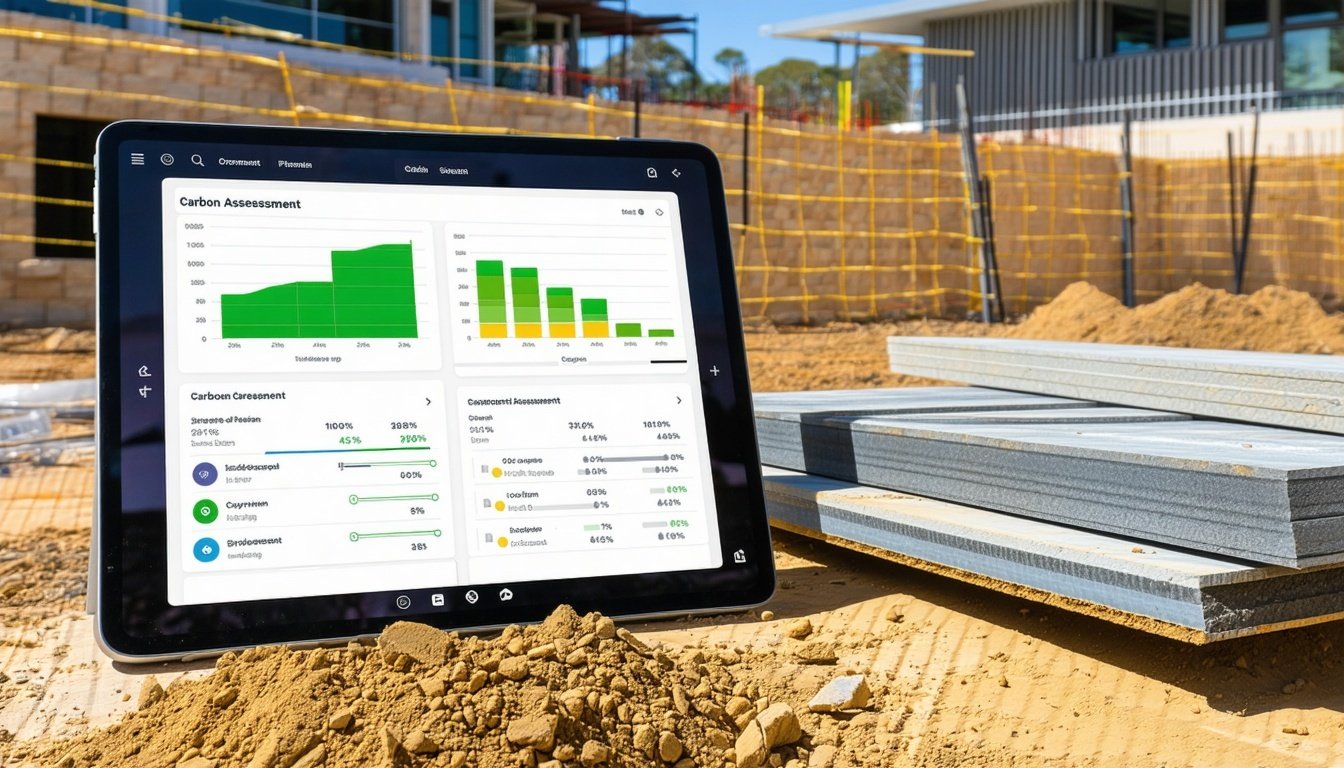
An embodied carbon report combines material quantities with applicable emissions factors. Depending on the scope and design stage, inputs may include architectural drawings, structural documentation, material schedules, façade details, specifications, bills of quantities, supplier information and Environmental Product Declarations.
The results can be grouped by material, building element or lifecycle stage. This allows the project team to distinguish between a high intensity material used sparingly and a moderate intensity material responsible for a large share of the complete building.
Once the hotspots are visible, realistic design alternatives can be tested. For more detail, read What Is Included in an Embodied Carbon Report?.
FAQ
Common Questions About High Embodied Carbon Materials
Which construction material has the highest embodied carbon?
It depends on the unit and product. Among common materials in the NABERS default database, extruded aluminium has a very high factor per kilogram. At whole building scale, concrete, reinforcing steel, structural steel and façade systems may create larger total impacts because of the quantities used.
Why can concrete have high embodied carbon if its factor per kilogram is relatively low?
Buildings may use very large quantities of concrete in foundations, slabs, columns, walls and cores. A moderate factor multiplied by hundreds or thousands of cubic metres can create a substantial total project contribution.
Is aluminium higher in embodied carbon than steel?
Current NABERS default factors for aluminium sheeting and extruded aluminium are substantially higher per kilogram than the default factors for general structural steel. Total building contribution still depends on the quantity and system in which each material is used.
Are glass façades high in embodied carbon?
They can be. A glazed façade combines glass with aluminium framing, coatings, spandrels, fixings, sealants and support structures. Large façade areas and complex curtain wall assemblies can create substantial system level impacts.
Is embodied energy the same as embodied carbon?
No. Embodied energy measures energy input, while embodied carbon measures greenhouse gas emissions expressed as CO₂e. The carbon result depends on the energy source, manufacturing process and direct chemical emissions.
How should two construction materials be compared?
Compare options that provide equivalent structural, thermal, fire, acoustic, durability and service life performance. Use compatible lifecycle boundaries, units, project quantities and suitable product specific data wherever available.
Related Guidance
Continue Reading About Embodied Carbon Materials
Embodied Carbon in Building Materials
A broader overview of how material decisions shape embodied carbon.
Low Embodied Carbon Materials
Practical material strategies for lower carbon construction.
Concrete, Steel and Timber
A focused comparison of structural systems and material quantities.
Façade Systems
How glazing, framing, cladding and shading affect embodied carbon.
Project Review
Need to identify the materials and systems driving your project result?
Certified Energy can review project documentation, material quantities and available product data to identify embodied carbon hotspots and assess whether structural, façade or specification changes may materially improve the outcome.
Visit the Embodied Carbon Report Knowledge Hub