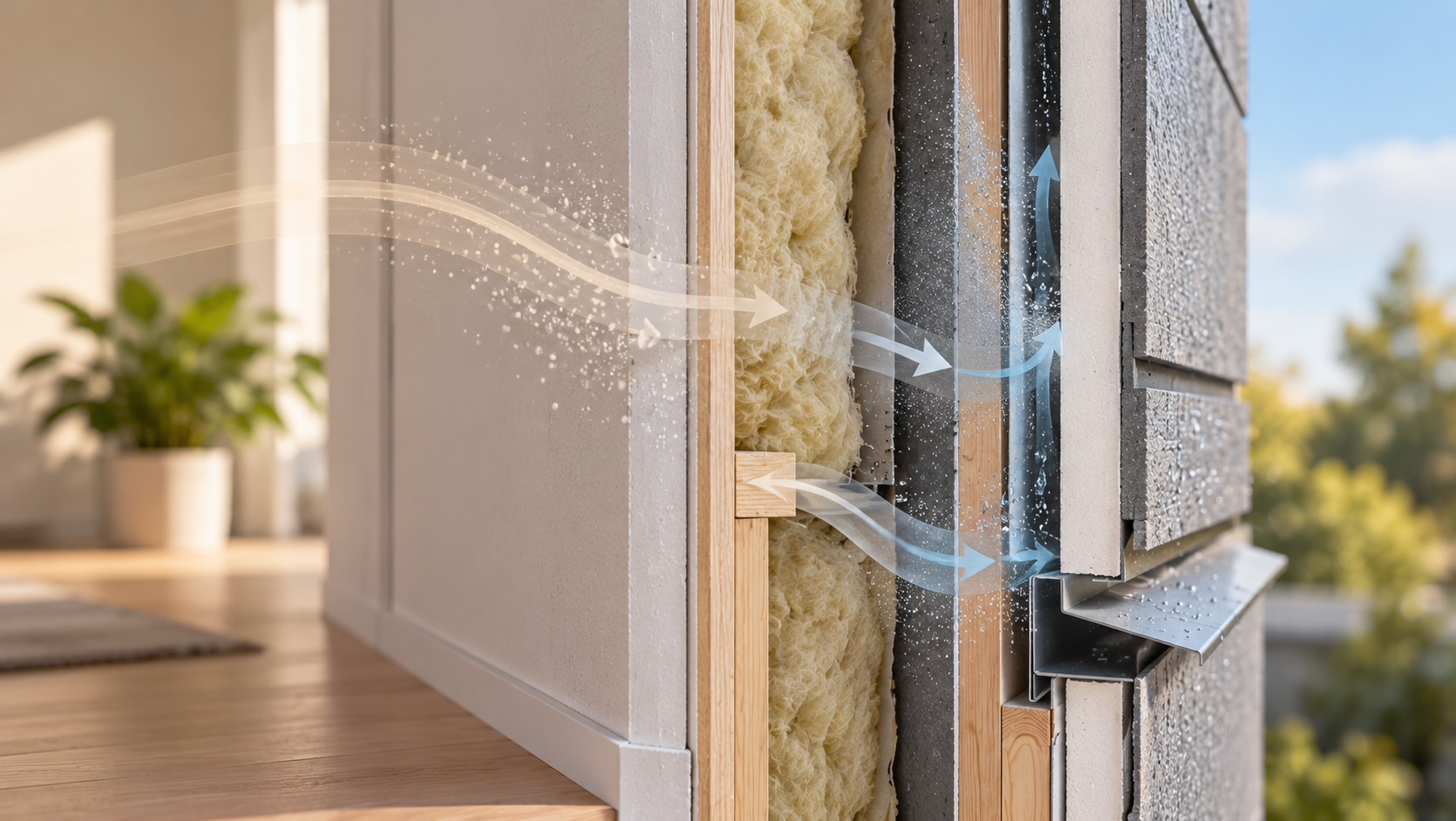



A wall or roof assembly does not necessarily remain dry throughout its service life. Changing environmental conditions, construction moisture and other moisture sources can create periods when materials absorb or retain water.
The important question is not always whether moisture can enter the assembly. It is also whether that moisture can leave when conditions become more favourable.
This ability to release moisture is described as drying potential. It is an important consideration in building envelope design because two assemblies exposed to similar moisture conditions may recover very differently depending on their materials, layer arrangement and environmental exposure.
A moisture-resilient assembly is not defined simply by whether it becomes wet. Its ability to recover between moisture events can be equally important.
In Brief
What Is Drying Potential in a Wall or Roof Assembly?
Drying potential describes the capacity of a construction assembly to release moisture under the environmental conditions acting on it.
Moisture may be stored within materials, transferred between layers or released towards the interior or exterior. The direction and rate of drying depend on the complete construction build-up, material properties, temperature, humidity and other relevant conditions.
An assembly may experience temporary moisture increases without progressive accumulation if sufficient drying occurs afterwards. Conversely, repeated moisture loading combined with inadequate drying may cause moisture levels to remain elevated or increase over successive periods.
Drying potential is therefore best understood as a time-dependent characteristic of the complete assembly, rather than a fixed property of one membrane or construction material.
Technical and NCC note: This article discusses moisture recovery and drying behaviour within building-envelope assemblies. It does not establish a universal minimum drying rate or replace applicable NCC condensation management provisions. Requirements depend on the relevant NCC edition, jurisdiction, building classification and construction arrangement. Drying potential should not be treated as a substitute for appropriate weatherproofing, waterproofing or the management of unintended water ingress.
Why Is Moisture Recovery Important?
Moisture conditions within a wall or roof can change throughout the day, across seasons and over longer periods of building operation.
Materials may absorb moisture when environmental conditions favour wetting and release moisture when the surrounding conditions favour drying.
This means that an isolated increase in moisture content does not necessarily describe the long-term behaviour of an assembly.
The subsequent recovery period is important. If moisture levels return towards an appropriate baseline before the next significant loading event, the assembly may behave differently from one in which moisture remains elevated.
The relevant risk depends on the amount of moisture, how long materials remain wet, their sensitivity to moisture and whether repeated exposure causes deterioration or other unacceptable conditions.
Understanding recovery therefore helps distinguish temporary moisture changes from patterns that may indicate progressive accumulation.
Wetting, Drying and Moisture Accumulation: Three Different Behaviours
The behaviour of an assembly can be understood by examining what happens during and after moisture loading.
| Behaviour | What happens | Assessment consideration |
|---|---|---|
| Temporary wetting | Moisture increases during a defined period. | Magnitude and duration of elevated moisture. |
| Moisture recovery | Moisture decreases as drying conditions return. | Rate, extent and timing of drying. |
| Progressive accumulation | Moisture is retained or increases across repeated cycles. | Long-term trend and material-specific consequences. |
These categories are useful for interpreting moisture behaviour, but they do not independently establish whether a particular material is performing acceptably.
For example, an assembly may show seasonal recovery while still experiencing periods of moisture exposure that require closer evaluation.
What Is the Difference Between Inward and Outward Drying?
Moisture within an assembly may be released towards the interior, towards the exterior or through a combination of pathways.
Inward Drying
Inward drying occurs when moisture moves from within the construction towards the indoor environment.
This pathway may be influenced by the vapour resistance of internal linings, finishes and other layers, together with indoor temperature and humidity conditions.
Outward Drying
Outward drying occurs when moisture moves towards the exterior environment.
The relevant pathway may depend on sheathing, membranes, cavities, cladding arrangements and the conditions outside the building.
Why Direction Matters
An assembly that can dry effectively in one direction under certain conditions may have restricted drying in that direction under other conditions.
The vapour pressure difference can change with climate and building operation, meaning drying direction should not be assumed to remain constant throughout the year.
For this reason, the ability to dry inward or outward should be considered in relation to the complete assembly and the environmental conditions acting on it, rather than treated as a universal rule for membrane placement.
Why Is Vapour Permeability Not the Same as Drying Potential?
Vapour permeability describes a material's ability to permit water vapour diffusion. Drying potential describes how a complete assembly can release moisture under relevant conditions.
These concepts are related, but they are not interchangeable.
A relatively vapour-permeable material may support drying through a particular layer. However, that does not establish whether the complete assembly can release moisture quickly enough or whether other layers restrict the pathway.
Likewise, a low-permeability layer may reduce moisture entering from one direction while also restricting drying in that direction.
The outcome depends on the position of the layer, adjacent materials, moisture sources, temperature conditions and available alternative drying pathways.
For membrane classifications and climate-specific vapour-control considerations, see Vapour Control Layers in Australian Climate Zones.
How Does Moisture Storage Affect Drying Behaviour?
Construction materials differ in their ability to absorb, store and release moisture.
Some materials can take up moisture from surrounding air and release it as conditions change. Others may store moisture through additional mechanisms, including capillary absorption where liquid water is present.
These characteristics influence how quickly moisture levels respond to changing environmental conditions.
A material with substantial moisture storage capacity may moderate short-term fluctuations, but this does not automatically make the assembly moisture-safe.
Stored moisture must still be considered in relation to the material's sensitivity, the duration of exposure and the ability of the surrounding construction to support drying.
Assessment of drying behaviour therefore requires appropriate material properties rather than relying solely on nominal insulation values or membrane classifications.
Why Does Seasonal Drying Matter?
A building envelope is exposed to changing temperature, humidity, rainfall, solar radiation and indoor operating conditions throughout the year.
These changes can alter both moisture loading and the opportunity for drying.
For example, an assembly may experience elevated moisture during one part of the year and lower moisture levels during another. The timing and extent of that recovery can be important when assessing longer-term performance.
A single calculation at one set of conditions may not reveal whether moisture increases during repeated seasonal cycles or whether it consistently returns towards lower levels.
Multi-period analysis can help distinguish assemblies that exhibit stable seasonal behaviour from those showing an increasing moisture trend under the modelled conditions.
However, the presence of seasonal drying does not independently establish acceptable performance. Material-specific criteria and the duration of elevated moisture still matter.
Do Walls and Roofs Have Different Drying Conditions?
Yes. Wall and roof assemblies can experience different environmental exposures, material arrangements and opportunities for moisture release.
Wall Assemblies
Wall drying behaviour may be influenced by façade orientation, solar exposure, cladding type, cavities, sheathing, insulation and internal finishes.
Two walls with the same nominal construction may experience different moisture conditions where orientation or exposure changes significantly.
Roof Assemblies
Roof drying behaviour may be influenced by roof covering, underlay, insulation location, roof-space configuration, ventilation where applicable and the temperature conditions created by solar exposure and night-time cooling.
A ventilated roof space and a compact insulated roof can provide substantially different moisture environments, even where some materials are similar.
These differences reinforce the importance of assessing the relevant assembly rather than assuming that a drying strategy suitable for one construction type will perform identically in another.
What Can Limit an Assembly's Ability to Dry?
Limited drying potential can result from the interaction of several construction and environmental factors.
These may include:
- low-permeability layers restricting relevant drying pathways;
- material arrangements that retain moisture at concealed interfaces;
- persistent environmental conditions that provide limited drying opportunities;
- moisture loading that exceeds the assembly's ability to recover;
- high initial moisture content in construction materials;
- inadequate cavity ventilation where ventilation is part of the intended design; and
- changes in building operation that alter indoor temperature or humidity.
These factors should not be interpreted as universally defective design features.
For example, a low-permeability layer may serve an important moisture-control function. Its suitability depends on its location and the performance of the complete assembly.
The assessment question is whether the proposed construction can manage the relevant moisture exposure without unacceptable accumulation or material deterioration.
How Can Drying Potential Be Evaluated Through Hygrothermal Analysis?
Where detailed assessment is appropriate, transient hygrothermal modelling can investigate how temperature and moisture conditions change through a defined assembly over time.
The assessment can consider the construction layers, relevant material properties, outdoor climate and indoor environmental conditions.
Depending on the method and scope, drying behaviour may be examined through changes in material moisture content, relative humidity or other relevant outputs at selected locations.
Questions that may be investigated include:
- Does moisture increase during particular periods?
- Does the assembly recover when conditions become more favourable?
- Are elevated moisture levels persistent?
- Is there a progressive increase across repeated cycles?
- Which layers retain moisture for longer periods?
- How sensitive is the drying response to defined material or environmental assumptions?
The results must be interpreted in relation to the material, assessment method and moisture-risk question.
A modelled decrease in moisture content is evidence of drying under the selected assumptions. It does not guarantee that every material remains within acceptable conditions or that unmodelled water ingress and construction defects will have no effect.
The wider role and limitations of hygrothermal assessment are explained in Certified Energy's Moisture & Condensation Risk Analysis guide.
When Should Drying Potential Influence a Design Decision?
Drying potential may warrant closer attention where a design introduces layers that substantially change moisture movement or where an assembly is expected to experience challenging environmental conditions.
Examples include:
- adding a low-permeability finish or membrane;
- changing the position or type of insulation;
- introducing a new sheathing or cladding system;
- altering a cavity or ventilation arrangement;
- retrofitting insulation to an existing wall or roof;
- using materials with significant initial moisture content; and
- changing the indoor conditions through heating, cooling or building use.
These situations do not automatically require detailed modelling. They identify circumstances in which the project team may benefit from considering how the proposed change affects the assembly's moisture recovery.
Where alternative constructions are being considered, the comparison should use consistent environmental and assessment assumptions so that differences in drying behaviour can be meaningfully interpreted.
Drying Potential: Design Review Checklist
The following questions can help establish whether drying behaviour needs further consideration.
- Is the complete wall or roof build-up documented?
- Which materials can absorb or store moisture?
- What moisture sources are relevant to the assembly?
- Which layers influence inward and outward drying?
- Are the vapour properties of relevant materials known?
- Could the assembly experience repeated moisture loading?
- How might seasonal climate conditions change drying opportunities?
- Could indoor heating, cooling or humidity alter the moisture response?
- Is there a risk of moisture remaining elevated between loading events?
- Have any proposed material changes altered the available drying pathways?
- Are suitable material data and assessment assumptions available?
- Would further technical assessment help resolve a specific design question?
Frequently Asked Questions
Drying Potential FAQs
What does drying potential mean in building construction?
Drying potential describes the ability of a construction assembly to release moisture under relevant environmental conditions. It depends on material properties, layer arrangement, moisture conditions and the available drying pathways.
Is a vapour-permeable wall always able to dry effectively?
No. The vapour permeability of one material does not establish the drying behaviour of the complete wall. Other layers, moisture storage, temperature and humidity conditions can influence the overall response.
Can a wall or roof dry in both directions?
Yes, depending on the construction and environmental conditions. Moisture may be released towards the interior, exterior or through a combination of pathways. The relative importance of each can change over time.
Does seasonal drying mean an assembly is moisture-safe?
Not necessarily. Seasonal recovery is relevant, but the magnitude and duration of moisture exposure and the sensitivity of affected materials must also be considered. Drying during one period does not automatically offset unacceptable conditions during another.
How can moisture accumulation over time be identified?
Where appropriate, hygrothermal analysis can examine material moisture conditions across changing environmental periods. Persistent elevated moisture or increasing trends may indicate a need for closer technical evaluation.
Can changing insulation or membranes affect drying potential?
Yes. Changes to insulation position, membrane vapour resistance or other construction layers can alter temperatures, moisture movement and drying pathways within an assembly. Their effect should be considered in the context of the complete construction.
Related Knowledge
Explore Related Moisture and Building Envelope Guidance
Moisture & Condensation Risk Analysis
Explore the wider relationship between climate, materials, moisture accumulation, drying and hygrothermal assessment.
Vapour Control Layers in Australian Climate Zones
Understand how membrane vapour properties and climate conditions influence construction layer decisions.
Condensation Risk in Roof and Ceiling Assemblies
Review how roof and ceiling configurations influence concealed moisture conditions.
Vapour Diffusion vs Air Leakage
Distinguish moisture movement through materials from water vapour transported by unintended airflow.
Moisture & Condensation Risk Analysis
Understand How Your Building Envelope Responds to Moisture Over Time
Where a proposed wall, roof or façade raises questions about moisture accumulation or limited drying, Certified Energy can assist with project-specific moisture and condensation risk analysis. A defined assessment scope can help establish whether further investigation of moisture recovery and assembly behaviour is appropriate.
Explore Moisture & Condensation Risk Analysis