

What Is BASIX?
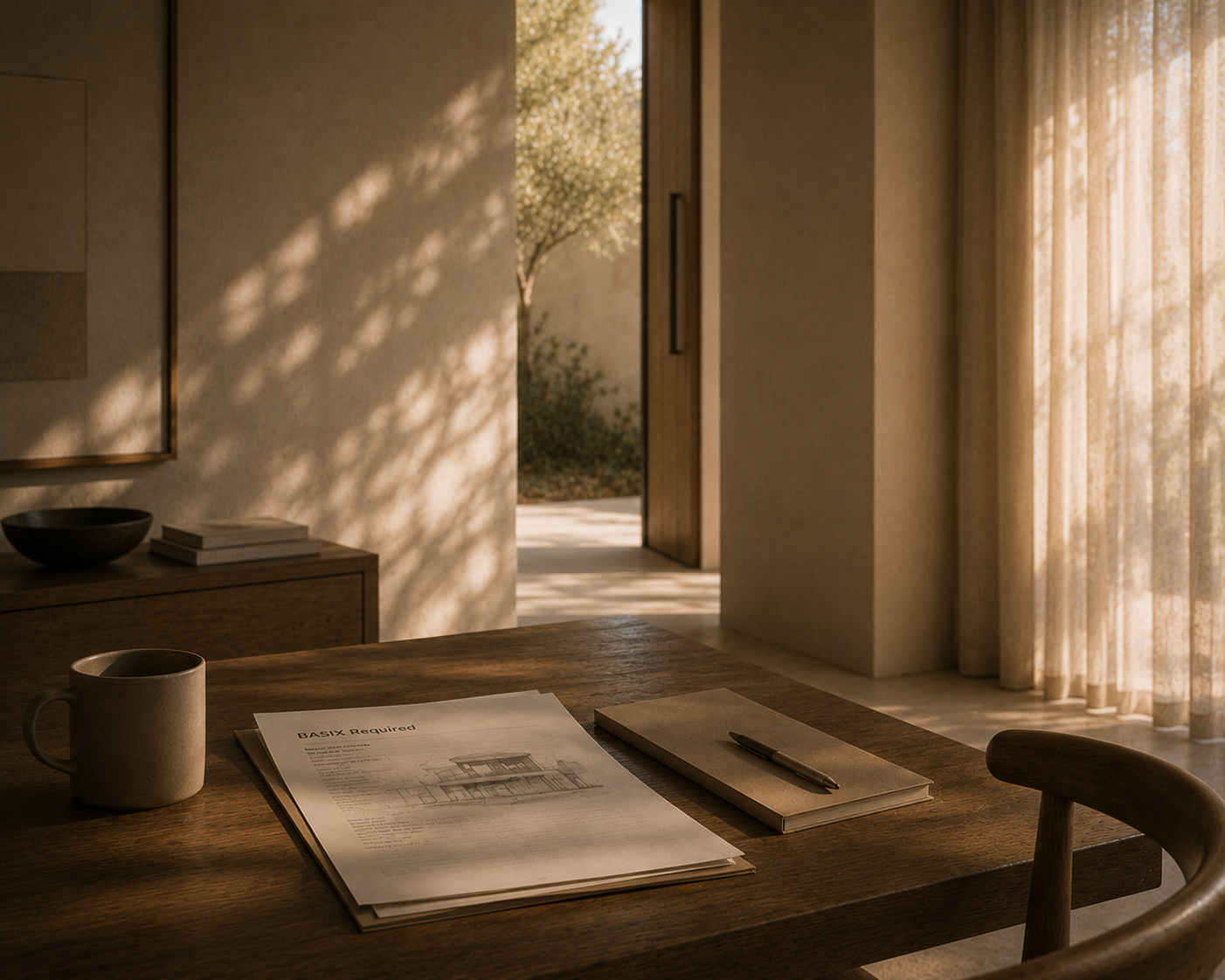
BASIX is the Building Sustainability Index used for residential development in New South Wales. It forms part of the NSW planning and approval system and establishes project-specific requirements for water use, energy use and thermal performance.
A BASIX assessment uses information about the proposed dwelling, including its location, size, glazing, construction, insulation, water measures and building services. The assessment also records construction materials so the embodied emissions associated with the development can be calculated and reported.
Once the applicable BASIX requirements have been satisfied, a BASIX Certificate can be generated. The Certificate lists the sustainability commitments that must correspond with the approval plans and be carried through into the completed development.
In Brief
What Does BASIX Mean?
BASIX stands for Building Sustainability Index. It is the NSW residential sustainability assessment framework used to demonstrate that a proposed development satisfies applicable requirements for water, energy and thermal performance. The BASIX Tool also records building materials and calculates their embodied emissions. A successful assessment produces a BASIX Certificate containing commitments that become part of the approved residential design.
Knowledge Navigation
Understanding the BASIX Framework
Assessment
What BASIX Assesses
Water, energy, thermal performance and construction-material information.
Documentation
The BASIX Certificate
The document that records the project’s sustainability commitments.
Approvals
How BASIX Is Used
How the Certificate relates to planning, certification and construction.
Related Systems
BASIX and NatHERS
Why the two systems are related but not interchangeable.
The Building Sustainability Index
BASIX was introduced in NSW in 2004 as a residential sustainability measure within the planning system. Rather than applying a single generic specification to every development, the BASIX Tool uses information about the proposed project to establish and assess requirements relevant to that dwelling.
The assessment reflects the relationship between the building, its location and the measures proposed within the design. Two projects with different dwelling types, climate conditions, glazing arrangements or building services may therefore have different BASIX inputs and commitments.
BASIX is not simply a product checklist. It considers a combination of design information, construction selections and operational systems. A project must satisfy the applicable requirements as a coordinated proposal before the Certificate can be generated.
What Does BASIX Assess?
The BASIX framework brings together four related areas of residential building information. Water, energy and thermal performance are assessed against applicable standards. The Materials Index records construction information and reports the embodied emissions associated with the selected materials.
Assessment Area 01
Water
The water section estimates the potable-water demand associated with the proposed development. Inputs can include water-efficient fixtures, rainwater systems, connected roof catchment, alternative water supplies, landscaping, pools, spas and shared water systems where relevant.
Assessment Area 02
Energy
The energy section estimates operational greenhouse-gas emissions associated with systems such as hot water, heating, cooling, ventilation, lighting, cooking, pools, spas and photovoltaic generation. The result depends on the systems and energy sources nominated for the project.
Assessment Area 03
Thermal Performance
Thermal performance considers the estimated heating and cooling required to maintain suitable internal conditions. It is influenced by the dwelling geometry, climate, orientation, glazing, shading, insulation, construction systems and other building-envelope characteristics.
Reporting Area 04
Materials Index
The Materials Index records information about the proposed floors, walls, roofs, structural systems, insulation and glazing. BASIX uses this information to calculate and report embodied emissions associated with the construction materials entered for the development.
Water Performance in BASIX
The BASIX water assessment looks at how the proposed development is expected to use mains drinking water. It considers the combined effect of fixtures, landscaping and alternative water sources rather than treating each measure as an isolated selection.
A project may include commitments relating to showerheads, toilets, tapware, rainwater storage, roof catchment, laundry or toilet connections, garden irrigation and pool or spa systems. The measures relied upon by the assessment must be practical for the site and consistent with the hydraulic, landscape and architectural documentation.
Energy Performance in BASIX
The BASIX energy assessment considers the operational systems proposed for the dwelling and their associated greenhouse-gas emissions. The result can be influenced by the type and efficiency of the hot-water, heating, cooling and ventilation systems, as well as cooking, lighting and renewable-energy selections.
Thermal performance and operational energy are related but remain distinct parts of the framework. A well-performing building envelope can reduce heating and cooling demand, while the energy section considers the systems selected to meet that demand and provide other household services.
Understand BASIX water, energy and thermal-performance targets →
Thermal Performance in BASIX
The thermal-performance section estimates how much artificial heating and cooling the dwelling may require. The applicable outcome is influenced by the local climate and the way the proposed building envelope responds to seasonal conditions.
Depending on the dwelling and assessment pathway, thermal performance may be demonstrated through the BASIX DIY Method, NatHERS Simulation Method or an accepted Passive House Standard method. The selected pathway affects the inputs, supporting documentation and professionals involved.
The technical design factors that influence the result—including orientation, glazing, insulation, shading, ventilation and thermal bridging—are addressed through separate specialist assessments and articles. Their role within this page is to explain what BASIX measures, rather than prescribe one universal design response.
The BASIX Materials Index
The Materials Index extends BASIX beyond operational water and energy considerations by recording the embodied emissions associated with the materials used to construct the proposed development.
The assessment may require information about construction areas and material types for floors, walls, roofs, structural frames, insulation, windows and glazed doors. The quality of the result therefore depends on those inputs corresponding with the proposed architectural and construction documentation.
The BASIX Materials Index is a regulatory reporting mechanism. It should not be interpreted as a complete lifecycle assessment of the building or as a substitute for detailed project-specific embodied-carbon analysis.
Explore materials information and the BASIX Materials Index →
The Compliance Document
What Is a BASIX Certificate?
A BASIX Certificate is the project-specific document generated after the required assessment fields are completed and the applicable BASIX requirements have been satisfied.
The Certificate identifies the development and records the principal sustainability measures relied upon by the assessment. These measures are known as BASIX commitments. They can relate to the building envelope, glazing, water systems, building services, renewable-energy systems and other project information.
The Certificate does not sit separately from the drawings. Relevant commitments must be shown or reflected in the plans and specifications submitted for approval. The development must then be constructed consistently with those commitments.
What Are BASIX Commitments?
BASIX commitments are the project measures recorded on the Certificate after the assessment is completed. They describe elements of the design and construction that must be delivered for the approved project to remain consistent with its BASIX assessment.
Depending on the project, commitments can include:
- water-fixture performance
- rainwater storage, catchment and connected uses
- wall, roof, ceiling and floor construction
- insulation and thermal-break requirements
- window and glazed-door performance
- eaves, awnings and external shading
- hot-water, heating and cooling systems
- mechanical ventilation and exhaust systems
- photovoltaic-system capacity
- pool or spa equipment where relevant
If the design or specification later changes, the project should be checked to determine whether the existing Certificate still describes the proposed development or whether a revised assessment is required.
How Does the BASIX Process Work?
At a high level, BASIX converts the proposed residential design into a set of assessable inputs and documented commitments.
1. The project is identified
The development type, site, dwelling arrangement and applicable assessment pathway are confirmed.
2. Design information is entered
The assessment records project details relating to water, energy, thermal performance and construction materials.
3. The project is assessed
The BASIX Tool calculates the results and identifies whether the applicable requirements have been satisfied.
4. The design is coordinated
Where required, the plans or specifications are reviewed so the project can meet the relevant requirements using practical commitments.
5. The Certificate is generated
Once the assessment is complete, the BASIX Certificate is generated and coordinated with the documents intended for approval.
6. Commitments are delivered
The approved project must be documented, constructed and certified consistently with the commitments on the Certificate.
When Does BASIX Apply?
BASIX generally applies to new residential dwellings in NSW, qualifying alterations and additions to existing dwellings, and certain swimming-pool and spa projects. The precise trigger depends on the development type, project scope and relevant planning pathway.
The applicability question is separate from understanding what BASIX is. Before beginning an assessment, the project should be classified correctly so the appropriate BASIX application type and supporting documentation can be selected.
Approval Pathway
How BASIX Fits the NSW Planning and Certification Process
The BASIX Certificate is initially submitted with the relevant development application or complying development certificate documentation. The plans and the Certificate should describe the same proposed development.
BASIX continues beyond planning approval. The Certificate is also relevant when construction documentation is prepared, because the applicable commitments must be shown on the plans used for certification and construction.
At completion, the certifying authority considers whether the development has been constructed consistently with the BASIX Certificate before the final occupation documentation is issued.
Is BASIX the Same as NatHERS?
No. BASIX and NatHERS are related, but they perform different functions.
| System | Primary Role | Relationship to the Project |
|---|---|---|
| BASIX | The NSW residential sustainability and planning framework. | Assesses water, energy and thermal performance and records materials information and project commitments. |
| NatHERS | A national home-energy-rating framework used to model residential thermal performance. | Can provide the detailed heating and cooling loads used within the BASIX Simulation Method. |
Where NatHERS Simulation is used, an accredited assessor models the dwelling in approved software and prepares supporting assessment documentation. The resulting heating and cooling loads are then used within the BASIX thermal-performance assessment.
What BASIX Does Not Replace
BASIX is one part of a wider residential design, approval and construction process. Understanding its boundaries helps avoid treating the Certificate as a substitute for other project responsibilities.
It does not replace the architectural documentation
The BASIX Certificate relies on the plans and specifications. It does not independently describe every element needed to construct the building.
It does not replace NatHERS where Simulation is used
The NatHERS model and Assessor Certificate remain supporting thermal-performance documents and must align with the BASIX application.
It does not replace the National Construction Code
A residential project may have separate obligations under the NCC and other planning, building and certification requirements.
It is not a complete lifecycle assessment
The Materials Index reports embodied emissions using information entered into BASIX, but it is not equivalent to a detailed project-specific lifecycle assessment.
It is not a guarantee of overall design quality
BASIX establishes regulatory residential sustainability requirements. Wider architectural quality, durability, moisture management, indoor environmental quality and broader sustainability objectives may require additional design work.
Assessment Support
Who Prepares a BASIX Assessment?
The BASIX Tool can be accessed by applicants and project teams, but the level of technical support required depends on the project and thermal-performance pathway.
A BASIX consultant can gather and interpret the required project information, coordinate the water, energy and materials inputs, review the proposed commitments and check the Certificate against the approval documentation.
Where the Simulation Method is used, the thermal model must be completed by an appropriately accredited NatHERS assessor using approved software. The assessor’s documentation is then coordinated with the wider BASIX application.
Frequently Asked Questions
BASIX FAQs
What does BASIX stand for?
BASIX stands for Building Sustainability Index. It is the NSW framework used to assess residential water use, energy use and thermal performance and to record embodied-emissions information for construction materials.
What is the purpose of a BASIX Certificate?
The Certificate demonstrates that the proposed residential development has completed the applicable BASIX assessment. It records the sustainability commitments that must align with the approval documentation and completed development.
Is BASIX only required for new homes?
No. BASIX also applies to qualifying alterations and additions and certain swimming-pool and spa developments. The exact trigger should be checked against the project type and scope.
Is BASIX the same as a NatHERS rating?
No. BASIX is the broader NSW residential sustainability framework. NatHERS is a national home-energy-rating system that can be used to model the thermal performance component of BASIX through the Simulation Method.
Does BASIX include building materials?
Yes. The BASIX Materials Index records information about the proposed construction and glazing materials and calculates their associated embodied emissions. It is a reporting mechanism rather than a complete lifecycle assessment.
Does a BASIX Certificate need to match the plans?
Yes. The Certificate, architectural plans and supporting thermal-performance documents should describe the same proposed development. Relevant BASIX commitments must be shown or reflected in the approval documentation.
Can BASIX commitments be changed?
Project changes can be reviewed and the assessment may be revised where necessary. The Certificate and supporting documents should be updated before the changed design is relied upon for approval, certification or construction.
Does BASIX guarantee that a home will have low energy bills?
No. BASIX assesses the proposed design and systems against regulatory requirements. Actual household energy and water use will also depend on construction quality, installed products, maintenance, occupancy patterns and how the home is operated.
Related Knowledge
Continue Exploring BASIX
Assessment note: BASIX requirements and assessment pathways vary according to the dwelling type, project scope, climate zone and current BASIX standards. The project-specific Certificate and supporting approval documentation should always be reviewed together.
For regulatory information, refer to the NSW Planning Portal BASIX guidance.
Last reviewed: July 2026.
BASIX Project Review
Need a BASIX Assessment for a NSW Residential Project?
Certified Energy can review the proposed design, confirm the appropriate assessment pathway and prepare coordinated BASIX and NatHERS documentation for the project.
Send Your Plans for Review →