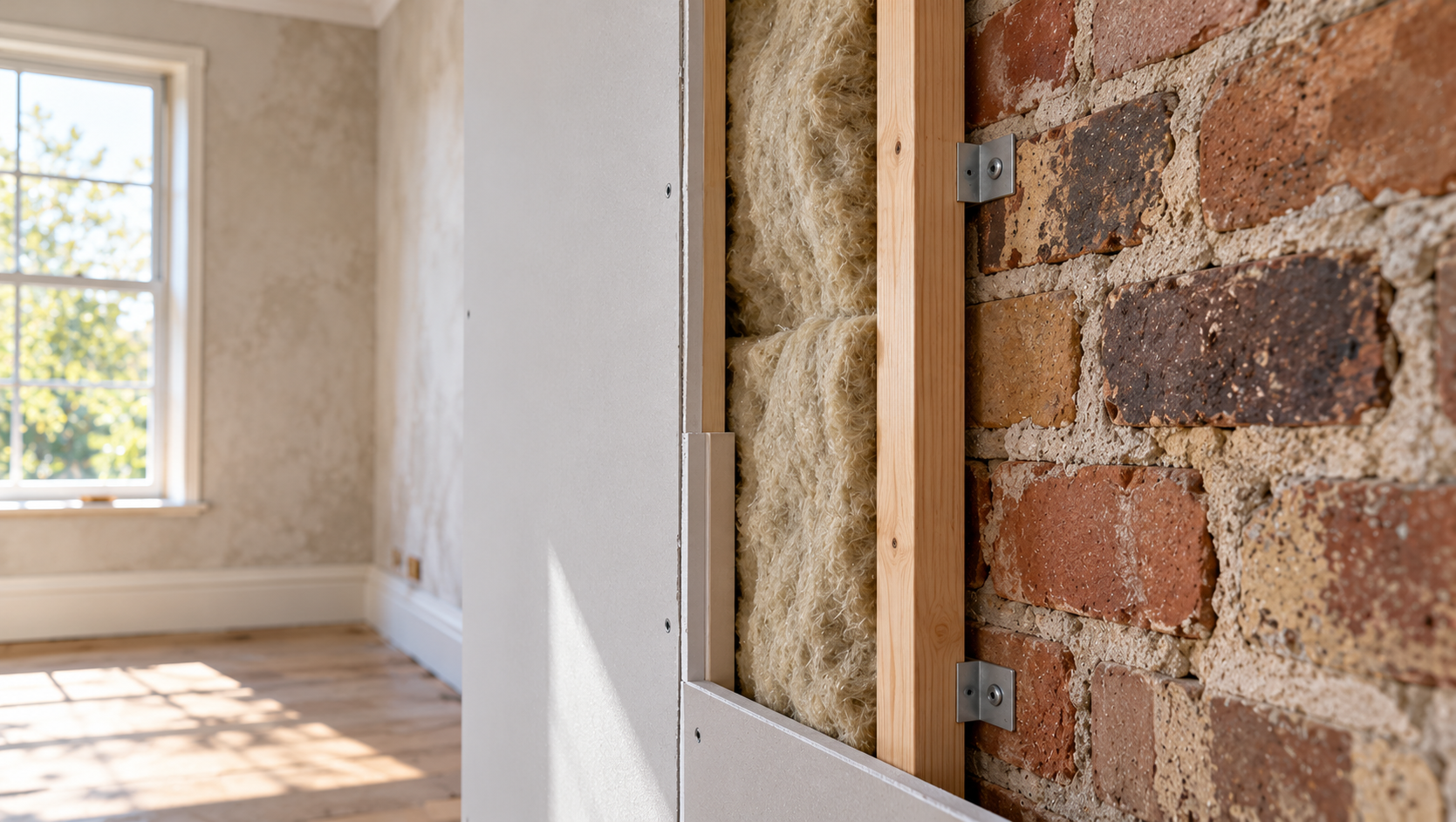



Mechanical cooling changes the temperature conditions experienced by a building envelope. While air conditioning is commonly considered in relation to indoor comfort and energy demand, it can also influence moisture behaviour within walls, roofs and façades.
In warm and humid conditions, the exterior environment may contain more water vapour than the conditioned interior. Depending on the construction and operating conditions, this can create moisture transport towards cooler internal regions of the building envelope.
The resulting condensation risk depends on the relationship between surface temperature, moisture availability, material properties and the duration of exposure. Understanding these interactions is particularly important where a building is cooled for extended periods or where external humidity remains elevated.
In mechanically cooled buildings, the location of cooler surfaces can change where moisture-sensitive conditions develop within the building envelope.
In Brief
Why Can Mechanical Cooling Influence Condensation Risk?
Mechanical cooling reduces indoor air temperature and can influence the temperature of construction layers within the building envelope.
Where warm, humid outdoor conditions create a higher external water vapour pressure than the conditioned interior, vapour diffusion may be directed inward through suitable materials.
Unintended air leakage can also introduce humid air into cooler cavities or interfaces, although the resulting moisture conditions depend on airflow direction, pressure differences and the temperatures encountered.
Condensation is possible when a surface reaches a temperature at or below the dew point of adjacent air. Elevated humidity at concealed material surfaces may also be relevant before visible condensation occurs.
The presence of air conditioning alone does not establish condensation risk. The complete assembly and operating conditions must be considered.
Technical and NCC note: Condensation management requirements depend on the applicable NCC edition, jurisdiction, building classification and compliance pathway. Mechanical cooling does not automatically trigger a universal requirement for hygrothermal modelling. This article addresses building envelope moisture behaviour rather than HVAC equipment design, refrigerant systems, duct insulation or condensation drainage from air-conditioning units.
How Does Mechanical Cooling Change Building Envelope Moisture Conditions?
A mechanically cooled building may maintain internal temperatures substantially below those experienced outdoors.
This changes the temperature distribution through external walls, roofs and façade systems.
Depending on insulation position, construction materials and the duration of cooling, some concealed interfaces may operate at lower temperatures than they would in an unconditioned building.
If moisture reaches these interfaces, the local relative humidity may increase. Under suitable conditions, condensation may occur.
Mechanical cooling may also remove moisture from indoor air through dehumidification, depending on the equipment and operating conditions. This can change the vapour pressure difference between the interior and exterior.
The moisture response therefore depends on both temperature control and humidity control, rather than cooling temperature alone.
What Is Inward Vapour Drive in a Mechanically Cooled Building?
Inward vapour drive describes water vapour diffusion towards the interior of a building where the relevant vapour pressure difference is directed inward.
This condition may occur when the external environment has a higher water vapour pressure than the conditioned interior.
In warm and humid weather, an air-conditioned interior may be cooler and drier than the exterior. Under these conditions, vapour diffusion through suitable construction layers may be directed inward.
However, the direction of diffusion is governed by water vapour pressure differences, not temperature alone.
Changes in outdoor weather, indoor humidity, solar exposure and building operation may alter the direction or magnitude of vapour movement over time.
A suitable moisture assessment should therefore consider the environmental conditions relevant to the actual building rather than assuming that vapour movement is permanently directed inward.
Is Inward Vapour Drive the Same as Humid Air Leakage?
No. Vapour diffusion and air leakage are different moisture transport mechanisms.
Vapour diffusion occurs through materials in response to water vapour pressure differences.
Air leakage involves the movement of air through openings or discontinuities, driven by air pressure differences. Water vapour may be transported with that moving air.
In a mechanically cooled building, humid outdoor air entering a cooler cavity may create moisture-sensitive conditions if it encounters sufficiently cold surfaces.
The actual outcome depends on the direction and quantity of airflow, the humidity of the air and the temperature of the surfaces involved.
The two mechanisms should not be treated as interchangeable. Measures that control diffusion may not necessarily provide airtightness, and an airtight layer may still allow vapour diffusion depending on its material properties.
For a detailed comparison, see Vapour Diffusion vs Air Leakage: How Moisture Enters Building Assemblies.
Which Building Envelope Interfaces May Be Vulnerable During Cooling?
The location of potentially moisture-sensitive interfaces depends on the construction arrangement and the resulting temperature profile.
Inward moisture movement may become relevant where vapour or humid air reaches surfaces cooled by the internal environment.
| Interface | Potential consideration |
|---|---|
| Internal linings and concealed surfaces | Cooling may influence local surface temperatures where moisture reaches the lining or adjacent layers. |
| Insulation interfaces | Temperature and vapour conditions may vary across insulation layers and their boundaries. |
| Membranes and low-permeability layers | Layer position and vapour resistance may influence moisture accumulation and drying. |
| Façade junctions and penetrations | Air-control discontinuities may allow humid air to reach cooler concealed surfaces. |
| Roof and ceiling assemblies | Solar exposure, roof construction and cooling conditions may produce time-dependent moisture behaviour. |
These locations are potential assessment considerations rather than evidence that condensation will occur. The relevant interfaces must be identified from the specific building assembly.
Why Does Vapour Control Layer Position Matter in Cooled Buildings?
Vapour control layers influence diffusion through a building assembly.
In mechanically cooled buildings, their location and vapour resistance may affect how moisture moves towards cooler internal regions and how the assembly releases accumulated moisture.
A low-permeability layer can reduce vapour diffusion through its location. However, it may also restrict drying in that direction.
For this reason, vapour control should not be reduced to a universal instruction to place a vapour barrier on the interior or exterior side of every assembly.
The appropriate arrangement depends on climate, indoor conditions, construction layers and the applicable NCC provisions.
For a broader discussion of membrane properties and climate considerations, see Vapour Control Layers in Australian Climate Zones.
Can Solar Exposure Increase Inward Moisture Movement?
Solar exposure can influence moisture behaviour in materials that absorb and store water.
Where an exterior material has become wet, subsequent solar heating may increase its temperature and affect the local vapour pressure conditions.
Under certain circumstances, this can contribute to moisture movement towards cooler regions of the assembly.
The effect depends on the material's moisture storage properties, rain exposure, solar conditions and the resistance of surrounding layers to vapour movement.
This mechanism may be relevant to some masonry and other moisture-storing cladding systems, but it should not be assumed to occur to the same extent in every façade.
Where solar-driven moisture movement is relevant, assessment conditions should reflect the actual exposure and material behaviour rather than relying only on a steady-state temperature difference.
How Do Indoor Temperature and Humidity Setpoints Affect Condensation Risk?
Indoor temperature and humidity conditions influence both the temperature of the building envelope and the water vapour pressure difference between the interior and exterior.
Lower indoor temperatures can create cooler construction interfaces. However, the moisture implications also depend on the indoor humidity achieved by the cooling and ventilation systems.
A building operating at one cooling setpoint may experience different moisture conditions from the same building operated at another setpoint.
Occupancy, internal moisture generation, outdoor air ventilation and the ability of the mechanical system to control humidity can all influence the relevant conditions.
For project-specific assessment, assumed indoor conditions should reflect the intended operation rather than being selected solely for modelling convenience.
Where operating conditions are uncertain or variable, sensitivity analysis may help establish whether the proposed assembly is particularly dependent on a narrow range of indoor conditions.
Does Continuous Cooling Create Different Conditions From Intermittent Cooling?
Yes. The duration and pattern of mechanical cooling can influence how long construction materials experience particular temperature and humidity conditions.
A continuously cooled building may maintain relatively stable indoor temperatures for extended periods.
An intermittently cooled building may experience repeated changes in temperature and humidity as the system operates and stops.
These different operating patterns can affect moisture storage, drying and the duration of elevated humidity at concealed interfaces.
Neither operating pattern automatically produces a higher condensation risk in every assembly.
The relevant outcome depends on the combined effect of environmental conditions, construction materials and the time-dependent moisture response.
Can Elevated Humidity Create Material Risk Without Visible Condensation?
Yes. Concealed material surfaces can experience elevated relative humidity without necessarily reaching the conditions required for visible liquid condensation.
Where moisture-sensitive materials remain exposed to favourable conditions for sufficient periods, mould growth potential may become relevant.
Temperature, exposure duration, material sensitivity and previous moisture conditions all influence this potential.
This is particularly important where a cooled construction interface remains concealed behind linings or finishes.
For a detailed explanation of these material considerations, see Moisture Accumulation and Mould Growth Risk in Building Materials.
When May Hygrothermal Assessment Be Useful for a Mechanically Cooled Building?
Detailed moisture assessment may be useful where prolonged cooling, humid external conditions or a particular construction arrangement raises uncertainty about concealed moisture behaviour.
Transient hygrothermal modelling can investigate temperature and moisture conditions over time within a defined building assembly.
Depending on the project, relevant inputs may include:
- the complete wall, roof or façade construction;
- thermal and moisture properties of relevant materials;
- local climate and exposure conditions;
- intended indoor temperature and humidity;
- continuous or intermittent cooling patterns;
- vapour-control and air-control layer arrangements;
- potentially vulnerable material interfaces; and
- the moisture mechanisms represented by the chosen method.
A simplified one-dimensional model may be appropriate for some assembly-level questions but may not capture localised junctions, three-dimensional temperature effects or unintended air leakage.
Where those mechanisms are material to the risk being investigated, they may require additional consideration.
The purpose of assessment is to evaluate a defined design question, not to assume that all mechanically cooled buildings require the same modelling approach.
What Should Architects Coordinate in Mechanically Cooled Building Envelopes?
The interaction between the building envelope and the intended mechanical operation should be considered during design development.
Relevant coordination questions include:
- What indoor temperature and humidity conditions are expected?
- Will the building be cooled continuously or intermittently?
- Could external humidity create inward vapour pressure differences?
- Which construction interfaces may be cooled by the indoor environment?
- Are vapour-control layers appropriate for the assembly and climate?
- Are air-control layers continuous at relevant junctions?
- Could humid outdoor air reach concealed cooler surfaces?
- Are moisture-sensitive materials located at potentially vulnerable interfaces?
- Does the assembly retain suitable drying opportunities?
- Could changes in mechanical operation affect the assumed moisture conditions?
The objective is not to prescribe a single construction arrangement for all cooled buildings.
It is to ensure that the proposed envelope and intended operating conditions are considered together where moisture performance may be sensitive to cooling.
Mechanically Cooled Building: Moisture Review Checklist
- Confirm the complete wall and roof construction build-ups.
- Identify the intended indoor cooling temperature.
- Establish the relevant indoor humidity assumptions.
- Consider external temperature and humidity conditions.
- Identify periods when inward vapour pressure differences may occur.
- Review the location and properties of vapour-control layers.
- Confirm continuity of relevant air-control layers.
- Identify concealed surfaces that may experience lower temperatures.
- Consider whether humid air could reach those surfaces.
- Review the moisture sensitivity of adjacent materials.
- Consider solar exposure and moisture-storing exterior materials where relevant.
- Review continuous and intermittent cooling conditions.
- Establish whether further moisture assessment would help resolve a specific risk.
- Confirm the applicable NCC requirements and assessment pathway.
Frequently Asked Questions
Mechanically Cooled Building Condensation FAQs
Can air conditioning cause condensation inside walls?
Mechanical cooling can influence temperatures within walls and other building envelope assemblies. Condensation may occur if sufficient moisture reaches a surface at or below the dew point of adjacent air. Air conditioning alone does not establish that condensation will occur.
What is inward vapour drive?
Inward vapour drive describes vapour diffusion towards the building interior where the water vapour pressure difference is directed inward. It may occur when warm, humid external conditions act on a cooler, conditioned building.
Does humid outdoor air always move into an air-conditioned building?
No. Air movement depends on air pressure differences and available leakage pathways. Vapour diffusion depends on water vapour pressure differences. Neither mechanism should be assumed to operate in one direction at all times.
Should vapour barriers always be installed on the outside of cooled buildings?
No universal placement rule applies to every assembly. Appropriate vapour control depends on climate, indoor conditions, construction layers, drying behaviour and applicable NCC requirements.
Can cooling create mould growth risk without visible condensation?
Yes. Concealed material surfaces may experience prolonged elevated relative humidity without visible liquid water. Mould growth potential depends on temperature, exposure duration, material sensitivity and moisture history.
Is hygrothermal modelling required for every mechanically cooled building?
No universal requirement applies to every mechanically cooled building. The applicable NCC provisions, jurisdiction, building classification and compliance pathway determine the relevant requirements. Detailed assessment may be useful where project-specific moisture risks remain uncertain.
Related Knowledge
Related Moisture and Building Envelope Guidance
Moisture & Condensation Risk Analysis
Explore the wider role of moisture transport, construction layers and environmental conditions in building envelope performance.
Vapour Control Layers in Australian Climate Zones
Understand how climate and material vapour properties influence the selection and arrangement of vapour control layers.
Vapour Diffusion vs Air Leakage
Review the differences between moisture transport through materials and moisture carried by moving air.
Moisture Accumulation and Mould Growth Risk
Explore how material sensitivity, humidity and exposure duration influence mould growth potential.
Moisture & Condensation Risk Analysis
Understand Moisture Behaviour in Mechanically Cooled Building Envelopes
Where a mechanically cooled building raises questions about inward moisture movement, concealed condensation or moisture-sensitive interfaces, Certified Energy can assist with project-specific moisture and condensation risk analysis. A defined assessment scope helps identify the construction layers and environmental conditions that warrant further investigation.
Explore Moisture & Condensation Risk Analysis