

Residential Performance Comparison
Passive House and NatHERS both examine residential energy performance, but they use different methodologies, produce different outcomes and serve different roles within an Australian building project.
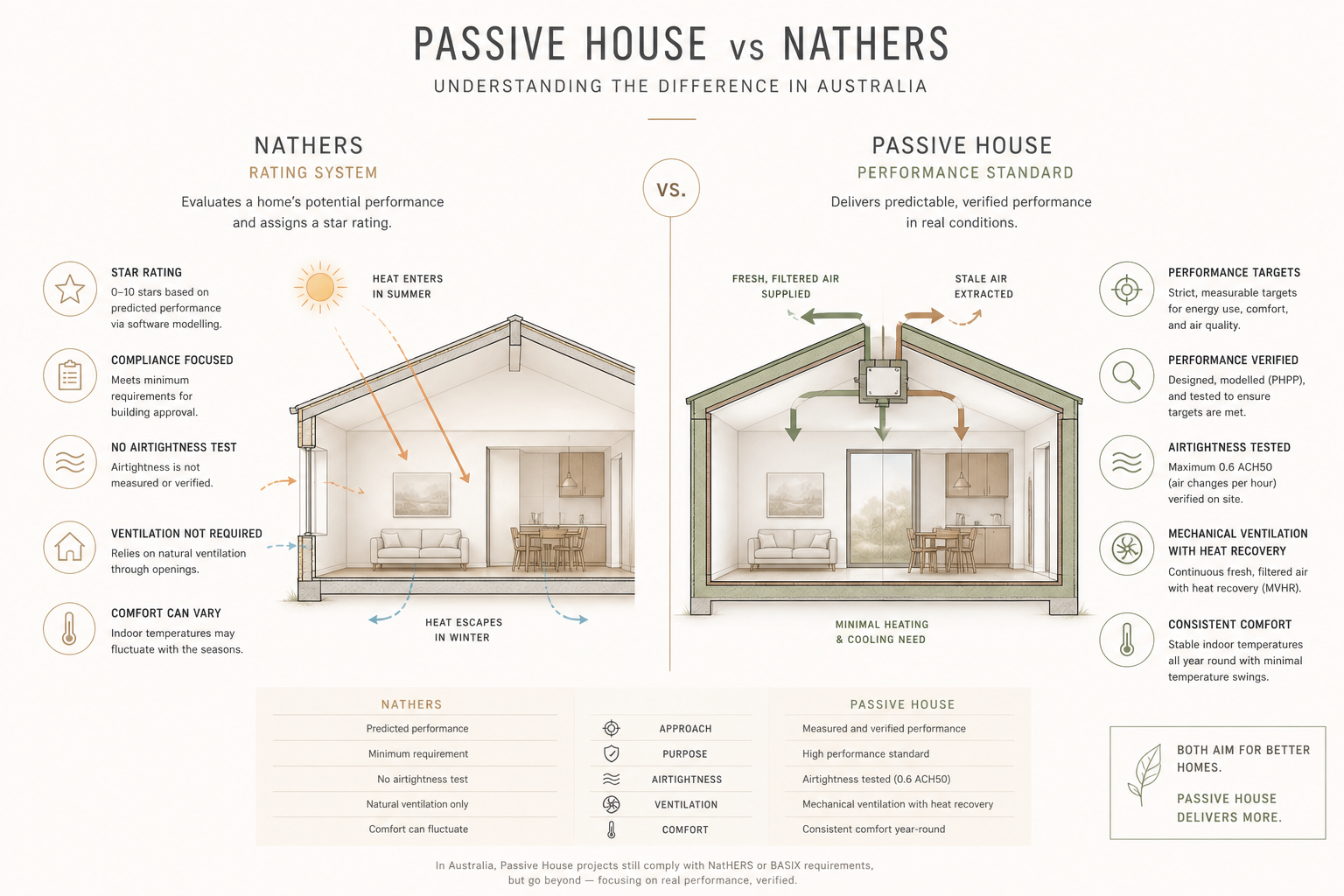
NatHERS is Australia’s national home energy-rating framework. Its thermal assessment models the predicted heating and cooling needs of a dwelling and expresses the result as a star rating between zero and ten. NatHERS assessments are commonly used to help demonstrate residential energy-efficiency requirements under the National Construction Code, subject to the pathway adopted in the relevant state or territory.
Passive House is a separate voluntary building standard. It combines energy balancing through the Passive House Planning Package, known as PHPP, with defined requirements relating to the building envelope, airtightness, windows, thermal bridges, controlled ventilation and construction verification.
This comparison focuses on where the systems overlap and where their boundaries differ. For a complete explanation of each framework, see the NatHERS Knowledge Hub and the Passive House in Australia guide.
In Brief
A Rating Framework and a Building Standard
NatHERS
An Australian home energy-rating framework that produces a thermal star rating and, where applicable, a separate Whole of Home energy rating.
Passive House
A voluntary international building standard using PHPP energy balancing, coordinated envelope design, airtightness, controlled ventilation and verification.
Core Difference
A NatHERS star rating does not convert directly into Passive House certification, and Passive House does not replace mandatory Australian compliance requirements.
A project may use both systems. NatHERS can address the applicable Australian rating or compliance role, while Passive House may provide an additional design, modelling and verification objective.
Shared Performance Territory
Why Are Passive House and NatHERS Often Compared?
Both systems consider how the residential design responds to its climate. Building form, orientation, windows, insulation, shading and construction assemblies can influence the calculated heating and cooling performance under either methodology.
This shared territory can make Passive House appear to be a higher level of NatHERS. That interpretation is incomplete. The systems use different calculation methods, assumptions, performance criteria and documentation pathways. They also produce different forms of evidence.
The most useful comparison is therefore not which system gives the “better” number. It is what question each system is designed to answer and what the resulting assessment demonstrates.
Framework Purpose
What Is Each System Designed to Do?
NatHERS provides a nationally recognised method for assessing Australian homes. The thermal star rating predicts the heating and cooling needs of the dwelling based on its design, construction and local climate. NatHERS is widely used within residential approval and energy-efficiency processes.
Passive House establishes a defined building-performance and quality-assurance framework. It is intended to coordinate low energy demand with envelope performance, airtightness, controlled ventilation, detailed modelling and verification against the applicable Passive House criteria.
NatHERS may therefore hold a regulatory or rating role on an Australian project. Passive House is normally a separate project objective adopted voluntarily by the owner, architect, developer or project team.
Comparison at a Glance
Passive House vs NatHERS: The Main Differences
Australian Rating Framework
NatHERS
Voluntary Building Standard
Passive House
Assessment Methodology
NatHERS Software and PHPP Are Not Interchangeable
A NatHERS thermal assessment is completed using software accredited for use within the national scheme. The assessor models the dwelling geometry, construction, insulation, glazing, shading, orientation and climate under the applicable NatHERS settings and conventions.
PHPP is the energy-balancing and planning tool used for Passive House, EnerPHit and PHI Low Energy Building assessment. It brings together the relevant building-envelope, window, shading, thermal-bridge, airtightness, ventilation and building-services information under the Passive House methodology.
The two models use different calculation structures, floor-area conventions, climate data, operating assumptions and assessment criteria. A result from one model therefore cannot be entered into a simple conversion formula to predict the outcome under the other.
Where a project uses both systems, the NatHERS model and PHPP assessment should be treated as separate technical workstreams supported by consistent architectural and construction information.
Assessment Outputs
Star Rating vs Performance Criteria
NatHERS Thermal Rating
Zero to Ten Stars
The star rating communicates the dwelling’s predicted thermal performance under the NatHERS methodology. Higher ratings generally indicate lower modelled heating and cooling requirements.
Passive House Assessment
Defined Building Criteria
PHPP is used to assess the building against the applicable Passive House criteria, including relevant energy-demand, load, summer-performance and primary-energy measures.
A Passive House is not awarded a NatHERS-equivalent star level through PHPP. Likewise, a NatHERS certificate does not demonstrate that the Passive House criteria, documentation and verification requirements have been satisfied.
Operational Energy Boundary
Where Does NatHERS Whole of Home Fit?
The NatHERS thermal star rating does not assess the efficiency of the selected household appliances or the effect of on-site renewable-energy systems. These are addressed through the separate NatHERS Whole of Home rating.
Whole of Home considers major energy use and generation associated with heating and cooling equipment, hot water, lighting, cooking, plug-in appliances, pool and spa equipment, solar generation and battery storage.
Passive House also addresses wider building energy demand through its own methodology, but PHPP and Whole of Home are not equivalent assessments. They use different inputs, conventions, metrics and intended outputs.
For a dedicated explanation of fixed systems, appliances and renewable-energy inputs, see the Whole of Home Knowledge Hub.
Envelope and Ventilation
How Do the Systems Treat Airtightness and Ventilation?
Passive House treats airtightness as a defined element of the building standard. The airtight layer must be designed as a continuous part of the envelope, and the completed building is subject to airtightness testing where formal certification is pursued.
Controlled mechanical ventilation with heat recovery is one of the recognised Passive House principles. The system must be considered alongside the envelope, building layout, climate, duct routes, equipment selection, installation and commissioning requirements.
NatHERS software uses the inputs and operating assumptions required under its accredited methodology. A design-stage NatHERS certificate, however, is not an on-site airtightness test and does not by itself demonstrate that a proposed mechanical ventilation system has been installed, balanced or commissioned.
This is a difference in assessment scope rather than evidence that one system is universally more appropriate. The necessary scope depends on the project objective and regulatory context.
Detailed Envelope Treatment
Windows and Thermal Bridges Are Assessed Differently
Both systems consider windows as part of the dwelling’s thermal response. NatHERS modelling incorporates the documented window size, orientation, frame, glazing performance and shading in accordance with the accredited software methodology.
Passive House assessment also considers the complete installed window condition. This may include the frame, glazing, spacer, installation position, solar exposure, shading and the thermal effect of the surrounding junction.
Thermal bridges are explicitly coordinated within the Passive House pathway because slab edges, structural connections, balconies, roof junctions, penetrations and window installations can affect the complete energy balance and internal surface conditions.
The treatment of junctions under NatHERS follows the applicable scheme and software rules. It should not be assumed to represent the same project-specific thermal-bridge analysis used within a Passive House certification pathway.
Rating Boundaries
Does a High NatHERS Rating Equal Passive House?
No. A high NatHERS rating may indicate that the dwelling has relatively low predicted heating and cooling needs under the NatHERS methodology. It does not establish compliance with Passive House energy criteria, airtightness requirements, ventilation provisions, thermal-bridge assessment or certification evidence.
Conversely, a project being developed toward Passive House performance should not assume a particular NatHERS result without completing the separate NatHERS assessment. Different assumptions and calculation methods can lead to results that do not align in a simple or uniform way.
Statements such as “Passive House equals eight or nine stars” may be useful as informal observations about particular projects, but they are not a formal conversion rule and should not be used as project evidence.
Combined Project Pathway
Can a Home Be Assessed Under Both Systems?
Yes. A project may complete a NatHERS assessment for an applicable Australian rating or approval purpose while separately using PHPP to develop a Passive House design and certification pathway.
Using both does not mean that every input will be identical. Each model follows its own definitions and conventions. The underlying architectural information should nevertheless describe the same building, including its geometry, orientation, envelope systems, windows and shading.
Changes made in response to one assessment should be checked against the other where they affect the shared design. A window substitution, revised insulation build-up, shading change or altered building form may influence both models even though the calculated effects differ.
Formal Passive House certification remains separate from the NatHERS assessment and must be undertaken through the applicable independent certification process.
Project Decision
Which Pathway Does an Australian Project Need?
The mandatory pathway is determined by the project location, building classification, approval circumstances and the energy-efficiency provisions adopted by the relevant state or territory. NatHERS is commonly used to demonstrate those requirements, but alternative methods may exist.
Passive House is normally considered in addition to those obligations. It may be selected where the project team wants a defined envelope-led performance standard, detailed energy balancing, airtightness testing, controlled ventilation and a formal independent certification pathway.
The question is therefore not always “NatHERS or Passive House?”. It may instead be “What must the project demonstrate for approval, and what additional performance standard does the project intend to pursue?”
Scope Considerations
What Should Be Clarified at the Start?
Approval Context
Mandatory Requirements
Confirm the NCC, state or territory pathway applying to the project and whether a NatHERS assessment is required or selected.
Performance Objective
Intended Passive House Scope
Distinguish between applying selected principles, undertaking PHPP-informed design and pursuing formal building certification.
Design Stage
Available Design Flexibility
Establish whether building form, glazing, shading, envelope build-ups and ventilation routes can still be coordinated.
Project Roles
Assessment and Verification
Confirm responsibility for NatHERS assessment, PHPP, detailed design, airtightness testing, commissioning and independent certification.
Project Coordination
Keep Both Assessments Connected to the Design
Where both systems are used, each assessment should be updated from the current project information. The NatHERS certificate, PHPP model, architectural drawings, window schedules, envelope specifications and relevant construction details should not describe materially different designs.
Geometry
Plans, elevations, sections, orientation and envelope dimensions should reflect the current design.
Envelope
Wall, roof and floor systems, insulation, windows, doors and shading should remain coordinated.
Design Changes
Changes affecting shared inputs should be reviewed in both assessments before earlier results are relied upon.
The final results may still differ because the methodologies are not the same. Coordination means that both assessments are based on the intended project, not that they must produce equivalent numerical outcomes.
Common Misunderstandings
What Passive House and NatHERS Should Not Be Confused With
Passive House is not a higher NatHERS star band. It is a separate building standard using a different assessment methodology.
A strong NatHERS result is not Passive House certification. Separate criteria, modelling, testing and evidence apply.
Passive House does not replace the NCC. Mandatory Australian requirements still need to be addressed through the applicable project pathway.
PHPP is not NatHERS software. Each model has its own inputs, conventions, outputs and evidence requirements.
NatHERS Whole of Home is not Passive House. It is a separate Australian operational-energy rating within the NatHERS framework.
The systems are not always competing choices. A project may need NatHERS and separately choose to pursue Passive House.
Frequently Asked Questions
Passive House vs NatHERS FAQs
Is Passive House the same as NatHERS?
No. NatHERS is Australia’s national home energy-rating framework. Passive House is a separate voluntary building standard using PHPP, defined performance criteria, airtightness, controlled ventilation and project verification.
Does a 7 Star NatHERS home qualify as a Passive House?
Not automatically. Seven stars is a NatHERS thermal-rating outcome. Passive House uses different criteria and also requires consideration of airtightness, thermal bridges, ventilation, energy demand and project evidence.
What NatHERS rating does a Passive House achieve?
There is no fixed NatHERS rating for a Passive House. The result depends on the project, climate and NatHERS model. A separate NatHERS assessment is required to determine the star rating.
Does Passive House replace NatHERS compliance?
Not universally. The applicable compliance method depends on the project location and approval pathway. Passive House does not remove the need to satisfy the NCC, BASIX or other mandatory jurisdictional requirements.
Can a house have both a NatHERS certificate and Passive House certification?
Yes. The NatHERS assessment and Passive House certification remain separate, but both can be completed for the same project where the design and project objectives require them.
Does NatHERS assess airtightness?
The NatHERS model follows the infiltration and ventilation assumptions required by its accredited methodology. A design-stage NatHERS certificate is not an on-site airtightness test and does not verify the completed building’s measured air leakage.
Does Passive House always require mechanical ventilation?
Controlled mechanical ventilation with heat recovery is one of the recognised Passive House principles. The specific system design must respond to the building, climate and applicable certification criteria.
Is PHPP more accurate than NatHERS?
The tools are designed for different frameworks and should not be reduced to a general accuracy ranking. Each uses its own methodology, assumptions, inputs and validation context. The appropriate tool depends on the assessment being undertaken.
Does NatHERS include household appliances and solar panels?
The thermal star rating focuses on the dwelling’s heating and cooling needs. Major appliances, fixed systems, solar generation and batteries are considered through the separate NatHERS Whole of Home rating.
When should the two pathways be coordinated?
Ideally, the project roles and assessment objectives are clarified during concept or early design. This allows building form, glazing, shading, envelope assemblies and ventilation planning to be considered before the documentation becomes fixed.
Related Guidance
Explore the Connected Residential Systems
Residential Performance Review
Need to Clarify NatHERS and Passive House for a Project?
Send the available plans, project location and performance objectives for an initial scope review. Certified Energy can help clarify the applicable NatHERS assessment requirements, the current design stage and whether a separate Passive House pathway or specialist role is being considered.
Send Your Project Documents