


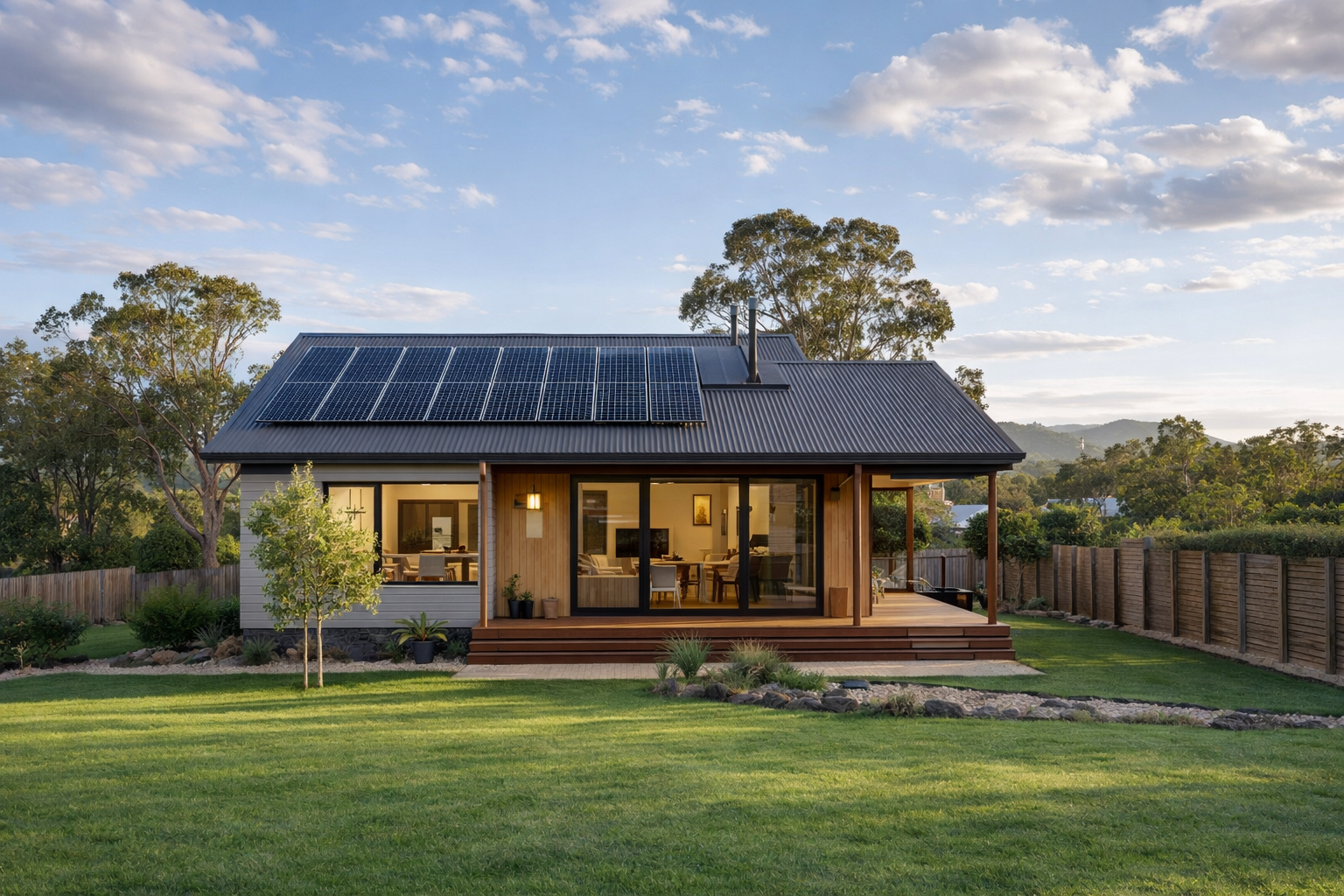
The Future of Sustainable Housing in Australia
Part 1 — What We’re Actually Seeing in Homes Today.
If you spend enough time inside existing homes, not just reviewing plans but observing how they actually perform, patterns begin to emerge.
Not occasionally. Consistently.
Across different suburbs, builders, and housing types, the same issues appear again and again.
Homes that look complete at handover, but do not perform once people begin living in them.
Rooms that overheat during Australian summers.
Spaces that lose warmth quickly in winter.
Heating and cooling systems working constantly just to maintain a basic level of comfort.
This is what the field is showing.
And it matters, because a home does not just exist at the moment it is constructed. It shapes daily life for the people living inside it for decades.
LOOKING BEYOND SUPPLY
In Australia, the housing conversation is often focused on supply, affordability, and planning approvals.
These are real and important challenges.
But there is another question that receives far less attention:
What kind of homes are we actually building?
Because the performance of a home determines far more than its appearance or compliance at completion.
It determines how comfortable it feels to live in.
How much energy is required to maintain that comfort.
How the building responds to the local climate over time.
These outcomes are not theoretical. They are experienced every day by the people living in these homes.
WHEN PERFORMANCE BECOMES VISIBLE
For most homeowners, building performance does not show up immediately as a technical issue.
It shows up as experience.
A bedroom that is too hot to sleep in.
A living area that never quite warms up in winter.
An air conditioning system that seems to run constantly.
Over time, this becomes visible in another way: energy bills.
Residential buildings account for approximately 24% of Australia’s total electricity consumption, making them one of the largest contributors to electricity demand in the country. When homes perform poorly, the impact extends beyond the household into the broader energy system.
What starts as a comfort issue becomes a cost issue.
And ultimately, a system wide issue.
A MOMENT THAT STAYED WITH ME
Several years ago, I worked on a project supporting improvements to the thermal performance of newly constructed housing.
At one point, homes were ready for handover.
Occupants had been waiting years.
But during the second week of January, when those homes were entered for the first time, they were too hot to safely occupy.
Handover was delayed.
That was not an isolated failure.
It reflected something broader.
We have been building in similar ways for a long time, often without fully responding to local climate conditions.
And when that happens, performance issues are not occasional.
They are predictable.
THIS IS NOT ABOUT ONE DECISION
One of the most important things to understand is that building performance is rarely determined by a single major choice.
It comes from a series of smaller decisions made early in the process.
Orientation on the site.
Window placement and shading.
Insulation levels.
How the building interacts with sunlight and airflow.
Individually, these decisions may seem minor.
Together, they determine whether a home works with the climate or against it.
WHAT THIS MEANS
Australia is entering a period where a large number of new homes will be built.
That creates pressure on the system.
But it also creates a clear opportunity.
Because every home built today becomes part of the national housing stock for decades to come.
If performance is not considered early, the same patterns we are seeing now will continue.
If it is considered, the outcome is straightforward:
More stable indoor temperatures.
Lower energy demand.
Homes that are simply easier to live in.
LOOKING AHEAD
We already understand what works.
Across Australia, there are clear examples of homes designed to respond well to climate. Homes that maintain comfort with far less reliance on mechanical systems.
The challenge now is not invention.
It is consistency.
Applying what we already know, more deliberately and more broadly.
Because every building placed into the landscape becomes part of the environment people will live in, not just today, but for generations.
And that makes this more than a design decision.
It makes it a responsibility.