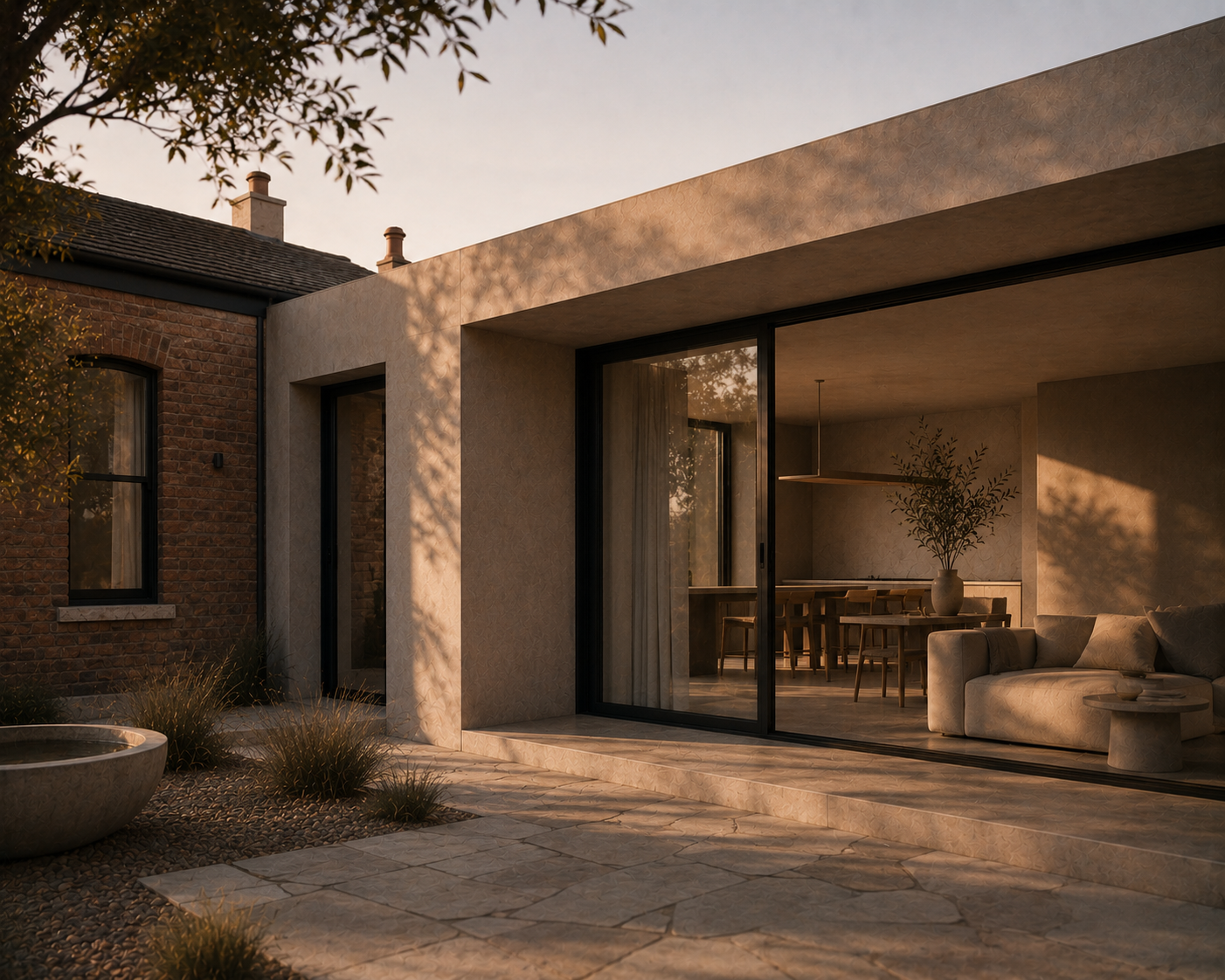



Thermal performance is the part of BASIX that assesses how much artificial heating and cooling a proposed dwelling is expected to require. It considers how the building envelope responds to the local climate before the efficiency of the installed heating or cooling equipment is taken into account.
The result is influenced by the dwelling geometry, orientation, glazing, shading, insulation, construction systems and exposure to external conditions. BASIX compares the estimated or simulated heating and cooling loads with the maximum loads allowed for the project.
A project must satisfy the applicable heating and cooling requirements using an accepted assessment method. Depending on the dwelling and project pathway, this may be the BASIX DIY Method, NatHERS Simulation Method or Passive House Standard method.
In Brief
What Does BASIX Thermal Performance Measure?
BASIX thermal performance measures the estimated heating and cooling energy needed to maintain suitable indoor conditions within a proposed dwelling. Heating and cooling are assessed separately against maximum loads determined for the project’s climate and dwelling type. Lower loads generally indicate that the building envelope requires less artificial heating or cooling. The thermal result is separate from the BASIX Energy score, although lower thermal loads can improve that score.
Knowledge Navigation
Understanding the Thermal-Performance Assessment
Assessment Results
Heating and Cooling Loads
What the loads represent and why both must satisfy their limits.
Assessment Pathways
DIY, Simulation or Passive House
How the accepted thermal-performance methods differ.
NatHERS
Stars and BASIX Caps
Why a star rating and the BASIX thermal result are related but not identical.
Documentation
Certificates and Plans
How the thermal assessment must align with the BASIX application.
What Is Thermal Performance in BASIX?
The thermal-performance assessment examines how the dwelling itself responds to seasonal temperatures and solar conditions. It focuses on the design and construction of the building envelope rather than the efficiency rating of the air-conditioning or heating appliance eventually installed.
The building envelope includes the floors, external walls, roofs, ceilings, windows, glazed doors, skylights, insulation and relevant shading elements separating internal conditioned spaces from outside or from unconditioned areas.
BASIX uses the design information to estimate or calculate how much heat would need to be added during colder conditions and removed during warmer conditions. These outcomes are expressed as heating and cooling loads.
The purpose is not to predict the precise temperature of every room or the future occupant’s actual electricity bill. It is to compare the proposed design with a consistent regulatory thermal-performance standard for its location and development type.
Terminology
Is BASIX Thermal Comfort the Same as Thermal Performance?
The expressions are commonly used interchangeably. Earlier BASIX guidance and industry documentation often referred to the Thermal Comfort section, while the current NSW Planning Portal principally uses the term Thermal Performance.
Both terms refer to the part of the BASIX assessment concerned with modelled heating and cooling demand. However, the assessment should not be interpreted as a guarantee that every future occupant will experience the same level of comfort.
Actual indoor comfort is also affected by construction quality, air movement, humidity, appliance use, window operation, occupant behaviour and local conditions that may differ from the standardised assessment assumptions.
What Are Heating and Cooling Loads?
A heating load represents the amount of heat energy that would need to be added to the dwelling to maintain internal temperatures within the assessment range during colder conditions.
A cooling load represents the amount of heat energy that would need to be removed to maintain the relevant internal conditions during warmer periods.
| Thermal Result | What It Represents | Passing Principle |
|---|---|---|
| Heating load | The modelled demand for adding heat during colder conditions. | The result must remain below the applicable maximum heating load. |
| Cooling load | The modelled demand for removing heat during warmer conditions. | The result must remain below the applicable maximum cooling load. |
| Total load | The sum of the heating and cooling loads. | A maximum total load can also apply to certain dwelling types and climate locations. |
Lower thermal loads generally indicate that less artificial heating or cooling would be needed under the standardised assessment conditions. However, heating and cooling must still be considered separately.
A very low heating load does not compensate for an excessive cooling load, and a low cooling result does not offset a heating failure. The dwelling must satisfy each applicable cap independently.
Thermal Loads Are Not the Same as Household Energy Use
Thermal performance measures the heating and cooling demand created by the building design. It does not by itself calculate the future household’s total electricity or gas use.
Building Demand
Thermal Performance
Examines the heating and cooling demand created by the building envelope, climate, glazing, shading and construction.
Equipment and Fuel
BASIX Energy
Considers the selected heating and cooling systems, efficiency, fuel source and wider operational-energy measures.
A dwelling with high thermal loads may still contain efficient air-conditioning equipment, but the building itself would require more heating or cooling to maintain the modelled conditions.
Conversely, a well-performing envelope reduces the demand that the equipment needs to meet. BASIX uses the thermal loads together with the nominated appliances when calculating the heating and cooling component of the Energy score.
Actual energy bills will still depend on equipment, tariffs, construction quality, occupant behaviour, thermostat settings and the amount of time the systems are operated.
The Three BASIX Thermal-Performance Methods
BASIX provides three accepted methods for demonstrating thermal performance. The correct method depends on the dwelling type, design complexity, location and project pathway.
| Method | Typical Application | Assessment Basis | Professional Involvement |
|---|---|---|---|
| DIY Method | Eligible single dwellings using common construction systems and within the method limits. | Web-based deemed-to-satisfy inputs that estimate heating and cooling loads. | A NatHERS assessor is not inherently required to operate the DIY Method. |
| Simulation Method | Complex single dwellings, townhouses, apartments and other multi-dwelling projects. | Detailed NatHERS thermal simulation using accredited software. | An appropriately accredited assessor completes the model and issues an Assessor Certificate. |
| Passive House Standard | Eligible Passive House projects in locations where the pathway is available. | Assessment through the Passive House Planning Package and Passive House requirements. | A certified Passive House designer or certifier prepares and verifies the required documentation. |
Assessment Method 01
The BASIX DIY Method
The DIY Method is a web-based deemed-to-satisfy pathway for eligible single dwellings using common building forms and construction systems.
The applicant enters the dwelling construction, insulation, windows, glazed doors, skylights and recognised shading elements. BASIX estimates the heating and cooling loads and compares them with the maximum loads applicable to the project.
The DIY Method is subject to eligibility limits relating to matters such as:
- the dwelling type
- conditioned floor area
- number of storeys
- mezzanines and habitable attic areas
- the number and area of windows and glazed doors
- the relationship between glazing area and floor area
- skylight area
- the available construction and shading selections
Where the project falls outside the DIY limits, the Simulation Method should generally be used. Simulation can also be selected voluntarily where the project team needs greater modelling flexibility or wishes to test design responses that cannot be represented adequately in the simplified method.
Assessment Method 02
The NatHERS Simulation Method
The Simulation Method uses NatHERS-accredited software to calculate the thermal performance of the proposed dwelling in greater detail.
An accredited assessor creates a digital model from the architectural plans and construction information. The software considers the geometry, zoning, orientation, climate, building fabric, insulation, glazing, shading, air movement and relationship between the dwelling and adjacent spaces.
The assessor then issues a NatHERS Assessor Certificate containing the thermal star rating and the heating and cooling loads. The relevant area-adjusted loads are entered into the BASIX assessment and compared with the project’s BASIX caps.
Simulation is generally required or particularly relevant for:
- townhouses and villas
- dual occupancies
- apartment developments
- complex or large single dwellings
- designs outside the DIY Method limits
- unusual construction systems
- projects requiring detailed design optimisation
The Simulation Method may allow design features, construction types and shading conditions to be represented more accurately than the DIY Method. This does not mean Simulation automatically produces a passing result; it provides a more detailed calculation of the proposed design.
Assessment Method 03
The Passive House Standard Method
The Passive House Standard method is an alternative BASIX thermal-performance pathway for eligible projects designed and assessed in accordance with the Passive House standard.
A certified Passive House designer or certifier uses the Passive House Planning Package to verify the proposed dwelling’s performance. The supporting report must demonstrate that the applicable heating, cooling and airtightness requirements have been satisfied.
The method is only available in NSW locations where it has been accepted as an appropriate alternative to the BASIX Simulation Method. Location eligibility should therefore be confirmed before the project relies on this pathway.
Passive House documentation remains part of the wider BASIX approval package. The project must also complete the applicable BASIX water, energy, materials and project-detail sections.
View the official Passive House Standard method requirements →
Which Thermal-Performance Method Should a Project Use?
The method should be selected from the project type, design complexity, intended construction and available professional documentation.
Use the DIY Method for an eligible, relatively conventional single dwelling
The design must remain within the prescribed DIY limits and use construction, glazing and shading options that can be represented within the tool.
Use Simulation where the project is complex or contains multiple dwellings
Simulation is the normal pathway for townhouses and apartments and can represent a broader range of design and construction conditions.
Use the Passive House method only where the complete project follows that standard
The project needs the required professional involvement, PHPP documentation, location eligibility and later quality-assurance evidence.
Confirm the method before the assessment is finalised
Changing the thermal pathway can alter the supporting documents, assessment inputs and commitments that need to appear on the plans.
How Do NatHERS Stars Relate to BASIX?
A NatHERS thermal star rating summarises the modelled heating and cooling demand of a dwelling on a scale from zero to ten stars. A higher star rating generally represents lower combined heating and cooling demand.
BASIX uses the detailed heating and cooling loads from the NatHERS assessment rather than relying only on the overall star rating. The project may need to satisfy a star requirement as well as separate heating, cooling and total-load caps.
| Measure | What It Communicates | BASIX Relevance |
|---|---|---|
| NatHERS star rating | A single summary of the dwelling’s combined thermal performance. | A minimum star result may form part of the applicable higher thermal-performance standard. |
| Heating load | The modelled demand for heating in the project climate. | Must remain below the applicable BASIX maximum heating load. |
| Cooling load | The modelled demand for cooling in the project climate. | Must remain below the applicable BASIX maximum cooling load. |
A dwelling can achieve a favourable overall star rating while still having an excessive heating or cooling result for its BASIX climate caps. The reverse can also occur where project-specific standards differ from a simple universal star threshold.
For many new homes, the current higher BASIX standards align broadly with 7-Star NatHERS outcomes. However, building type, climate zone and applicable transition or exception provisions must still be checked. It is not accurate to treat one star number as the complete BASIX thermal requirement for every NSW project.
Dwelling Types
Do Houses and Apartments Have the Same Thermal Requirements?
No. The applicable standards and assessment structure depend on the type of residential development.
A detached or attached house is assessed as an individual dwelling. Where the current higher standards apply, the project can be subject to a minimum NatHERS star outcome together with revised heating and cooling caps.
Apartment developments are assessed across multiple dwellings. Requirements can include a minimum result for each apartment, an average result across the building and separate individual or average heating and cooling caps.
Apartment position also influences performance. A top-floor or corner dwelling may have more external exposure, while an intermediate apartment can benefit from adjoining conditioned spaces but may have different solar access or ventilation opportunities.
Explore BASIX for apartments and residential flat buildings →
Why Climate Changes the BASIX Thermal Result
NSW contains warm-humid, temperate, cool, cold and alpine conditions. A design response that performs well in one region may not produce the same result elsewhere.
BASIX assigns maximum heating and cooling loads using the applicable NatHERS climate region. The climate data represents recurring local temperature, solar and weather patterns used in the assessment.
A cooler inland or elevated location may place greater pressure on the heating result. A warm coastal or western location may be more strongly constrained by cooling demand. Some climates require careful balancing because a measure that reduces summer heat gain can also reduce useful winter solar gain.
The assessment should therefore be based on the actual project address and site orientation. A thermal specification from another development should not be assumed to produce the same result at a different location.
What Influences a BASIX Thermal-Performance Result?
Thermal performance is produced by the interaction of several building-design factors. No individual product or design measure determines the complete result.
Climate and Orientation
The site location and direction of the dwelling influence solar exposure and seasonal heating and cooling demand.
Windows and Glazed Doors
Window size, orientation, frame, glass and thermal properties affect heat gain, heat loss and solar access.
External Shading
Eaves, balconies, awnings and other external devices can change summer and winter solar access.
Insulation and Construction
Floors, walls, ceilings, roofs, framing and insulation determine how heat moves through the building envelope.
Ventilation and Air Movement
Openings, breeze paths and ceiling fans can influence how cooling conditions are represented within the assessment.
Building Form and Exposure
Floor area, ceiling height, zoning, external surface area, party walls, garages and adjacent spaces affect the modelled loads.
These factors are introduced here only to explain what shapes the thermal result. Their detailed design and specification remain the responsibility of the relevant specialist pages and the project-specific assessment.
Envelope Detail
How Do Thermal Bridging and Airtightness Fit BASIX?
Thermal bridging occurs where heat can move through a more conductive part of the building assembly, reducing the effective performance of the surrounding insulation. Steel framing and interruptions in the insulation layer can be relevant examples.
The relevant construction and thermal-break requirements must be represented accurately in the assessment and carried into the plans and specifications.
Airtightness relates to uncontrolled air leakage through the building envelope. It can affect actual building performance, but it should not be presented as a standalone universal BASIX score or as a general requirement for every project to undergo blower-door testing.
Understand airtightness and BASIX →
Projects using the Passive House Standard method have separate airtightness verification and testing requirements associated with that pathway.
Which Thermal-Performance Documents Must Match?
The thermal assessment is not an isolated calculation. Its assumptions and commitments must align with the wider approval documentation.
| Document | Purpose | Key Coordination |
|---|---|---|
| Architectural plans | Define the proposed dwelling geometry and approval design. | Dimensions, room layouts, windows, shading, orientation and construction must match the assessment. |
| NatHERS Assessor Certificate | Records the Simulation Method result and assessed building features. | The Certificate and linked drawings must represent the same dwelling entered in BASIX. |
| BASIX Certificate | Records the project’s regulatory sustainability commitments. | The thermal method, loads and relevant envelope commitments must be consistent with the assessment documents. |
| Schedules and specifications | Communicate the products and construction requirements for procurement. | Glazing values, insulation, framing, thermal breaks and shading must meet the assessed requirements. |
Where the Simulation Method is used, both the BASIX Certificate and NatHERS documentation form part of the lodgement package. The dwelling address, drawing revisions, unit identifiers and assessment details should be consistent.
What Does the NatHERS Assessor Certificate Show?
For the Simulation Method, the accredited assessor issues a NatHERS Assessor Certificate through the approved certificate-generation system.
The documentation can include:
- the dwelling address and assessment details
- a unique certificate number and QR code
- the NatHERS thermal star rating
- heating and cooling loads
- assessed floor area
- construction and insulation details
- window and glazed-door performance
- shading and ceiling-fan assumptions
- the drawing set associated with the assessment
For an apartment development, a project summary may be accompanied by individual dwelling Certificates. The dwelling identifiers should allow each result to be traced to the correct apartment in the architectural set.
The NatHERS Certificate supports the BASIX thermal result. It does not replace the BASIX Certificate or the requirement to complete the other BASIX assessment sections.
Assessment Outcome
What Happens If the Thermal Result Does Not Pass?
The BASIX Certificate cannot be finalised until the project satisfies the applicable thermal-performance requirements.
The first step is to confirm that the assessment model or DIY inputs match the current plans. Incorrect orientation, window sizes, construction systems, insulation or shading can produce a result that does not represent the actual design.
Where the information is correct, the assessor can identify whether heating, cooling or both are above the relevant limits. The appropriate response should then address the specific problem rather than apply unrelated upgrades across the project.
Possible changes may involve glazing, shading, insulation, construction, building form or air-movement assumptions. The most effective solution depends on the climate, orientation and reason the assessment is failing.
Does Passing BASIX Eliminate Overheating Risk?
Passing the cooling-load requirement demonstrates compliance with the applicable BASIX thermal standard. It does not guarantee that overheating can never occur in the completed home.
Overheating can still be influenced by local urban heat, unusual weather, construction quality, internal heat gains, occupant behaviour, window operation and future changes around the site.
Projects with extensive glazing, limited natural ventilation, strong western exposure or highly occupied internal spaces may require more detailed consideration than the minimum compliance result alone provides.
What If the Design Changes After the Thermal Assessment?
Changes to the building envelope should be reviewed before they are incorporated into the approval or construction documents.
Changes that can affect the result include:
- altered floor plans or conditioned areas
- relocated, enlarged or reduced windows
- changes to glass, frames, U-values or SHGC values
- different wall, floor or roof systems
- changes to insulation levels
- revised eaves, balconies or external shading
- changes to colours or solar absorptance where relevant
- changed ceiling fans or ventilation assumptions
- changes to adjoining dwellings, garages or unconditioned spaces
A revised thermal model may produce new loads, star ratings or construction requirements. Where the BASIX inputs or commitments change, the BASIX assessment and Certificate may also need to be revised.
Common Misunderstandings About BASIX Thermal Performance
Thermal performance is another BASIX percentage score
Thermal performance is assessed using heating and cooling loads and, where applicable, NatHERS star requirements rather than another water-style percentage.
A higher heating or cooling load is better
Lower loads generally indicate less modelled demand for artificial heating or cooling.
A good combined result allows either heating or cooling to fail
Heating and cooling caps are separate. Both applicable limits must be satisfied.
Every NSW dwelling only needs to reach 7 stars
The complete requirement can also include heating and cooling caps and varies according to climate, dwelling type and applicable standards.
Efficient air conditioning fixes a thermal failure
Appliance efficiency affects the BASIX Energy assessment. It does not remove excessive heating or cooling demand created by the building envelope.
Double glazing automatically makes the project pass
Glazing is one part of the design. Orientation, size, shading, frame performance and the rest of the building envelope remain relevant.
Once assessed, the thermal specification can be changed freely
Changes to assessed windows, insulation, construction or shading should be checked before substitution or construction.
Frequently Asked Questions
BASIX Thermal Performance FAQs
What does BASIX thermal performance assess?
It assesses the estimated heating and cooling demand created by the dwelling design, construction, glazing, insulation, shading and local climate.
What is the difference between a heating load and a cooling load?
The heating load represents the heat that would need to be added during colder conditions. The cooling load represents the heat that would need to be removed during warmer conditions.
Is a lower thermal load better?
Generally, yes. A lower load indicates less modelled demand for artificial heating or cooling. The project must remain below each applicable BASIX maximum load.
Does every BASIX project require a NatHERS assessment?
No. Eligible single dwellings may use the BASIX DIY Method. NatHERS Simulation is used for multi-dwelling projects and projects requiring or selecting the more detailed simulation pathway.
Is a 7-Star NatHERS rating enough to pass BASIX?
Not necessarily. The dwelling may also need to satisfy separate BASIX heating, cooling and total-load caps. The applicable standard depends on the climate, building type and project circumstances.
Can a strong heating result compensate for poor cooling performance?
No. Heating and cooling are separate compliance tests. Each applicable result must remain below its own maximum load.
Does BASIX thermal performance predict future energy bills?
No. It assesses standardised heating and cooling demand. Actual energy use also depends on installed systems, tariffs, construction quality, occupancy and how the home is operated.
Can the thermal assessment be completed before the plans are final?
Yes. Preliminary assessment can help identify performance issues during design development. The final assessment and Certificate must reflect the coordinated plans intended for approval.
What happens if windows or insulation change after assessment?
The change should be reviewed against the thermal assessment. A revised NatHERS model, BASIX application or Certificate may be required where the assessed inputs or commitments have changed.
Who can complete the BASIX Simulation Method?
The thermal simulation must be completed by an appropriately accredited assessor using approved NatHERS software. The assessor provides the Assessor Certificate and loads used in the BASIX application.
Related Knowledge
Continue Exploring BASIX Thermal Performance
Assessment note: BASIX thermal-performance requirements vary according to the project location, dwelling type, assessment method and applicable BASIX standards. The project-specific load limits, assessor documentation and Certificate commitments should always be reviewed together.
For regulatory information, refer to the NSW Planning Portal thermal-performance guidance.
Last reviewed: July 2026.
BASIX Thermal Review
Need to Confirm the Thermal-Performance Pathway?
Certified Energy can review the residential plans, confirm the appropriate BASIX and NatHERS pathway and prepare coordinated assessment documentation for the project.
Send Your Plans for Review →