

21 min read

NatHERS vs Whole of Home: What Is the Difference?

By Team CE on Jun 11, 2026 12:43:38 PM

Two NatHERS Ratings Explained

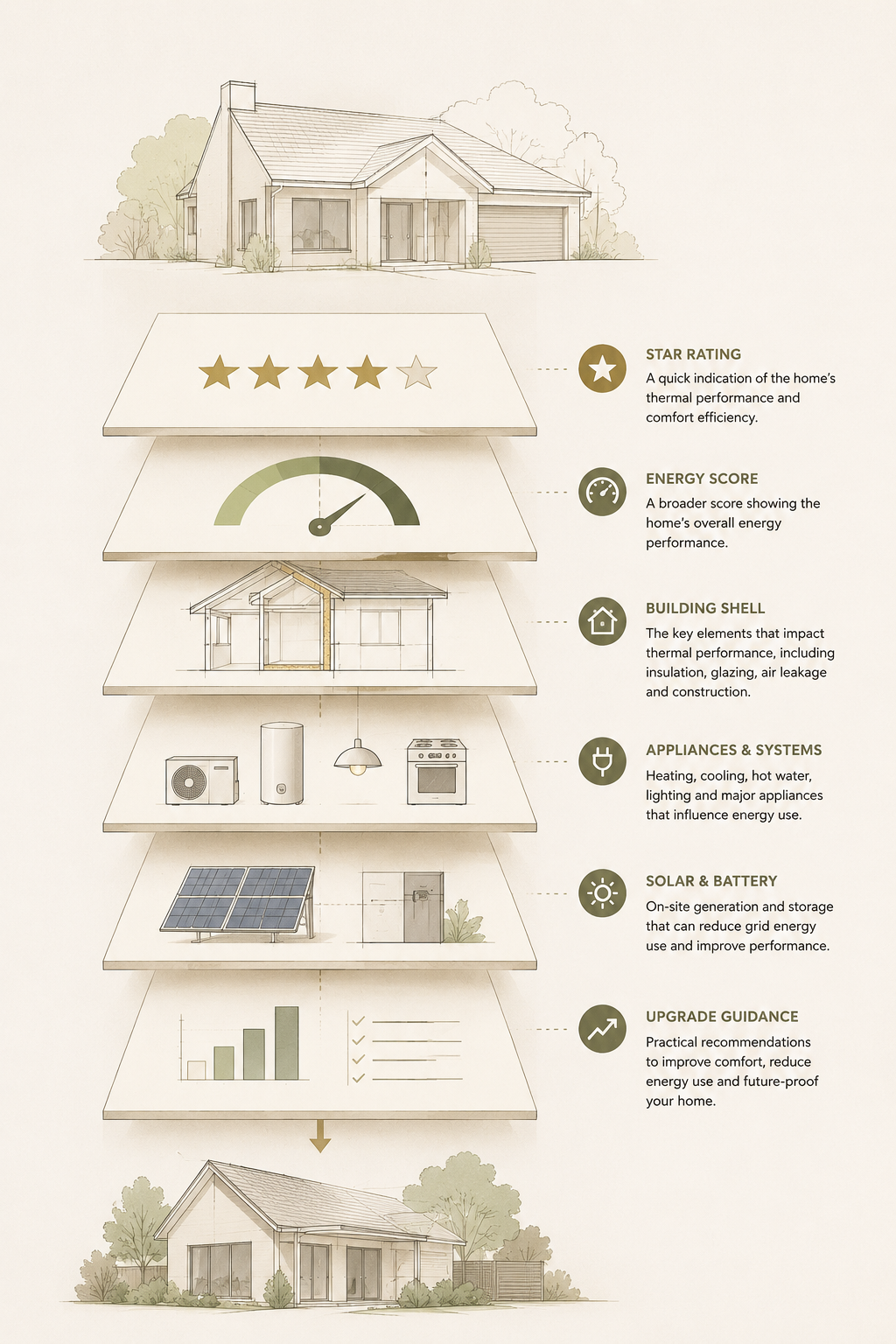
The NatHERS thermal star rating and Whole of Home rating measure different parts of residential energy performance. One assesses the thermal response of the building shell. The other assesses major household energy uses, onsite generation and storage.


NatHERS and Whole of Home are sometimes described as competing assessment methods. This is no longer an accurate way to understand their relationship.

NatHERS is the wider residential energy-rating framework. Within that framework, a proposed home can receive a thermal star rating out of 10 and a separate Whole of Home rating out of 100. The two results answer different questions about the same dwelling.

The thermal star rating asks how much heating and cooling the home is likely to need because of its design and construction. The Whole of Home rating builds on those thermal loads and considers the energy performance of household systems, solar generation and battery storage.

Topics: NatHERS Whole-of-Home Residential Energy Performance
20 min read

BASIX and Whole of Home: What Is Changing?

By Team CE on Jun 6, 2026 3:52:40 PM

BASIX and Whole of Home in NSW

BASIX and the NatHERS Whole of Home rating respond to related residential energy objectives, but they are not interchangeable assessments. Understanding the distinction is important when planning a new residential project in New South Wales.


Residential energy requirements changed significantly when the higher BASIX standards and the State Environmental Planning Policy (Sustainable Buildings) 2022 commenced on 1 October 2023.

At around the same time, NCC 2022 introduced stronger thermal-performance requirements and an annual energy-use budget for new homes. NatHERS was expanded to support these national changes through a separate Whole of Home rating that considers major household energy uses, solar generation and battery storage.

Because both changes look beyond the thermal shell alone, BASIX and Whole of Home are often discussed together. The practical question for a NSW project is not whether one has replaced the other, but how the state-based BASIX pathway relates to the national NatHERS assessment method.

Topics: BASIX Whole-of-Home Residential Energy Performance
24 min read

BASIX and 7 Star NatHERS in NSW | Certified Energy

By Team CE on Jun 6, 2026 3:45:37 PM

NSW Residential Compliance Guide

BASIX is the NSW residential sustainability framework. Where the BASIX Simulation method applies, NatHERS modelling can be used to demonstrate the dwelling’s thermal-performance outcome against the applicable BASIX targets.


BASIX and NatHERS are often discussed together on NSW residential projects, but they are not interchangeable systems. BASIX is the state-based assessment and submission framework. NatHERS is a national residential energy-rating framework that can be used within one of the BASIX thermal-performance methods.

Under the Simulation method, an accredited assessor models the proposed dwelling using approved NatHERS software. The resulting star rating and heating and cooling loads are then used to support completion of the BASIX thermal-performance section.

This guide focuses specifically on how the BASIX thermal pathway and the 7 Star NatHERS benchmark relate. For the complete NSW submission process, certificate requirements and wider water, energy and materials commitments, see the BASIX submission guide.

Topics: BASIX 7 Star Homes Residential Energy Performance
12 min read

Home Energy Rating vs Residential Efficiency Scorecard | Certified Energy

By Team CE on Jun 3, 2026 1:04:59 PM

Current and Former Existing-Home Pathways

Home Energy Rating and the Residential Efficiency Scorecard both relate to existing homes, but they are not interchangeable names for the same assessment.


The Residential Efficiency Scorecard was a separate government-supported assessment program for existing homes. It operated under its own methodology, assessor requirements and reporting arrangements before closing on 23 June 2026.

Home Energy Rating is Certified Energy’s current service name for assessments delivered through NatHERS for existing homes. It is now the relevant pathway where a new assessment of an established dwelling is required.

The comparison is therefore no longer about choosing between two available schemes. It is about distinguishing the current assessment pathway from a former program and understanding what an older Scorecard report still represents.

Topics: Residential Efficiency Scorecard Home Energy Rating Residential Energy Performance
25 min read

How to Prepare for NatHERS Whole of Home Compliance

By Team CE on Aug 18, 2025 10:52:41 AM

Whole of Home Assessment Preparation

A smoother NatHERS Whole of Home assessment depends on confirming the project pathway, coordinating the thermal model and household systems, and ensuring the final plans and specifications match the assessed dwelling.


Preparing for a NatHERS Whole of Home assessment is not simply a matter of adding solar panels or selecting efficient appliances near the end of design.

The Whole of Home result is connected to the thermal performance of the dwelling and to the heating, cooling, hot-water, cooking, lighting, pool, spa, solar and battery information represented in the assessment. When these inputs are incomplete or inconsistent, the project may require additional assumptions, design changes or repeated modelling before certification.

The objective is therefore not only to reach an applicable rating benchmark. It is to reach that outcome using a coordinated design that can be documented, approved and constructed as assessed.

Topics: NatHERS Whole-of-Home Residential Energy Performance
21 min read

How to Design a 7 Star NatHERS Home | Certified Energy

By Team CE on May 12, 2025 2:42:47 PM

7 Star Residential Design Guide

A 7 Star NatHERS home is usually created through coordinated decisions about climate, orientation, building form, glazing, shading, insulation and construction—not by adding one high-performance product at the end of design.


Designing towards a 7 Star NatHERS outcome begins with understanding how the proposed dwelling will respond to its site and climate. The same window, insulation level or shading strategy can perform differently when applied to another orientation, floor plan or climate zone.

NatHERS modelling considers the documented home as a complete thermal system. The result is therefore influenced by how building form, rooms, openings, construction and solar exposure interact rather than by compliance with a simple product checklist.

This guide focuses specifically on the design methodology used to work towards the target. For guidance on what the benchmark means, when it may apply and how it relates to residential compliance pathways, see the 7 Star NatHERS requirements guide.

Topics: 7 Star Homes Residential Energy Performance
27 min read

Does Double Glazing Help You Get a 7 Star Rating?

By Team CE on Jul 18, 2022 12:53:32 PM

NatHERS Window Performance Guide

Double glazing can improve a NatHERS result, but the effect depends on the complete window system, local climate, orientation, solar exposure, window area and the wider dwelling design.


Double glazing is frequently presented as a direct route to a higher NatHERS star rating. It can be an effective improvement, particularly where heat transfer through the windows is limiting the dwelling’s thermal performance. It is not, however, a guaranteed or identical solution for every project.

NatHERS does not assess the number of glass panes in isolation. The model uses the thermal properties of the complete window system, including the glass, frame, seals and other relevant components. Window size, location, orientation and shading also influence how that system performs within the dwelling.

This guide focuses specifically on when double glazing may improve the model, what the window performance values mean and which information should be coordinated with the assessor and supplier.

For the broader relationship between climate, orientation, shading, insulation and building form, see How to Design a 7 Star NatHERS Home.

Topics: Double Glazing 7 Star Homes Residential Energy Performance
25 min read

7 Star NatHERS Without Unnecessary Cost | Certified Energy

By Team CE on Jul 11, 2022 11:39:00 AM

7 Star Cost-Prioritisation Guide

Working towards a 7 Star NatHERS result does not mean selecting the most expensive version of every building component. The more useful approach is to identify what is limiting the design and direct the project budget towards the changes that materially improve the model.


The cost of reaching a 7 Star NatHERS target varies between projects. Some designs may require only focused refinements, while others may need wider changes to glazing, shading, insulation, construction or building form.

The difference is rarely explained by one product alone. A high-cost upgrade may provide limited improvement when it does not address the part of the dwelling creating the dominant heating or cooling load. Conversely, several smaller changes may produce a stronger result without unnecessarily increasing the specification across the entire home.

This guide focuses specifically on how project teams can prioritise expenditure when working towards the target. For the broader relationship between climate, orientation, glazing, shading and construction, see How to Design a 7 Star NatHERS Home.

For guidance on what the 7 Star benchmark means and when it may apply, see the 7 Star NatHERS requirements guide.

Topics: 7 Star Homes Residential Energy Performance
20 min read

Green Home Loans and NatHERS Ratings | Certified Energy

By Team CE on Jun 21, 2022 3:34:02 PM

Sustainable Home Finance Guide

A NatHERS rating may help demonstrate the energy performance of a home for a green home loan application, but it does not create automatic eligibility. Each lender sets its own qualifying threshold, accepted evidence and credit requirements.


Green home loans are intended to support the purchase, construction or improvement of homes that satisfy defined environmental or energy-performance criteria. Depending on the product, the lender may offer a pricing benefit, additional finance for upgrades or another incentive.

NatHERS can provide recognised technical evidence about a new home. Its thermal star rating describes the modelled heating and cooling performance of the dwelling fabric, while a separate Whole of Home rating may record the broader modelled energy performance of household systems, solar generation and battery storage.

Whether either result is accepted for a particular green loan remains a lender decision. Applicants should confirm the lender’s current eligibility criteria before relying on a target rating, specification or certificate.

Topics: 7 Star Homes Residential Energy Performance