

19 min read

Water Efficiency in Green Star Homes | Framework Guide

By Team CE on Jun 8, 2026 1:53:18 PM

Green Star Homes Resilience Guide

Water efficiency supports the Resilient outcome within Green Star Homes by reducing potable-water demand and coordinating fixtures, appliances, rainwater systems and outdoor water use across repeatable home designs.


Green Star Homes is a voluntary residential certification pathway structured for eligible volume home builders. Its requirements bring energy, health and resilience measures together across repeatable home designs and individual completed dwellings.

Within that framework, water efficiency is not established by one isolated product. It depends on the relationship between water-using fixtures, appliances, outdoor demand, any alternative water supply and the specifications ultimately delivered during construction.

This guide focuses on water efficiency as a Green Star Homes framework and evidence issue. Broader residential compliance, site-water and stormwater pathways remain separate. For the complete certification context, visit the Green Star Homes Knowledge Hub.
Topics: Residential Sustainability Frameworks Green Star Homes
22 min read

All-Electric Homes and Green Star Homes

By Team CE on Jun 8, 2026 1:49:00 PM

Green Star Homes Energy Guide

All-electric design is central to the Positive outcome within Green Star Homes, but replacing gas appliances is only one part of the required residential energy and certification strategy.


An all-electric home uses electricity rather than gas or another onsite fossil fuel for major household services such as cooking, hot water, space heating and cooling. These systems can then be supported by onsite solar generation and renewable electricity.

Within Green Star Homes, this is not treated as a collection of unrelated appliance choices. The Positive outcome connects electrification with thermal performance, airtightness, efficient household systems, renewable energy and information that helps the resident operate the home as intended.

This guide focuses on how all-electric design is coordinated across an eligible volume builder’s product range and carried into individual completed homes. For the complete framework context, visit the Green Star Homes Knowledge Hub.
Topics: Residential Sustainability Frameworks Green Star Homes Electrification
21 min read

Green Star Homes vs Passive House | Key Differences

By Team CE on Jun 8, 2026 1:36:27 PM

Residential Sustainability Comparison

Green Star Homes and Passive House can both support higher-performing Australian homes, but they address different objectives, use different evidence pathways and apply to different project contexts.


Green Star Homes is a voluntary Australian residential certification pathway developed by the Green Building Council of Australia. It is structured for eligible volume home builders delivering repeatable new-home designs or product ranges and organises its requirements around Positive, Healthy and Resilient outcomes.

Passive House is a separate international building-performance standard. It uses the Passive House Planning Package, known as PHPP, together with detailed envelope design, airtightness, high-performance windows, thermal-bridge control, controlled ventilation and project verification.

This comparison explains where the two pathways differ, where they overlap and when each may be relevant. For complete framework guidance, visit the Green Star Homes Knowledge Hub and the Passive House in Australia guide.

Topics: Passive House Green Star Rating Residential Sustainability Frameworks
16 min read

Green Star Homes vs NatHERS Residential Pathways

By Team CE on Jun 8, 2026 1:35:15 PM

Victorian Stormwater Treatment Guide

Rainwater tanks, raingardens, permeable surfaces and other WSUD measures can improve stormwater treatment performance, but their contribution depends on more than simply including them in the design.


A stormwater treatment assessment considers how runoff from roofs, driveways, paving and other impervious areas is managed by the treatment measures connected to them. The presence of a tank, raingarden or permeable surface does not by itself establish that the required treatment outcome will be achieved.

Performance depends on the relationship between catchment area, treatment capacity, rainwater reuse, physical connections and any impervious surfaces that remain untreated. A measure that is appropriately sized and connected can contribute strongly to the assessment. The same measure may contribute much less where it receives only a small catchment or cannot operate as represented in the model.

This guide focuses specifically on how common WSUD measures can support quantitative stormwater treatment performance. For the wider difference between site strategy and modelling, see STORM vs WSUD.

Topics: NatHERS Residential Energy Performance Residential Sustainability Frameworks Green Star Homes
24 min read

Green Star Homes vs Commercial Green Star | Key Differences

By Team CE on Jun 8, 2026 1:33:20 PM

Green Star Framework Comparison

Green Star Homes and the Green Star tools used for buildings, fitouts, operational assets and communities belong to the same Australian rating system, but they assess different project types through different certification pathways.


Green Star Homes is a voluntary residential certification pathway developed by the Green Building Council of Australia. It is currently structured for eligible volume home builders delivering repeatable new-home designs or product ranges.

The phrase commercial Green Star is different. It is not the formal name of one rating tool. It is commonly used as shorthand for Green Star pathways applying to new buildings, major refurbishments, existing operational assets, fitouts and masterplanned communities.

This guide explains how the pathways divide the territory and why the correct tool depends on the project’s assessment boundary rather than whether the development is described informally as residential or commercial. For full framework guidance, visit the Green Star Homes Knowledge Hub and the Commercial Green Star Knowledge Hub.

Topics: Green Star Rating Sustainability & Wellbeing Frameworks Residential Sustainability Frameworks Green Star Homes
25 min read

Green Star Homes vs BASIX | Key Differences

By Team CE on Jun 8, 2026 1:30:21 PM

NSW Residential Sustainability Comparison

Green Star Homes and BASIX can both influence the sustainability of a new home in New South Wales, but they serve different purposes, apply to different project structures and produce different forms of evidence and recognition.


BASIX is a New South Wales residential sustainability assessment used within the planning and development approval pathway. Where it applies, the project must complete the relevant assessment and carry the resulting certificate commitments into the design and construction documentation.

Green Star Homes is a separate voluntary certification framework administered by the Green Building Council of Australia. It is structured for eligible volume home builders delivering repeatable home designs or residential product ranges.

A NSW home may therefore require BASIX regardless of whether Green Star Homes certification is being pursued. The two pathways can be coordinated, but neither replaces the other. For full pathway guidance, visit the Green Star Homes Knowledge Hub and the BASIX assessment page.

Topics: BASIX Residential Sustainability Frameworks Green Star Homes Residential Compliance
25 min read

What is PHPP? Passive House Modelling Explained

By Team CE on May 5, 2026 12:41:25 PM

Passive House Modelling Guide

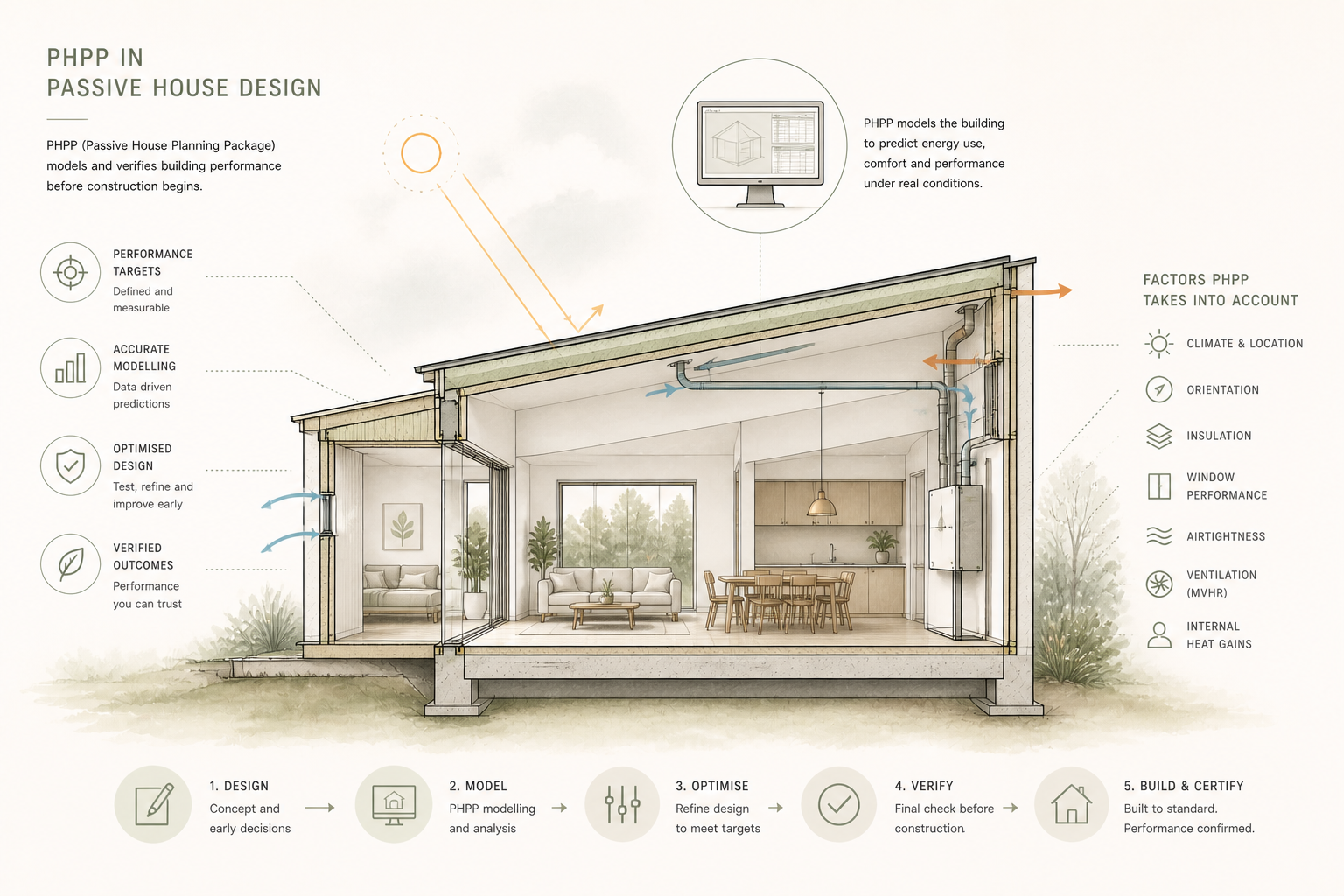
PHPP is the energy-balancing and planning tool used to develop Passive House, EnerPHit and PHI Low Energy Building projects. It connects the proposed building geometry, envelope, windows, airtightness, ventilation and services within one coordinated assessment.


Passive House performance cannot be established from a product checklist alone. Insulation, windows, shading, thermal bridges, airtightness, ventilation and building services affect one another and must be considered as part of the complete building energy balance.

The Passive House Planning Package, commonly referred to as PHPP, provides the calculation framework for bringing those elements together. It can be introduced during early design, refined as the documentation develops and updated to reflect the information required for the intended project pathway.

This article focuses specifically on PHPP and its modelling role. For the wider building standard, five principles, Australian climate application and delivery process, see the Passive House in Australia Knowledge Hub.

Topics: Passive House Residential Sustainability Frameworks
24 min read

Passive House Cost Australia | Building Cost Guide

By Team CE on May 5, 2026 12:21:04 PM

Passive House Cost Guide

There is no single square-metre rate or universal construction premium for a Passive House in Australia. Cost depends on the building, climate, design stage, procurement strategy, project team and whether formal certification is pursued.


Passive House costs are often described as though the standard adds a fixed percentage to an otherwise identical home. In practice, the comparison is rarely that simple. Building form, glazing, structural systems, finishes, site conditions and documentation quality may differ before the Passive House scope is considered.

The additional project scope may include PHPP modelling, more resolved envelope assemblies, higher-performance windows, airtightness detailing, thermal-bridge coordination, controlled ventilation, testing and independent certification. The cost effect of those items depends on how early they are integrated and whether the base project already represents a high-quality residential build.

This article focuses specifically on cost formation and cost control. For the wider standard, principles, climate application and project pathway, see the Passive House in Australia Knowledge Hub.

Topics: Passive House Residential Sustainability Frameworks
24 min read

Passive House vs NatHERS Australia | Key Differences

By Team CE on May 5, 2026 11:59:11 AM

Residential Performance Comparison

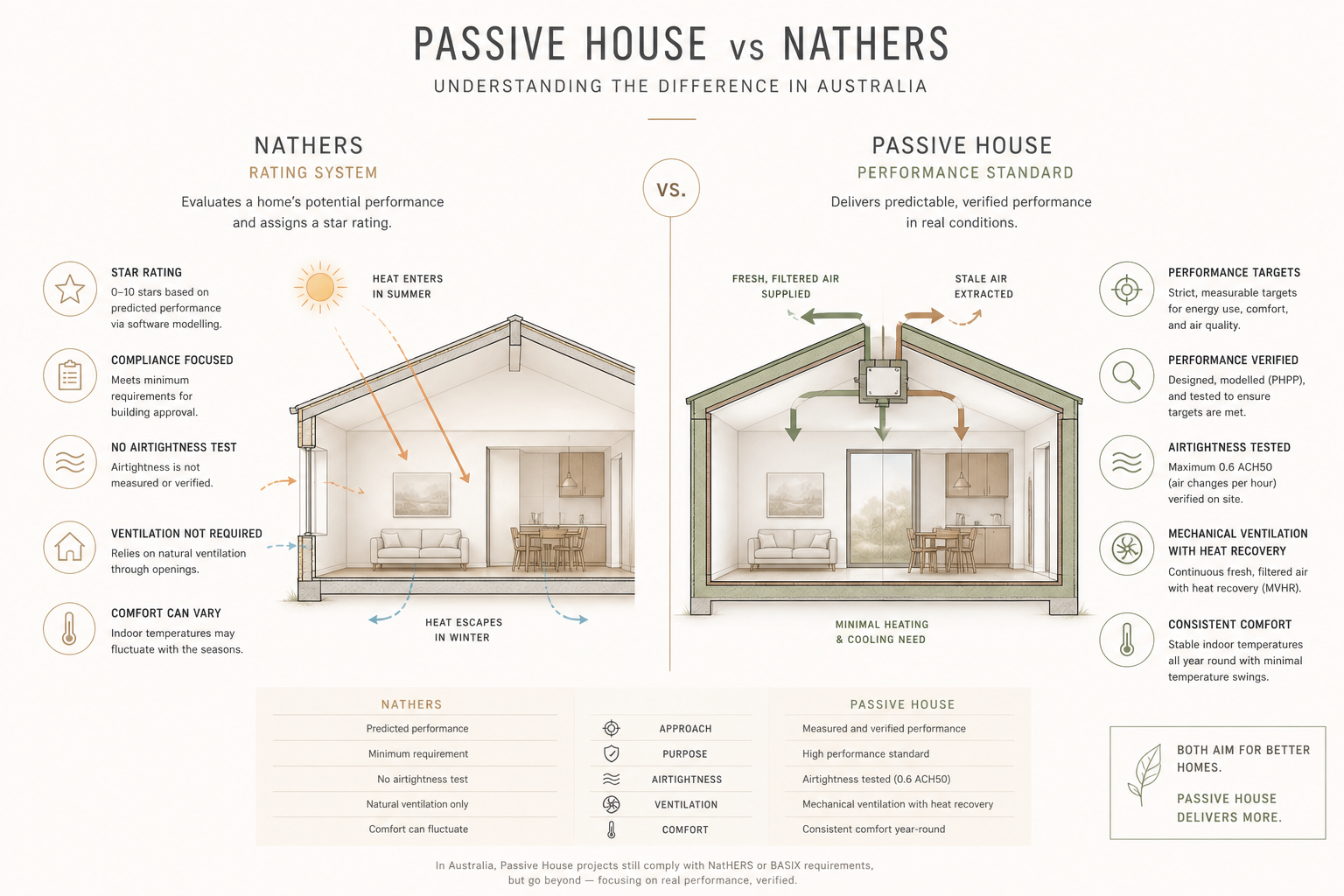
Passive House and NatHERS both examine residential energy performance, but they use different methodologies, produce different outcomes and serve different roles within an Australian building project.


NatHERS is Australia’s national home energy-rating framework. Its thermal assessment models the predicted heating and cooling needs of a dwelling and expresses the result as a star rating between zero and ten. NatHERS assessments are commonly used to help demonstrate residential energy-efficiency requirements under the National Construction Code, subject to the pathway adopted in the relevant state or territory.

Passive House is a separate voluntary building standard. It combines energy balancing through the Passive House Planning Package, known as PHPP, with defined requirements relating to the building envelope, airtightness, windows, thermal bridges, controlled ventilation and construction verification.

This comparison focuses on where the systems overlap and where their boundaries differ. For a complete explanation of each framework, see the NatHERS Knowledge Hub and the Passive House in Australia guide.

Topics: NatHERS Passive House Residential Energy Performance Residential Sustainability Frameworks
29 min read

Passive House Certification Australia | Process Guide

By Team CE on Oct 7, 2025 10:32:24 AM

Passive House Certification Guide

Passive House certification is an independent quality-assurance process. It connects PHPP modelling, coordinated design documentation, construction evidence, airtightness testing and building-services information to the completed project.


A building does not become a certified Passive House simply because it uses high-performance windows, additional insulation or mechanical ventilation. Certification considers whether the complete building has been modelled, designed, documented and delivered in accordance with the applicable Passive House Institute criteria.

The process is carried out through an appropriately accredited Passive House Building Certifier. The certifier independently reviews the project information and determines whether the building satisfies the requirements for the intended certification pathway.

This guide focuses specifically on how certification develops. For the wider standard, five principles and Australian climate application, see the Passive House in Australia Knowledge Hub.

Topics: Passive House Residential Sustainability Frameworks